Stage 01 · Write · Researched comparison
Best Python Template Engines in 2026
Jinja is the first pick for most teams. It is fast, widely used, and works with Flask, standalone scripts, and static site generators. Mako suits projects that want templates written as near-plain Python, and Chameleon fits teams that need strict HTML and XML handling. Django's built-in template engine is the natural choice when you already build on Django.

By Shihab Mia
Published 27 Nov 2026 · 6 tools compared
We run no ads and no affiliate links at launch. The order of a list follows our published method. See how we score.
Prices are the starting prices vendors list publicly. Plans change, so confirm the current price on the vendor page before you buy.
Key takeaways
- Jinja is the most common choice and works outside any web framework.
- Mako compiles templates to Python modules and allows full Python expressions.
- Django templates ship with Django and need no extra install.
- All engines listed here are free and open source.
Who each pick is for
Comparison
| Tool | Best for | Standout feature | Listed starting price | Free plan or trial |
|---|---|---|---|---|
| 1Jinja | General web and text templating in Python | Large user base and clear documentation | Free (open source) | Free plan |
| 2Mako | Templates that embed Python logic directly | Compiles templates to Python modules for speed | Free (open source) | Free plan |
| 3Chameleon | Strict HTML and XML template rendering | Validates template markup | Free (open source) | Free plan |
| 4Django Template Language | Projects already built on Django | Ships with Django and needs no extra install | Free (open source) | Free plan |
| 5Genshi | XML-based templating and stream processing | XML-centric design | Free (open source) | Free plan |
| 6Cheetah3 | Legacy projects that need a maintained Cheetah | Familiar Cheetah syntax | Free (open source) | Free plan |
How we picked
We compared engines on fit for common Python templating jobs, supported platforms, licence and price, handling of untrusted templates, and documented limits. Sources are vendor documentation, project repositories, and public package pages. All listed engines are free and open source. Prices and maintenance status can change, so confirm details on the vendor or repository site before you commit.
The tools, one by one
Jinja
Best for general web and text templating in Python
What it is and where it fits
Jinja renders templates with a syntax close to Django's but adds filters, macros, template inheritance, and autoescaping. It runs on any Python version the project supports and ships as a standalone package. Flask uses it by default, and many static site generators and documentation tools build on it.
The project is maintained under the Pallets organization and released under a BSD licence. There is no paid tier. For untrusted templates, Jinja offers a sandbox mode, but the docs warn that sandboxing is not a full security boundary. Teams that render user-supplied templates should review those limits before shipping.
Jinja suits most web apps, email builders, and code generators. Skip it if you need templates that execute arbitrary Python logic inline; Mako handles that style better.
Standout: Large user base and clear documentation
Free (open source), as listed by the vendor (Jinja website). Confirm the current plan price before you buy.
Free plan. Plans change, so confirm on the vendor's pricing page before you buy.
Benefits
- Large user base and clear documentation
- works with or without Flask
Drawbacks
- Not the default engine in Django
- some sandbox limits need care
Skip it if this limit matters to you: not the default engine in Django.
Verdict. A sensible pick for general web and text templating in Python.
Alternatives in this guide: Mako, Chameleon, Django Template Language
Mako
Best for templates that embed Python logic directly
What it is and where it fits
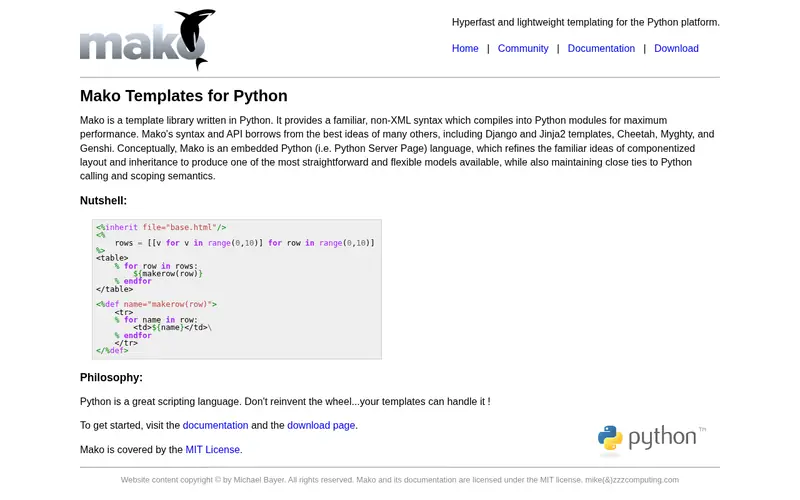
Mako is a template library that compiles templates into Python modules. It supports control structures, blocks, inheritance, and Python expressions inside templates. That makes it flexible for complex output but also means template authors can write a lot of logic in the template itself.
Mako is used by projects such as Pyramid and has been maintained for many years. It is released under the MIT licence with no paid option. Because templates compile to Python, the first render has some cost, but repeated renders are fast.
Choose Mako when your team is comfortable mixing Python and markup. Skip it if you want strict separation between presentation and logic, where Jinja or Django templates fit better.
Standout: Compiles templates to Python modules for speed
Free (open source), as listed by the vendor (Mako website). Confirm the current plan price before you buy.
Free plan. Plans change, so confirm on the vendor's pricing page before you buy.
Benefits
- Compiles templates to Python modules for speed
- allows full Python expressions
Drawbacks
- Less strict separation of logic and markup
- smaller community than Jinja
Skip it if this limit matters to you: less strict separation of logic and markup.
Verdict. A sensible pick for templates that embed Python logic directly.
Alternatives in this guide: Jinja, Chameleon, Django Template Language
Chameleon
Best for strict HTML and XML template rendering
What it is and where it fits
Chameleon is a template engine that focuses on correct markup. It supports several template languages, including Zope Page Templates and a Jinja-like syntax, and it can validate output against HTML or XML rules. That makes it useful for projects that must produce well-formed documents.
The project is open source under a BSD-style licence and has no paid tier. It runs on standard Python and is often used in Pyramid and Zope-related stacks. Documentation lives on Read the Docs.
Chameleon fits teams that need strict output checks or work in the Zope ecosystem. Skip it if you want the largest community and the most tutorials, where Jinja leads.
Standout: Validates template markup
Free (open source), as listed by the vendor (Chameleon website). Confirm the current plan price before you buy.
Free plan. Plans change, so confirm on the vendor's pricing page before you buy.
Benefits
- Validates template markup
- supports multiple template languages
Drawbacks
- Smaller user base
- less material for beginners
Skip it if this limit matters to you: smaller user base.
Verdict. A sensible pick for strict HTML and XML template rendering.
Alternatives in this guide: Jinja, Mako, Django Template Language
Django Template Language
Best for projects already built on Django
What it is and where it fits
Django's template language is built into the Django web framework. It emphasizes separation between templates and code, with a restricted set of tags and filters. Autoescaping is on by default, which reduces cross-site scripting risk in web pages.
It is free and open source under a BSD licence. The engine is tied to Django, so using it outside a Django project takes extra setup. For Django apps, it is the path of least resistance and integrates with forms, admin, and the rest of the framework.
Use it when you build on Django. Skip it for standalone scripts or non-Django frameworks, where Jinja or Mako are simpler to adopt.
Standout: Ships with Django and needs no extra install
Free (open source), as listed by the vendor (Django Template Language website). Confirm the current plan price before you buy.
Free plan. Plans change, so confirm on the vendor's pricing page before you buy.
Benefits
- Ships with Django and needs no extra install
- strong autoescaping defaults
Drawbacks
- Limited logic by design
- hard to use outside Django
Skip it if this limit matters to you: limited logic by design.
Verdict. A sensible pick for projects already built on Django.
Genshi
Best for xML-based templating and stream processing
What it is and where it fits
Genshi is a template toolkit built around XML. It offers a markup-based template language and a stream-based processing model. It has been used in projects such as Trac.
The project is open source under a BSD-style licence with no paid tier. Development is slower than for Jinja, so check recent releases before adopting it for new work. It runs on standard Python.
Genshi suits teams that work heavily with XML or need stream processing. For most new web projects, Jinja is the more active choice.
Standout: XML-centric design
Free (open source), as listed by the vendor (Genshi website). Confirm the current plan price before you buy.
Free plan. Plans change, so confirm on the vendor's pricing page before you buy.
Benefits
- XML-centric design
- supports template streams
Drawbacks
- Slower release cadence
- smaller community
Skip it if this limit matters to you: slower release cadence.
Verdict. A sensible pick for XML-based templating and stream processing.
Cheetah3
Best for legacy projects that need a maintained Cheetah
What it is and where it fits
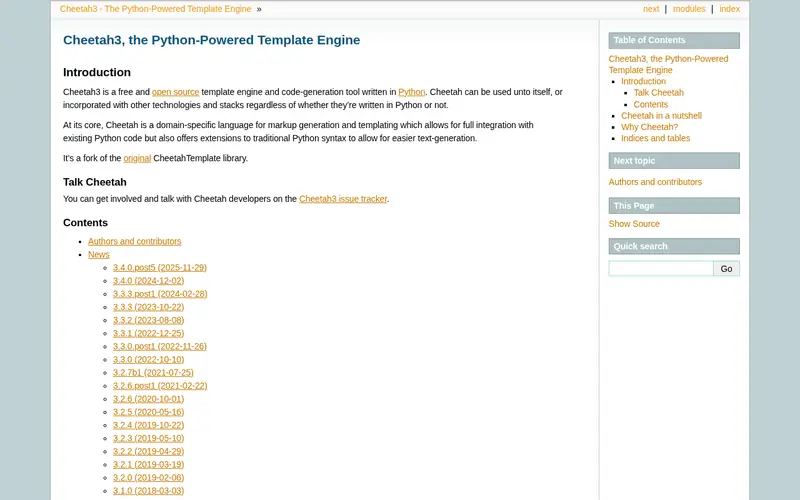
Cheetah3 is a maintained fork of the Cheetah template engine. It keeps the original syntax, where templates mix text and Python-like directives, and updates it for current Python versions.
It is open source under the MIT licence with no paid option. The project is smaller than Jinja or Mako, so examples and third-party integrations are fewer. It is mainly relevant to teams maintaining older code that already uses Cheetah.
Choose Cheetah3 for existing Cheetah codebases. Skip it for greenfield projects unless you specifically want its syntax.
Standout: Familiar Cheetah syntax
Free (open source), as listed by the vendor (Cheetah3 website). Confirm the current plan price before you buy.
Free plan. Plans change, so confirm on the vendor's pricing page before you buy.
Benefits
- Familiar Cheetah syntax
- actively maintained fork
Drawbacks
- Niche user base
- fewer modern integrations
Skip it if this limit matters to you: niche user base.
Verdict. A sensible pick for legacy projects that need a maintained Cheetah.
Who should use what
If you build a Flask app or a standalone generator, start with Jinja. If you already run Django, use the built-in Django template language. If your team wants Python logic inside templates, pick Mako. If you need strict HTML or XML output, look at Chameleon. Teams maintaining older Cheetah or Genshi code should stay on those engines unless a migration is planned.
Questions to settle before you buy
What to check before you buy
- Confirm the engine supports your Python version and framework.
- Check autoescaping defaults and how to enable or disable them.
- Review sandbox or trust limits if templates come from users.
- Look at recent releases and issue activity in the repository.
- Read the licence terms and confirm they fit your project.
FAQ
Is Jinja the same as Django templates?
No. They share a similar syntax, but Jinja is a separate package with extra features such as macros and filters. Django's engine is built into Django and restricts logic by design. Jinja works with or without Flask.
Which Python template engine is fastest?
Speed depends on the workload and caching. Mako compiles templates to Python modules, which can help repeated renders. Jinja also caches compiled templates. Measure with your own templates rather than relying on general claims.
Can I use these engines for non-HTML output?
Yes. Jinja, Mako, and others can render plain text, email bodies, configuration files, and code. Autoescaping matters mainly for HTML and XML output, so check settings for text use.
Are these template engines free?
All engines listed here are free and open source. There are no paid tiers for the engines themselves. Support and hosting costs depend on your own stack.
Is it safe to render user-supplied templates?
Generally no. Template engines can expose Python internals. Jinja offers a sandbox mode, but its docs warn it is not a full security boundary. Avoid rendering untrusted templates on a server with sensitive data.
Sources we checked
Method: how we score · editorial policy.
Change log. First published 27 Nov 2026.