Stage 01 · Write · Researched comparison
Best Python Serialization Libraries in 2026
msgspec is the first pick for most teams that want fast, typed serialization across JSON, MessagePack and YAML, and it suits developers who need both validation and speed. Pydantic is the better fit when data validation and settings management matter more than raw encode speed, since it is the base of many web frameworks. marshmallow remains a solid choice for teams that want explicit schema classes and fine control over field-level validation, and cattrs fits projects that already use dataclasses or attrs.

By Shihab Mia
Published 27 Nov 2026 · 8 tools compared
We run no ads and no affiliate links at launch. The order of a list follows our published method. See how we score.
Prices are the starting prices vendors list publicly. Plans change, so confirm the current price on the vendor page before you buy.
Key takeaways
- msgspec, Pydantic, marshmallow, cattrs and dataclasses-json are all free and open source, so cost is not a deciding factor for these libraries.
- orjson only handles JSON, but it is a fast drop-in replacement for the standard library json module when you need JSON alone.
- pickle is part of the Python standard library but is unsafe for untrusted data, so avoid it for anything that crosses a trust boundary.
- MessagePack via msgpack gives compact binary output, but it is a format library rather than a typed schema or validation layer.
Who each pick is for
- Fast typed serialization and validation across several formatsmsgspec
- Data validation and settings with broad framework supportPydantic
- Explicit schema classes with field-level validation controlmarshmallow
- Serializing dataclasses and attrs classes without extra model codecattrs
- Fast JSON encoding and decoding onlyorjson
- Adding JSON encode and decode methods to dataclassesdataclasses-json
- Compact binary serialization with a small payload sizemsgpack
- Serializing Python objects for trusted, local use onlypickle
Comparison
| Tool | Best for | Standout feature | Listed starting price | Free plan or trial |
|---|---|---|---|---|
| 1msgspec | Fast typed serialization and validation across several formats | Supports JSON, MessagePack and YAML with one schema system | Free (open source) | Free plan |
| 2Pydantic | Data validation and settings with broad framework support | Widely used and well documented | Free (open source) | Free plan |
| 3marshmallow | Explicit schema classes with field-level validation control | Clear schema definitions separate from your models | Free (open source) | Free plan |
| 4cattrs | Serializing dataclasses and attrs classes without extra model code | Works with existing dataclasses and attrs classes | Free (open source) | Free plan |
| 5orjson | Fast JSON encoding and decoding only | Very fast JSON serialization | Free (open source) | Free plan |
| 6dataclasses-json | Adding JSON encode and decode methods to dataclasses | Small API that fits existing dataclasses | Free (open source) | Free plan |
| 7msgpack | Compact binary serialization with a small payload size | Smaller payloads than JSON for many datasets | Free (open source) | Free plan |
| 8pickle | Serializing Python objects for trusted, local use only | Part of the standard library | Free | Free plan |
How we picked
We picked libraries that are currently maintained and that genuinely handle serialization or deserialization for Python. Criteria were fit for the job, supported platforms, licence and price, safety of the format, and the main limits each tool imposes. Sources are vendor documentation, project repositories and public pricing pages. All listed libraries are free or open source. Prices and features change, so confirm details on the vendor site before you commit.
The tools, one by one
msgspec
Best for fast typed serialization and validation across several formats
What it is and where it fits
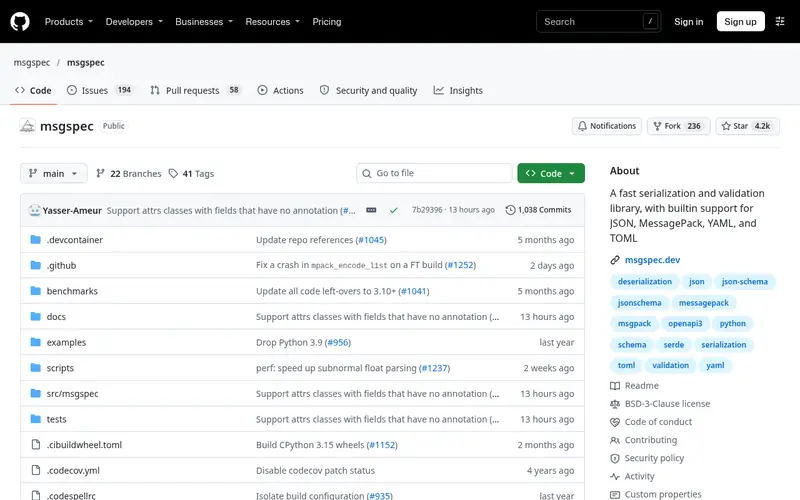
msgspec is a serialization and validation library built around typed Struct classes. You define a Struct, and msgspec encodes and decodes it to JSON, MessagePack or YAML, checking types on the way in and out. It runs on CPython and PyPy and installs from PyPI. The project is open source under a BSD licence and is maintained on GitHub.
For this job, msgspec is a strong pick when you want one library to handle both wire formats and type checking. It avoids the overhead of converting to dictionaries first, which matters in high-throughput services. It also supports schema generation for JSON Schema.
Skip msgspec if your codebase is already built around Pydantic models or if you depend on Pydantic-specific features such as settings management and the wider plugin ecosystem. Its documentation is good but less extensive than Pydantic's, so teams new to typed serialization may need more reading.
Standout: Supports JSON, MessagePack and YAML with one schema system
Free (open source), as listed by the vendor (msgspec website). Confirm the current plan price before you buy.
Free plan. Plans change, so confirm on the vendor's pricing page before you buy.
Benefits
- Supports JSON, MessagePack and YAML with one schema system
- fast encode and decode paths
- built-in type validation
Drawbacks
- Smaller ecosystem than Pydantic
- schema features differ from Pydantic models
Skip it if this limit matters to you: smaller ecosystem than Pydantic.
Verdict. A sensible pick for fast typed serialization and validation across several formats.
Alternatives in this guide: Pydantic, marshmallow, cattrs
Pydantic
Best for data validation and settings with broad framework support
What it is and where it fits
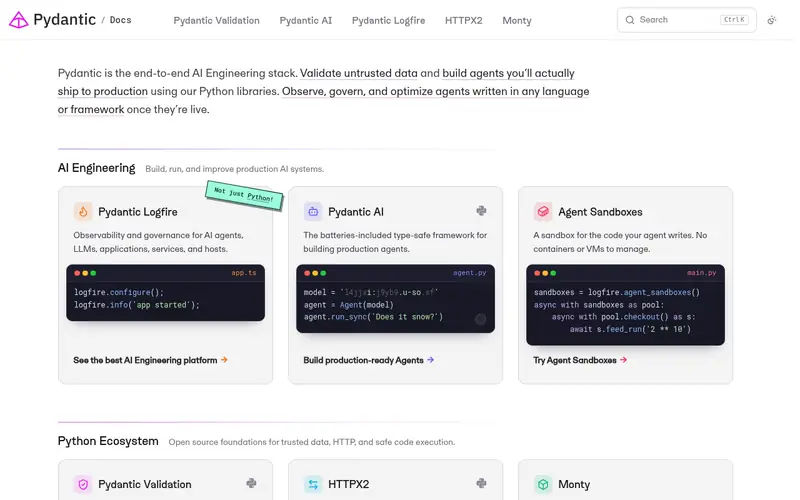
Pydantic is a data validation library that also handles serialization to and from JSON and Python dictionaries. You declare models as classes with type annotations, and Pydantic validates incoming data and can export it back out. Version 2 rewrote the core in Rust for speed. It runs on CPython and PyPy and is open source under the MIT licence.
For serialization work, Pydantic is the natural choice when validation is the main goal and serialization is secondary. It is the model layer for FastAPI and appears in many other projects, so examples and community answers are easy to find. It supports JSON Schema generation and custom serializers.
The tradeoff is that Pydantic models carry more machinery than plain encoders, and very hot paths may benefit from a lighter library. If you only need to turn dictionaries into JSON bytes, a dedicated encoder is simpler. Pydantic is also a large dependency, which matters for small scripts or CLI tools.
Standout: Widely used and well documented
Free (open source), as listed by the vendor (Pydantic website). Confirm the current plan price before you buy.
Free plan. Plans change, so confirm on the vendor's pricing page before you buy.
Benefits
- Widely used and well documented
- strong validation and error messages
- integrates with many web frameworks
Drawbacks
- Validation overhead can be higher than pure encoders
- model definitions add boilerplate
Skip it if this limit matters to you: validation overhead can be higher than pure encoders.
Verdict. A sensible pick for data validation and settings with broad framework support.
Alternatives in this guide: msgspec, marshmallow, cattrs
marshmallow
Best for explicit schema classes with field-level validation control
What it is and where it fits
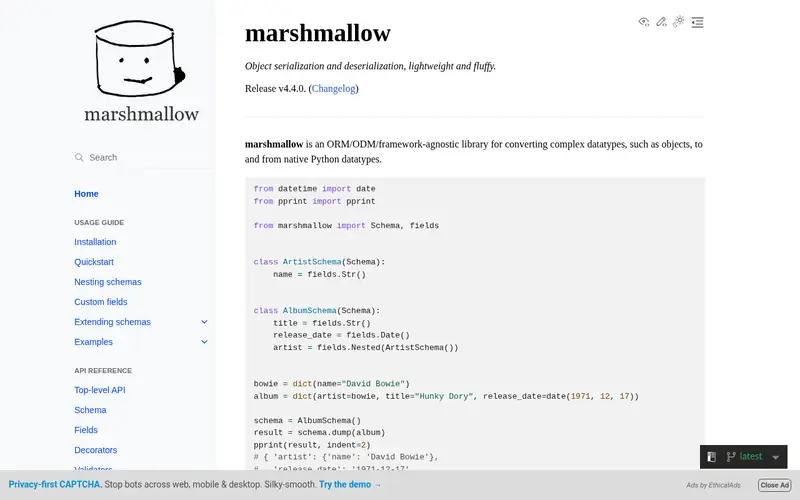
marshmallow is an object serialization and deserialization library built around Schema classes. You define fields explicitly, and marshmallow converts between Python objects and primitive types such as dictionaries and JSON-compatible structures. It runs on CPython and PyPy and is open source under the MIT licence.
For this job, marshmallow suits teams that want schemas as separate, explicit objects rather than annotations on domain models. That separation helps when the wire format differs from your internal classes, or when several output shapes share one model. It has hooks for pre-processing and post-processing and supports many field types.
The cost is verbosity: every field is declared, and large schemas take more code than an annotation-based library. Performance is generally lower than compiled or code-generated approaches, so measure before using it in tight loops. Skip marshmallow if you want minimal boilerplate or the fastest possible decode path.
Standout: Clear schema definitions separate from your models
Free (open source), as listed by the vendor (marshmallow website). Confirm the current plan price before you buy.
Free plan. Plans change, so confirm on the vendor's pricing page before you buy.
Benefits
- Clear schema definitions separate from your models
- fine-grained field and validation hooks
Drawbacks
- More verbose than annotation-based libraries
- slower than compiled alternatives in many cases
Skip it if this limit matters to you: more verbose than annotation-based libraries.
Verdict. A sensible pick for explicit schema classes with field-level validation control.
cattrs
Best for serializing dataclasses and attrs classes without extra model code
What it is and where it fits
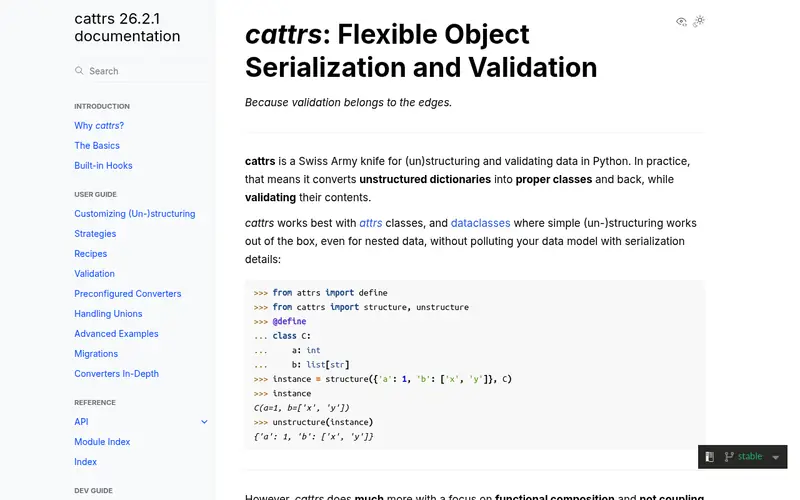
cattrs converts between Python objects and plain dictionaries, building on attrs and the standard library dataclasses module. It handles structuring (dict to object) and unstructuring (object to dict), and you pair it with a JSON library for the final encode step. It runs on CPython and PyPy and is open source under the MIT licence.
For this job, cattrs is a good fit when your codebase already uses dataclasses or attrs and you do not want to rewrite models as a separate schema. It respects your existing class definitions and lets you register custom converters for types it does not handle by default, such as dates or enums.
cattrs does less validation than Pydantic out of the box, so if strict input checking is a requirement you will add it yourself or pair it with another tool. It also needs a JSON library for actual bytes, which means one more dependency. Skip it if you want a single library that covers validation, schema generation and encoding.
Standout: Works with existing dataclasses and attrs classes
Free (open source), as listed by the vendor (cattrs website). Confirm the current plan price before you buy.
Free plan. Plans change, so confirm on the vendor's pricing page before you buy.
Benefits
- Works with existing dataclasses and attrs classes
- customizable structure and unstructure hooks
Drawbacks
- Less validation built in than Pydantic
- requires some configuration for complex types
Skip it if this limit matters to you: less validation built in than Pydantic.
Verdict. A sensible pick for serializing dataclasses and attrs classes without extra model code.
Alternatives in this guide: msgspec, Pydantic, marshmallow
orjson
Best for fast JSON encoding and decoding only
What it is and where it fits
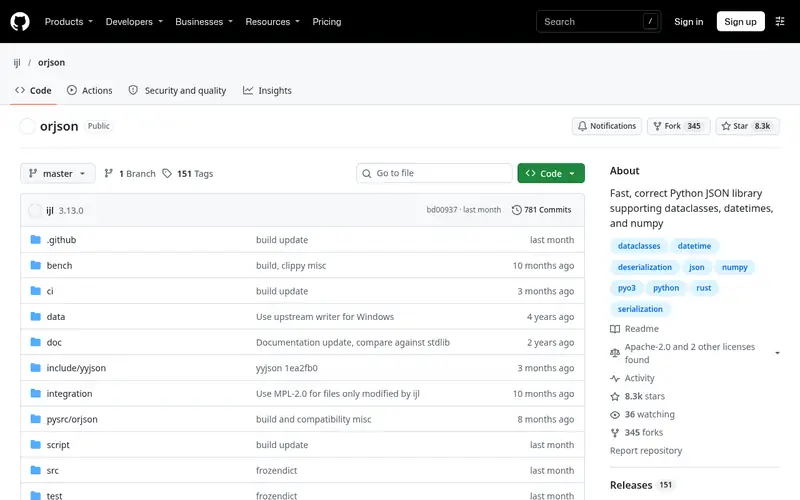
orjson is a JSON library for Python written in Rust. It provides dumps and loads functions that are faster than the standard library json module in most cases, and it natively serializes dataclasses, datetime objects, UUIDs and numpy arrays. It runs on CPython and is open source under the Apache 2.0 and MIT licences.
For this job, orjson is the pick when JSON is the only format you need and speed matters. It is a drop-in replacement in many codebases, though its API differs slightly from the standard library: dumps returns bytes, and options are passed as flags. It does not validate types, so it complements rather than replaces a validation library.
Skip orjson if you need MessagePack, YAML or schema validation, or if you must support PyPy, which it does not target. It also has no pure-Python fallback, so platforms without a compatible wheel need a build toolchain. For simple scripts, the standard library json module is often enough.
Standout: Very fast JSON serialization
Free (open source), as listed by the vendor (orjson website). Confirm the current plan price before you buy.
Free plan. Plans change, so confirm on the vendor's pricing page before you buy.
Benefits
- Very fast JSON serialization
- handles dataclasses, datetimes and numpy types natively
Drawbacks
- JSON only, no MessagePack or YAML
- no schema validation
Skip it if this limit matters to you: JSON only, no MessagePack or YAML.
Verdict. A sensible pick for fast JSON encoding and decoding only.
Alternatives in this guide: msgspec, Pydantic, marshmallow
dataclasses-json
Best for adding JSON encode and decode methods to dataclasses
What it is and where it fits
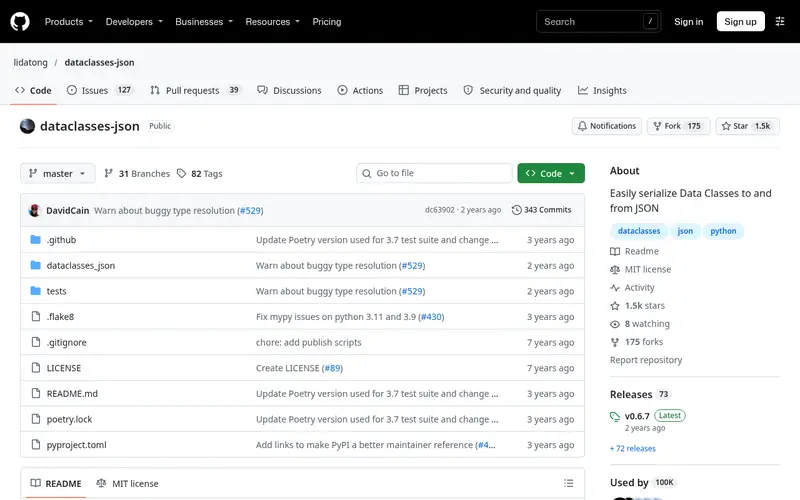
dataclasses-json adds to_json and from_json methods to standard library dataclasses through a decorator. It handles nested dataclasses, lists, dictionaries and common types such as datetime and Decimal. It runs on CPython and is open source under the MIT licence.
For this job, dataclasses-json is a low-friction option when your models are already dataclasses and you want JSON conversion without a new schema system. The decorator approach keeps changes small, and the library covers the common cases without much configuration.
The project is smaller and less actively developed than Pydantic or msgspec, so check recent commit activity before adopting it for long-lived code. Validation is minimal, and complex custom types need extra handling. Skip it if you need strict validation, schema generation or binary formats.
Standout: Small API that fits existing dataclasses
Free (open source), as listed by the vendor (dataclasses-json website). Confirm the current plan price before you buy.
Free plan. Plans change, so confirm on the vendor's pricing page before you buy.
Benefits
- Small API that fits existing dataclasses
- handles nested dataclasses and common field types
Drawbacks
- Less active than larger projects
- limited validation compared with Pydantic
Skip it if this limit matters to you: less active than larger projects.
Verdict. A sensible pick for adding JSON encode and decode methods to dataclasses.
Alternatives in this guide: msgspec, Pydantic, marshmallow
msgpack
Best for compact binary serialization with a small payload size
What it is and where it fits
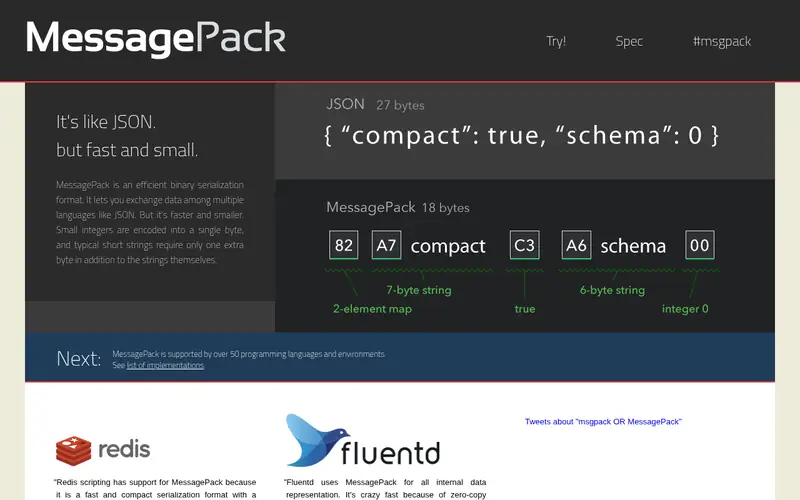
MessagePack is a binary serialization format, and msgpack-python is the reference implementation for Python. It packs Python objects into compact bytes and unpacks them back, with options for strict type mapping and custom encoders. It runs on CPython and PyPy and is open source under the Apache 2.0 licence.
For this job, msgpack is the choice when payload size or decode speed matters and you control both ends of the connection. It is common in inter-service messaging and in systems that span multiple languages, since MessagePack implementations exist for most runtimes.
The format is not human readable, which makes debugging harder than with JSON, and it carries no schema, so both sides must agree on structure. It also does not validate types. Pair it with a schema library such as msgspec if you need typed decoding, and skip it if readability or browser compatibility is a priority.
Standout: Smaller payloads than JSON for many datasets
Free (open source), as listed by the vendor (msgpack website). Confirm the current plan price before you buy.
Free plan. Plans change, so confirm on the vendor's pricing page before you buy.
Benefits
- Smaller payloads than JSON for many datasets
- wide language support for cross-language systems
Drawbacks
- Binary format is not human readable
- no built-in schema or validation
Skip it if this limit matters to you: binary format is not human readable.
Verdict. A sensible pick for compact binary serialization with a small payload size.
Alternatives in this guide: msgspec, Pydantic, marshmallow
pickle
Best for serializing Python objects for trusted, local use only
What it is and where it fits
pickle is the standard library module for converting Python object graphs to bytes and back. It handles classes, instances and most built-in types without custom code. It ships with CPython and is documented in the Python standard library reference.
For this job, pickle is only appropriate when the data stays inside a trusted boundary, such as a local cache or a multiprocessing queue you control. The Python documentation warns that unpickling data from untrusted sources can execute arbitrary code, so never load pickle files from users, the network or unknown storage.
pickle output is tied to Python and can break across versions or when class definitions change. It is not a good fit for APIs, cross-language systems or long-term storage. For those cases use JSON, MessagePack or a typed library such as msgspec or Pydantic.
Standout: Part of the standard library
Free, as listed by the vendor (pickle website). Confirm the current plan price before you buy.
Free plan. Plans change, so confirm on the vendor's pricing page before you buy.
Benefits
- Part of the standard library
- handles most Python objects without extra code
Drawbacks
- Unsafe for untrusted data
- not portable across Python versions or languages
Skip it if this limit matters to you: unsafe for untrusted data.
Verdict. A sensible pick for serializing Python objects for trusted, local use only.
Alternatives in this guide: msgspec, Pydantic, marshmallow
Who should use what
If you are building a FastAPI service and want validation plus serialization in one place, use Pydantic. If you need fast typed encoding across JSON and MessagePack in a high-throughput service, use msgspec. If your codebase is built on dataclasses or attrs and you want to keep those classes, use cattrs. If you only need faster JSON output and no validation, use orjson. If you need compact binary payloads between services in different languages, use msgpack, and keep pickle for trusted local data only.
Questions to settle before you buy
What to check before you buy
- Confirm which formats you need: JSON only, or also MessagePack, YAML or binary.
- Check whether you need input validation, schema generation or both, and pick a library that covers it.
- Verify Python version and platform support, including whether wheels exist for your target.
- Never unpickle data from untrusted sources, and avoid pickle for anything crossing a trust boundary.
- Measure encode and decode speed on your own data before replacing an existing library.
FAQ
What is the fastest Python serialization library?
Speed depends on the format and the data shape. orjson is designed for fast JSON encoding and decoding, and msgspec is built for fast typed encoding across JSON and MessagePack. Both are compiled. Measure with your own payloads rather than relying on general claims.
Can I use Pydantic and orjson together?
Yes. Pydantic models can be converted to dictionaries and then encoded with orjson, or you can use Pydantic's own JSON output. Some projects use Pydantic for validation and a separate encoder for the final bytes. Check that both handle the same field types, such as datetimes and enums.
Is pickle safe to use?
Only for trusted data. The Python documentation states that unpickling data from untrusted sources can execute arbitrary code. Do not load pickle files from users, the network or unknown storage. For anything that crosses a trust boundary, use JSON, MessagePack or a typed library instead.
What is the difference between marshmallow and Pydantic?
marshmallow uses explicit Schema classes with declared fields, which keeps schemas separate from your models. Pydantic uses type annotations on model classes and validates on construction. Pydantic is more common in web frameworks, while marshmallow gives more explicit control over field definitions and hooks.
Do I need a separate library for MessagePack?
You need a MessagePack implementation such as msgpack-python, since the standard library does not include one. Some libraries, including msgspec, support MessagePack directly with typed schemas. If you only need compact binary output and control both ends, msgpack-python is enough.
Sources we checked
Method: how we score · editorial policy.
Change log. First published 27 Nov 2026.