Stage 01 · Write · Researched comparison
Best Python Markdown Libraries in 2026
Python-Markdown is the first pick for most projects that need Markdown to HTML with extensions and a stable, widely used API. Choose markdown-it-py when you want CommonMark compliance and a plugin pipeline modeled on markdown-it. Choose mistune when rendering speed and a small dependency footprint matter most. All three are open source and install from PyPI.

By Shihab Mia
Published 27 Nov 2026 · 5 tools compared
We run no ads and no affiliate links at launch. The order of a list follows our published method. See how we score.
Prices are the starting prices vendors list publicly. Plans change, so confirm the current price on the vendor page before you buy.
Key takeaways
- Python-Markdown, markdown-it-py, mistune, Marko and cmarkgfm are all free and open source.
- Python-Markdown has the largest extension ecosystem but is not fully CommonMark compliant by default.
- markdown-it-py follows the CommonMark spec and supports plugins through a token-based parser.
- These libraries run locally in your Python process, so pasted content never leaves your machine.
Who each pick is for
- Projects needing a mature API and many extensionsPython-Markdown
- CommonMark compliance and plugin-based parsingmarkdown-it-py
- Fast rendering with a small dependency footprintmistune
- CommonMark parsing with a clean AST and extensible renderersMarko
- GitHub-flavored Markdown rendered by the cmark-gfm C librarycmarkgfm
Comparison
| Tool | Best for | Standout feature | Listed starting price | Free plan or trial |
|---|---|---|---|---|
| 1Python-Markdown | Projects needing a mature API and many extensions | Large extension ecosystem | Free (open source) | Free plan |
| 2markdown-it-py | CommonMark compliance and plugin-based parsing | Follows the CommonMark spec | Free (open source) | Free plan |
| 3mistune | Fast rendering with a small dependency footprint | Fast pure-Python parser | Free (open source) | Free plan |
| 4Marko | CommonMark parsing with a clean AST and extensible renderers | CommonMark compliant with extension support | Free (open source) | Free plan |
| 5cmarkgfm | GitHub-flavored Markdown rendered by the cmark-gfm C library | Matches GitHub-flavored Markdown behavior | Free (open source) | Free plan |
How we picked
We picked libraries that are currently maintained, install from PyPI and genuinely parse Markdown in Python. Criteria were spec compliance, extension model, output format (HTML or AST), dependencies, licence and platform support. Details come from vendor documentation, project repositories and PyPI pages. Prices and licences can change, so confirm on the project site. None of these libraries send your content to a third party; parsing happens locally in your process.
The tools, one by one
Python-Markdown
Best for projects needing a mature API and many extensions
What it is and where it fits
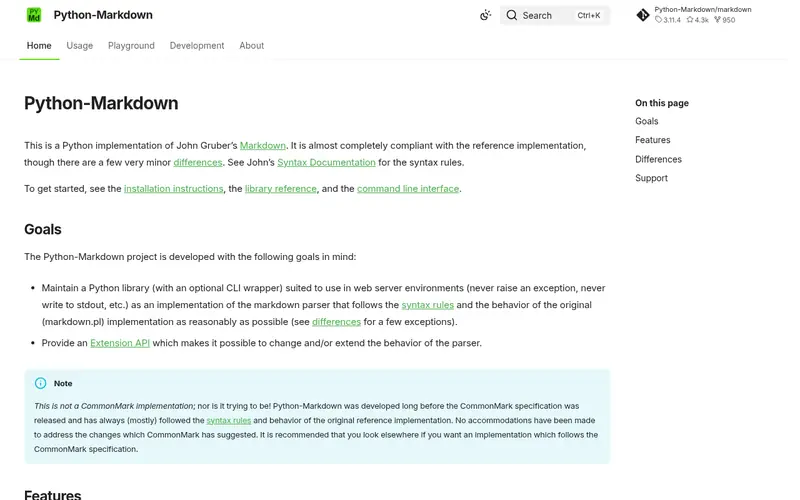
Python-Markdown converts Markdown to HTML and ships with a broad set of built-in extensions, including tables, footnotes, fenced code and a table of contents. You enable extensions by name when you create the Markdown instance. It also supports custom extensions written as Python modules.
It runs anywhere Python runs and has no compiled dependencies. The project is licensed under BSD. Its output is HTML only; it does not produce an AST for further processing. If you need strict CommonMark behavior or a token stream, look at markdown-it-py instead.
Standout: Large extension ecosystem
Free (open source), as listed by the vendor (Python-Markdown website). Confirm the current plan price before you buy.
Free plan. Plans change, so confirm on the vendor's pricing page before you buy.
Benefits
- Large extension ecosystem
- stable, long-maintained API
Drawbacks
- Not fully CommonMark compliant by default
- slower than some parsers
Skip it if this limit matters to you: not fully CommonMark compliant by default.
Verdict. A sensible pick for projects needing a mature API and many extensions.
Alternatives in this guide: markdown-it-py, mistune, Marko
markdown-it-py
Best for commonMark compliance and plugin-based parsing
What it is and where it fits
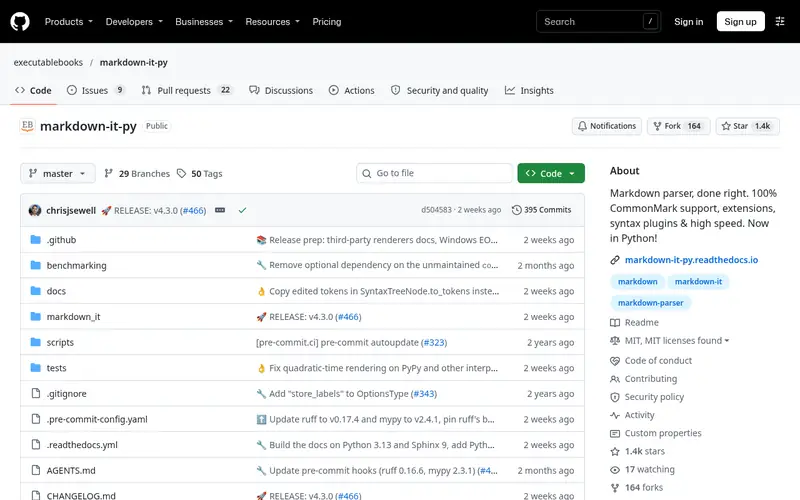
markdown-it-py is a Python port of the markdown-it JavaScript library. It parses Markdown into a token stream and renders HTML from those tokens, which makes it a good fit when you need to inspect or transform the parse tree. It targets CommonMark compliance and supports syntax plugins such as footnotes and definition lists.
It is pure Python and installs from PyPI. The project is MIT licensed. Because the parser exposes tokens, it suits tools that need to post-process Markdown, such as docsite builders or linters. If you only need simple HTML output and want the widest set of ready extensions, Python-Markdown may be less work.
Standout: Follows the CommonMark spec
Free (open source), as listed by the vendor (markdown-it-py website). Confirm the current plan price before you buy.
Free plan. Plans change, so confirm on the vendor's pricing page before you buy.
Benefits
- Follows the CommonMark spec
- token-based parser with a plugin system
Drawbacks
- Fewer ready-made extensions than Python-Markdown
- plugin API takes learning
Skip it if this limit matters to you: fewer ready-made extensions than Python-Markdown.
Verdict. A sensible pick for commonMark compliance and plugin-based parsing.
Alternatives in this guide: Python-Markdown, mistune, Marko
mistune
Best for fast rendering with a small dependency footprint
What it is and where it fits
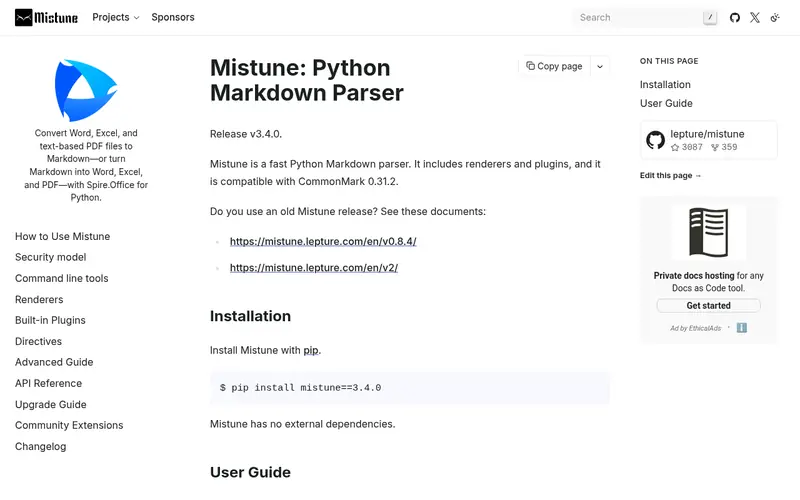
mistune is a Markdown parser written in pure Python with an emphasis on speed. It provides a renderer interface so you can output HTML or build your own output format, and it supports plugins for features like footnotes and tables. It is used by several static site generators and documentation tools.
It installs from PyPI with no compiled extensions and is BSD licensed. The API has seen breaking changes between major releases, so pin a version and check the changelog when upgrading. It is a good choice for high-volume rendering where you control the Markdown input. For strict CommonMark compliance, markdown-it-py is the safer pick.
Standout: Fast pure-Python parser
Free (open source), as listed by the vendor (mistune website). Confirm the current plan price before you buy.
Free plan. Plans change, so confirm on the vendor's pricing page before you buy.
Benefits
- Fast pure-Python parser
- supports plugins and custom renderers
Drawbacks
- Extension set is smaller than Python-Markdown's
- API has changed across major versions
Skip it if this limit matters to you: extension set is smaller than Python-Markdown's.
Verdict. A sensible pick for fast rendering with a small dependency footprint.
Alternatives in this guide: Python-Markdown, markdown-it-py, Marko
Marko
Best for commonMark parsing with a clean AST and extensible renderers
What it is and where it fits
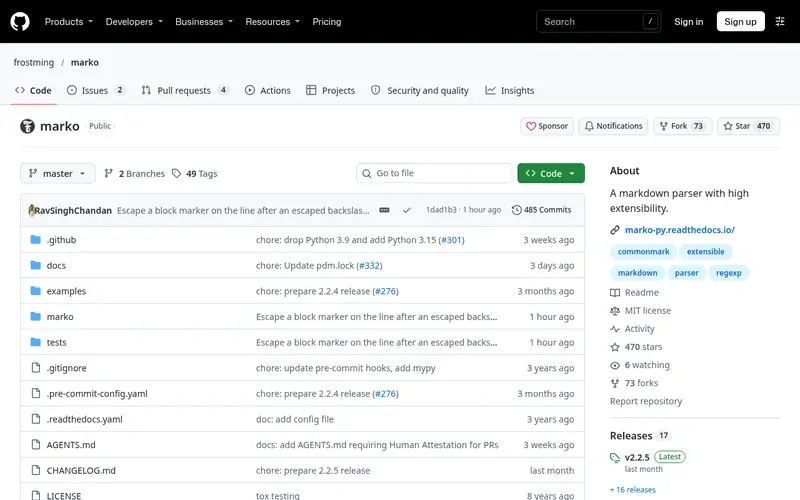
Marko is a pure-Python Markdown parser that follows the CommonMark spec and provides extensions for features like tables, footnotes and strikethrough. It separates parsing from rendering, so you can walk the AST or plug in a custom renderer. It also offers a command-line interface for converting files.
It installs from PyPI and is MIT licensed. The project is smaller than Python-Markdown, so fewer community extensions exist. It suits projects that want CommonMark behavior plus the ability to customize output, such as generating HTML with custom classes or exporting to another format. If you need the largest extension catalog, compare with Python-Markdown.
Standout: CommonMark compliant with extension support
Free (open source), as listed by the vendor (Marko website). Confirm the current plan price before you buy.
Free plan. Plans change, so confirm on the vendor's pricing page before you buy.
Benefits
- CommonMark compliant with extension support
- parser and renderer are separate
Drawbacks
- Smaller community than Python-Markdown
- fewer third-party extensions
Skip it if this limit matters to you: smaller community than Python-Markdown.
Verdict. A sensible pick for commonMark parsing with a clean AST and extensible renderers.
Alternatives in this guide: Python-Markdown, markdown-it-py, mistune
cmarkgfm
Best for gitHub-flavored Markdown rendered by the cmark-gfm C library
What it is and where it fits
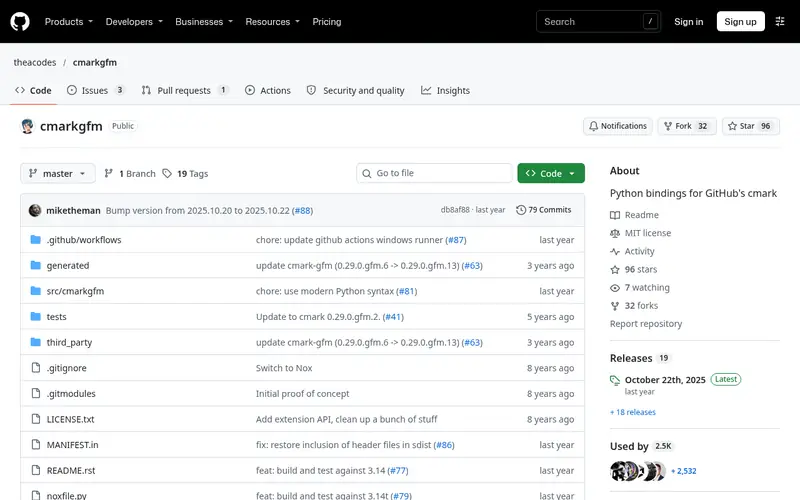
cmarkgfm provides Python bindings to GitHub's cmark-gfm C library. It renders GitHub-flavored Markdown, including tables, task lists, strikethrough and autolinks, and offers options for unsafe HTML and other GitHub behaviors. Because it wraps a C library, it is fast and closely tracks how GitHub renders Markdown.
It installs from PyPI as a compiled extension, so you need a working build toolchain on platforms without prebuilt wheels. It is MIT licensed. Use it when output must match GitHub's rendering, such as previewing README files. If you need to walk a parse tree or write custom renderers in Python, a pure-Python parser is a better fit.
Standout: Matches GitHub-flavored Markdown behavior
Free (open source), as listed by the vendor (cmarkgfm website). Confirm the current plan price before you buy.
Free plan. Plans change, so confirm on the vendor's pricing page before you buy.
Benefits
- Matches GitHub-flavored Markdown behavior
- fast C-backed parser
Drawbacks
- Requires a compiled extension
- fewer Python-level customization hooks
Skip it if this limit matters to you: requires a compiled extension.
Verdict. A sensible pick for gitHub-flavored Markdown rendered by the cmark-gfm C library.
Alternatives in this guide: Python-Markdown, markdown-it-py, mistune
Who should use what
If you maintain a CMS or docs site that relies on many extensions, Python-Markdown is the least disruptive choice. If you need strict CommonMark output and a token stream to post-process, use markdown-it-py. If you render large volumes of Markdown and want a fast pure-Python parser, try mistune. If output must match GitHub's rendering of README files, cmarkgfm is the closest match. For CommonMark plus custom renderers, Marko is a solid option.
Questions to settle before you buy
What to check before you buy
- Check whether the library targets CommonMark or its own dialect, and whether that matches your input.
- Confirm the extensions you need (tables, footnotes, task lists) exist or are easy to add.
- Check whether you need HTML output, an AST or both.
- Verify the package installs on your platforms, including any compiled-extension requirements.
- Pin a version and read the changelog, since some libraries change APIs across major releases.
FAQ
Is Python-Markdown fully CommonMark compliant?
No. Python-Markdown follows its own behavior and offers extensions, and it does not claim full CommonMark compliance. If strict CommonMark output matters, use markdown-it-py, Marko or cmarkgfm, which target the spec or GitHub-flavored Markdown.
Which library is fastest?
Speed depends on input and configuration. mistune and cmarkgfm are designed with performance in mind, and cmarkgfm wraps a C library. Rather than rely on claims, measure with your own documents and the version you plan to ship.
Can these libraries sanitize HTML?
Most of them can pass raw HTML through or escape it depending on options, but sanitizing untrusted HTML is a separate job. Pair the parser with an HTML sanitizer such as nh3 or bleach before rendering user content in a browser.
Do these libraries work offline?
Yes. All of them run locally in your Python process and do not call external services. That makes them suitable for build pipelines and tools that handle private content.
Is commonmark.py still a good choice?
The commonmark.py package is deprecated in favor of markdown-it-py. New projects should use markdown-it-py for CommonMark parsing, and existing users should plan a migration.
Sources we checked
Method: how we score · editorial policy.
Change log. First published 27 Nov 2026.