Stage 01 · Write · Researched comparison
Best Python Fuzzy Matching Libraries in 2026
RapidFuzz is the first pick for most teams. It covers the common string similarity ratios, runs on CPython and PyPy, and is fast enough for large candidate lists. thefuzz is a good alternative if you want the familiar fuzzywuzzy API with a small dependency footprint. splink suits record linkage and deduplication work where you need probabilistic matching across tables. All three are open source and free to use.

By Shihab Mia
Published 27 Nov 2026 · 7 tools compared
We run no ads and no affiliate links at launch. The order of a list follows our published method. See how we score.
Prices are the starting prices vendors list publicly. Plans change, so confirm the current price on the vendor page before you buy.
Key takeaways
- RapidFuzz, thefuzz, jellyfish, textdistance, difflib, python-Levenshtein, and splink are all free or open source, so cost is rarely the deciding factor.
- RapidFuzz and python-Levenshtein ship compiled extensions, which means faster scoring but a build step on some platforms.
- difflib is in the Python standard library, so it adds no dependency but is slower on large candidate sets.
- splink targets record linkage and deduplication, not single-pair string scoring, so pick it only when you need entity resolution.
Who each pick is for
- Fast batch string scoring in production pipelinesRapidFuzz
- Projects already written against the fuzzywuzzy APIthefuzz
- Phonetic and edit-distance string comparisonjellyfish
- Comparing many distance and similarity algorithmstextdistance
- Zero-dependency similarity checks in standard Pythondifflib
- Fast edit-distance scoring with a small APIpython-Levenshtein
- Probabilistic record linkage and deduplication at scalesplink
Comparison
| Tool | Best for | Standout feature | Listed starting price | Free plan or trial |
|---|---|---|---|---|
| 1RapidFuzz | Fast batch string scoring in production pipelines | Fast C++ backed scoring | Free (open source) | Free plan |
| 2thefuzz | Projects already written against the fuzzywuzzy API | Familiar fuzzywuzzy-compatible API | Free (open source) | Free plan |
| 3jellyfish | Phonetic and edit-distance string comparison | Includes phonetic algorithms like Soundex and Metaphone | Free (open source) | Free plan |
| 4textdistance | Comparing many distance and similarity algorithms | Large set of algorithms in one package | Free (open source) | Free plan |
| 5difflib | Zero-dependency similarity checks in standard Python | Part of the standard library | Free | Free plan |
| 6python-Levenshtein | Fast edit-distance scoring with a small API | Fast C implementation of edit distance | Free (open source) | Free plan |
| 7splink | Probabilistic record linkage and deduplication at scale | Probabilistic matching model | Free (open source) | Free plan |
How we picked
We picked libraries that genuinely perform fuzzy string matching or record linkage and are currently maintained. Criteria were fit for the job, supported platforms and Python versions, licence and price, whether the tool runs locally, and known limits such as compiled dependencies or narrow scope. Sources are vendor documentation, project repositories, and public licence pages. Prices and licences can change, so confirm details on the official project page before you commit.
The tools, one by one
RapidFuzz
Best for fast batch string scoring in production pipelines
What it is and where it fits
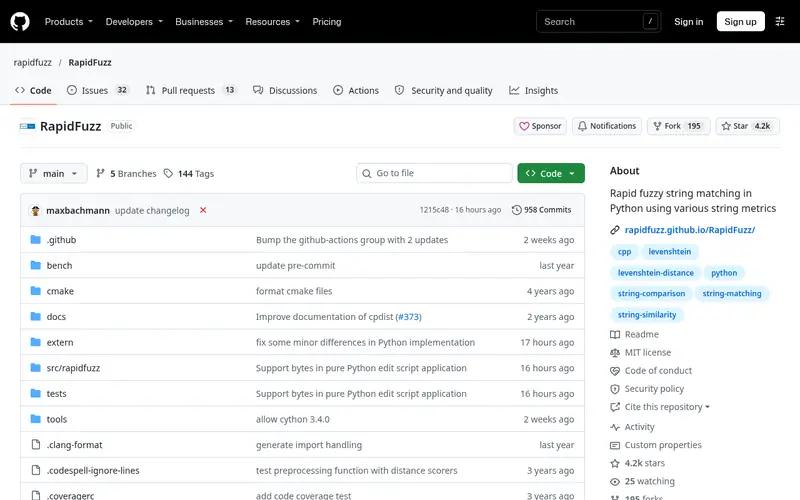
RapidFuzz provides string similarity ratios such as ratio, partial_ratio, token_sort_ratio, and token_set_ratio. It also includes process helpers like extract and extractOne for scoring one string against a list of candidates. The core is written in C++ with Python bindings, so it handles large candidate sets faster than pure-Python options.
It installs from PyPI with prebuilt wheels for common platforms, including Windows, macOS, and many Linux targets. On unusual architectures you may need a compiler. The project is MIT licensed and free to use. It works on CPython and PyPy.
Skip RapidFuzz if you need a pure-Python dependency with no compiled code, or if you want the exact fuzzywuzzy API with no changes. In those cases thefuzz or difflib may fit better.
Standout: Fast C++ backed scoring
Free (open source), as listed by the vendor (RapidFuzz website). Confirm the current plan price before you buy.
Free plan. Plans change, so confirm on the vendor's pricing page before you buy.
Benefits
- Fast C++ backed scoring
- drop-in replacements for common fuzzywuzzy calls
Drawbacks
- Compiled wheels needed on some platforms
- API differs slightly from fuzzywuzzy
Skip it if this limit matters to you: compiled wheels needed on some platforms.
Verdict. A sensible pick for fast batch string scoring in production pipelines.
Alternatives in this guide: thefuzz, jellyfish, textdistance
thefuzz
Best for projects already written against the fuzzywuzzy API
What it is and where it fits
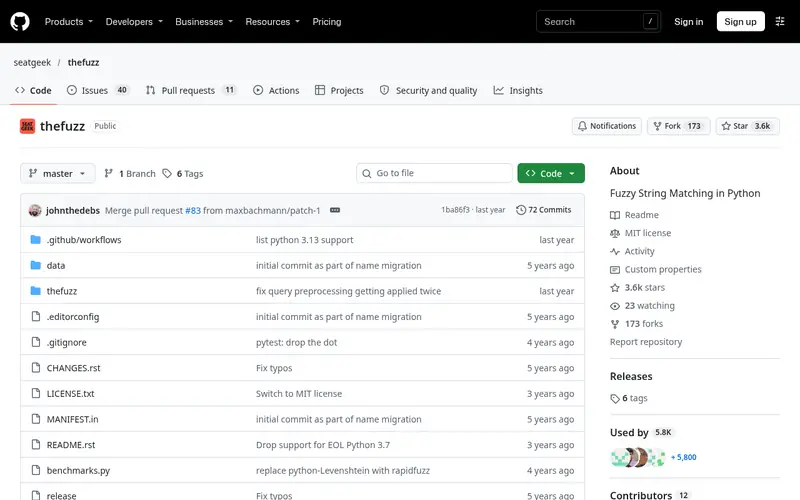
thefuzz is the maintained fork of fuzzywuzzy. It keeps the familiar fuzz and process modules, so code written against fuzzywuzzy usually works with a changed import. It provides ratio, partial_ratio, token_sort_ratio, token_set_ratio, and the process.extract helpers.
The package is pure Python. You can install python-Levenshtein alongside it to speed up some operations, but the library works without it. It is MIT licensed and free. It runs wherever Python runs, including CPython and PyPy.
Choose thefuzz when you are migrating an existing fuzzywuzzy codebase and want minimal changes. Skip it for new high-volume scoring work where RapidFuzz gives better throughput, or when you need more advanced token handling.
Standout: Familiar fuzzywuzzy-compatible API
Free (open source), as listed by the vendor (thefuzz website). Confirm the current plan price before you buy.
Free plan. Plans change, so confirm on the vendor's pricing page before you buy.
Benefits
- Familiar fuzzywuzzy-compatible API
- pure Python with optional speedups
Drawbacks
- Slower than RapidFuzz on large lists
- fewer scoring options than RapidFuzz
Skip it if this limit matters to you: slower than RapidFuzz on large lists.
Verdict. A sensible pick for projects already written against the fuzzywuzzy API.
Alternatives in this guide: RapidFuzz, jellyfish, textdistance
jellyfish
Best for phonetic and edit-distance string comparison
What it is and where it fits
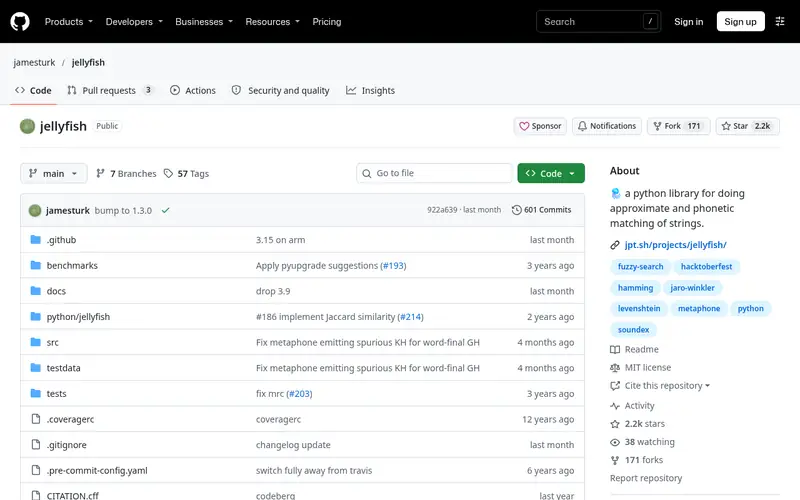
jellyfish provides string comparison functions such as Levenshtein distance, Damerau-Levenshtein distance, Jaro, Jaro-Winkler, and Hamming distance. It also includes phonetic encoders: Soundex, Metaphone, NYSIIS, and Match Rating Approach. That mix suits name matching and spelling-variant work.
The library has a Rust core with Python bindings, so it installs as a compiled package. Prebuilt wheels cover common platforms. It is MIT licensed and free. The API is simple and works on single string pairs, so you loop over candidates yourself.
Pick jellyfish when phonetic comparison or edit distance is central to the task. Skip it if you need a ready-made extract function that ranks a query against a large list, or if you need probabilistic record linkage.
Standout: Includes phonetic algorithms like Soundex and Metaphone
Free (open source), as listed by the vendor (jellyfish website). Confirm the current plan price before you buy.
Free plan. Plans change, so confirm on the vendor's pricing page before you buy.
Benefits
- Includes phonetic algorithms like Soundex and Metaphone
- simple single-pair API
Drawbacks
- No built-in batch extract helper
- not aimed at record linkage
Skip it if this limit matters to you: no built-in batch extract helper.
Verdict. A sensible pick for phonetic and edit-distance string comparison.
Alternatives in this guide: RapidFuzz, thefuzz, textdistance
textdistance
Best for comparing many distance and similarity algorithms
What it is and where it fits
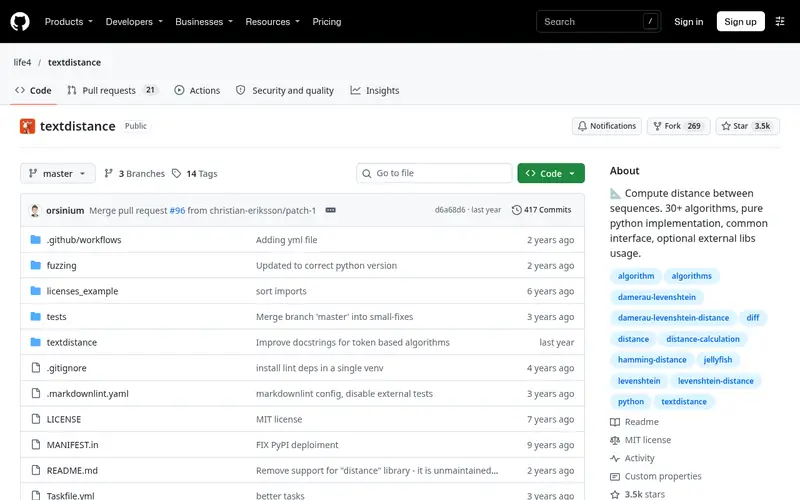
textdistance bundles dozens of algorithms: edit-based distances, token-based measures, sequence measures, phonetic algorithms, and compression-based distances. It lets you compare approaches without installing several packages. Each algorithm is available as a class or a function.
The package is pure Python, with optional dependencies for some algorithms. It is MIT licensed and free. It runs on standard Python and is easy to install from PyPI. Because it is pure Python, very large batch scoring can be slower than compiled alternatives.
Use textdistance for exploration and for tasks that need several algorithm families. Skip it for high-throughput production scoring where RapidFuzz or python-Levenshtein is faster, or when you only need one simple ratio.
Standout: Large set of algorithms in one package
Free (open source), as listed by the vendor (textdistance website). Confirm the current plan price before you buy.
Free plan. Plans change, so confirm on the vendor's pricing page before you buy.
Benefits
- Large set of algorithms in one package
- pure Python with optional extras
Drawbacks
- Pure-Python speed on large batches
- wide API surface to learn
Skip it if this limit matters to you: pure-Python speed on large batches.
Verdict. A sensible pick for comparing many distance and similarity algorithms.
difflib
Best for zero-dependency similarity checks in standard Python
What it is and where it fits
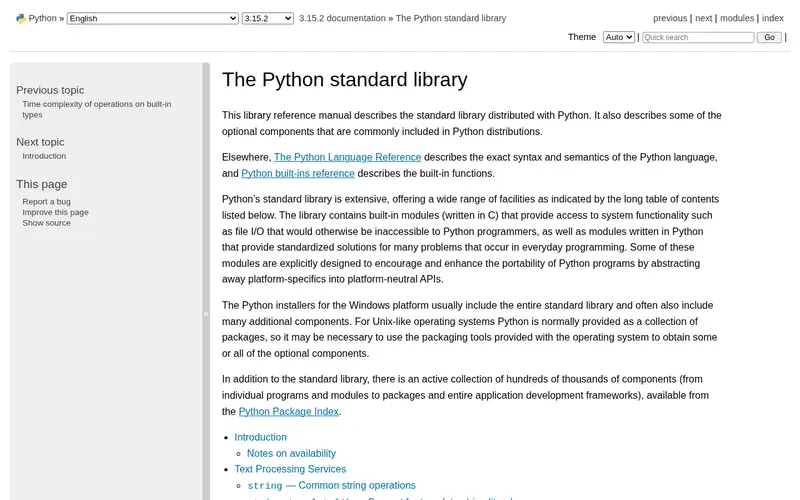
difflib ships with Python. SequenceMatcher gives a ratio for two sequences, and get_close_matches ranks a word against a list of candidates. It also provides diff helpers for comparing text. Because it is in the standard library, there is nothing to install and no dependency to audit.
The trade-off is speed. SequenceMatcher is pure Python and can be slow when you score thousands of pairs. The scoring model is also simpler than the token-based ratios in RapidFuzz or thefuzz. It is free and available on every standard Python install.
Use difflib for scripts, small datasets, and environments where adding dependencies is hard. Skip it for large-scale matching or when you need phonetic algorithms and advanced token handling.
Standout: Part of the standard library
Free, as listed by the vendor (difflib website). Confirm the current plan price before you buy.
Free plan. Plans change, so confirm on the vendor's pricing page before you buy.
Benefits
- Part of the standard library
- no install step
Drawbacks
- Slower on large candidate sets
- limited scoring options
Skip it if this limit matters to you: slower on large candidate sets.
Verdict. A sensible pick for zero-dependency similarity checks in standard Python.
python-Levenshtein
Best for fast edit-distance scoring with a small API
What it is and where it fits
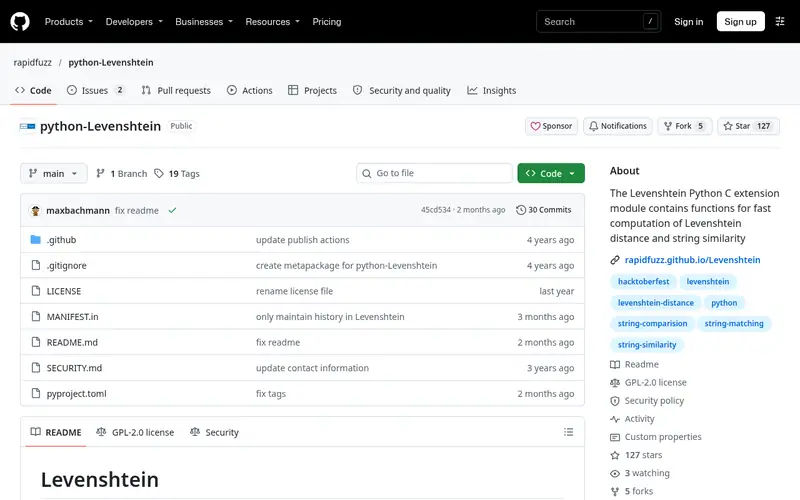
python-Levenshtein provides fast Levenshtein distance and ratio functions, plus helpers such as matching blocks and edit operations. It is a compiled extension, so it is quick on large numbers of pairs. It is often installed as an optional speedup for other fuzzy matching code.
The package is GPL licensed, which matters if you distribute software. Check the licence against your project before you depend on it. It installs from PyPI with wheels for common platforms. It is free to use.
Choose python-Levenshtein when edit distance is the main measure and you want speed. Skip it if you need token-based ratios, phonetic encoders, or a permissive licence for closed-source distribution.
Standout: Fast C implementation of edit distance
Free (open source), as listed by the vendor (python-Levenshtein website). Confirm the current plan price before you buy.
Free plan. Plans change, so confirm on the vendor's pricing page before you buy.
Benefits
- Fast C implementation of edit distance
- also provides ratio and matching helpers
Drawbacks
- Narrower scope than full matching libraries
- compiled extension to install
Skip it if this limit matters to you: narrower scope than full matching libraries.
Verdict. A sensible pick for fast edit-distance scoring with a small API.
splink
Best for probabilistic record linkage and deduplication at scale
What it is and where it fits
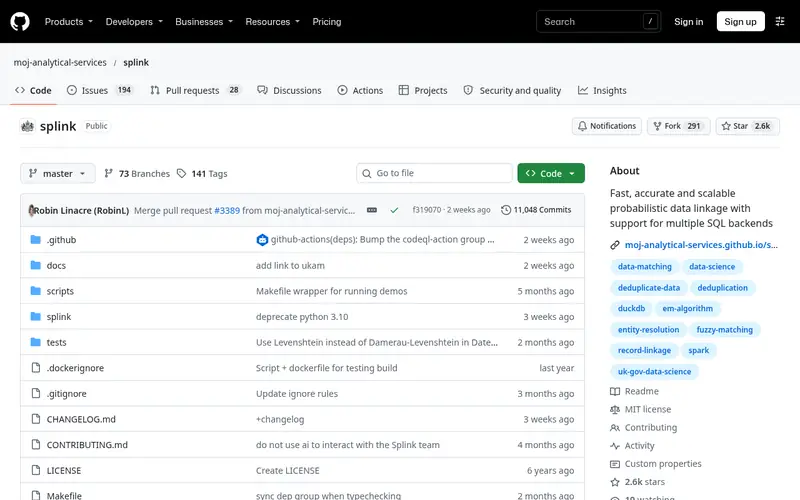
splink is a record linkage and deduplication library. It compares records across or within tables using a probabilistic model, and it can run on SQL backends such as DuckDB, Spark, and Athena. You define blocking rules and comparisons, then train and predict match probabilities.
It is not a single-pair string scorer. It targets entity resolution: finding records that refer to the same person, company, or product. The project is MIT licensed and free. Setup takes more work than calling a ratio function, and you need to understand blocking and comparison levels.
Use splink when the job is linking or deduplicating datasets, not scoring two strings. Skip it for simple fuzzy search or autocomplete, where RapidFuzz or thefuzz is a better fit.
Standout: Probabilistic matching model
Free (open source), as listed by the vendor (splink website). Confirm the current plan price before you buy.
Free plan. Plans change, so confirm on the vendor's pricing page before you buy.
Benefits
- Probabilistic matching model
- scales with SQL backends
Drawbacks
- Steeper setup than string libraries
- aimed at tabular record linkage
Skip it if this limit matters to you: steeper setup than string libraries.
Verdict. A sensible pick for probabilistic record linkage and deduplication at scale.
Who should use what
If you are building a search or autocomplete feature, start with RapidFuzz for fast batch scoring. If you are migrating an existing fuzzywuzzy codebase, thefuzz keeps changes small. If you are matching names and need phonetic algorithms, jellyfish covers Soundex and Metaphone. If the task is deduplicating customer or product records across tables, splink is built for that job. For quick scripts with no dependencies, difflib is already in the standard library.
Questions to settle before you buy
What to check before you buy
- Confirm the licence fits your distribution model, especially for GPL packages like python-Levenshtein.
- Check that prebuilt wheels exist for your OS and Python version if the library has a compiled core.
- Test scoring speed on a realistic candidate list size, not just a few pairs.
- Decide whether you need single-pair scoring, batch ranking, or full record linkage.
- Verify the API you plan to use is present in the current release, since forks and renames are common.
FAQ
What is the fastest Python fuzzy matching library?
RapidFuzz is generally the fastest of these for batch string scoring because its core is written in C++. python-Levenshtein is also fast for edit distance. Speed depends on your data and how you call the library, so test with your own candidate lists.
Is thefuzz the same as fuzzywuzzy?
thefuzz is a maintained fork of fuzzywuzzy with a similar API. Code written for fuzzywuzzy often works after changing the import. It is a separate project and is actively maintained, while the original fuzzywuzzy is not.
Can I do fuzzy matching without installing anything?
Yes. difflib is part of the Python standard library. SequenceMatcher and get_close_matches cover basic similarity and close-match ranking with no install step. It is slower than compiled libraries on large datasets.
When should I use splink instead of a string library?
Use splink when you need record linkage or deduplication across tables, with blocking rules and probabilistic match scores. Use a string library like RapidFuzz or thefuzz when you only need to score or rank individual strings.
Are these libraries safe for sensitive data?
All of these run locally in your Python process, so data is not sent to a third-party web page. Still review each library's licence and dependencies, and avoid pasting secrets or production data into online fuzzy matching demos.
Sources we checked
Method: how we score · editorial policy.
Change log. First published 27 Nov 2026.