Stage 01 · Write · Researched comparison
Best Python Async Frameworks in 2026
FastAPI is the first pick for most teams building async APIs, thanks to typed request handling, automatic OpenAPI docs and broad adoption. Starlette suits developers who want a small ASGI toolkit without FastAPI's typing layer. Litestar is a strong alternative when you want strict typing, dependency injection and a batteries-included design. All three are open source and free to use.

By Shihab Mia
Published 27 Nov 2026 · 8 tools compared
We run no ads and no affiliate links at launch. The order of a list follows our published method. See how we score.
Prices are the starting prices vendors list publicly. Plans change, so confirm the current price on the vendor page before you buy.
Key takeaways
- FastAPI, Starlette, Sanic, aiohttp, Tornado, Litestar, Quart and Falcon are all open source and free to use.
- FastAPI and Starlette run on ASGI servers such as Uvicorn; aiohttp and Sanic ship their own server components.
- Tornado and aiohttp are older projects with mature async networking code and large existing codebases.
- None of these frameworks require a paid licence; costs come from hosting and supporting services you add.
Who each pick is for
- Typed async APIs with automatic OpenAPI documentationFastAPI
- A lightweight ASGI toolkit for custom async servicesStarlette
- Async web apps that want a built-in server and extensionsSanic
- Async HTTP clients and servers in one libraryaiohttp
- Long-lived async services and WebSocket-heavy applicationsTornado
- Typed async APIs with dependency injection and pluginsLitestar
- Async ports of Flask-style applicationsQuart
- Lean, high-control async APIs and microservicesFalcon
Comparison
| Tool | Best for | Standout feature | Listed starting price | Free plan or trial |
|---|---|---|---|---|
| 1FastAPI | Typed async APIs with automatic OpenAPI documentation | Type-hint driven validation and serialization | Free (open source) | Free plan |
| 2Starlette | A lightweight ASGI toolkit for custom async services | Small core with routing, middleware, WebSockets and background tasks | Free (open source) | Free plan |
| 3Sanic | Async web apps that want a built-in server and extensions | Ships its own server and worker model | Free (open source) | Free plan |
| 4aiohttp | Async HTTP clients and servers in one library | Mature async client and server in one package | Free (open source) | Free plan |
| 5Tornado | Long-lived async services and WebSocket-heavy applications | Mature async networking and WebSocket support | Free (open source) | Free plan |
| 6Litestar | Typed async APIs with dependency injection and plugins | Strict typing, DI and plugin system in one framework | Free (open source) | Free plan |
| 7Quart | Async ports of Flask-style applications | Flask-compatible API in an async framework | Free (open source) | Free plan |
| 8Falcon | Lean, high-control async APIs and microservices | Minimal, explicit API with ASGI and WSGI support | Free (open source) | Free plan |
How we picked
We selected frameworks that genuinely handle asynchronous request processing in Python and are currently maintained, with official documentation or a public repository. Criteria were fit for the job, supported platforms and server models, licence and price, ecosystem size and documented limits. Sources are vendor documentation pages, project repositories and public licence files. We did not run benchmarks or collect user reviews. Prices and licences can change, so confirm details on the vendor site before you commit.
The tools, one by one
FastAPI
Best for typed async APIs with automatic OpenAPI documentation
What it is and where it fits
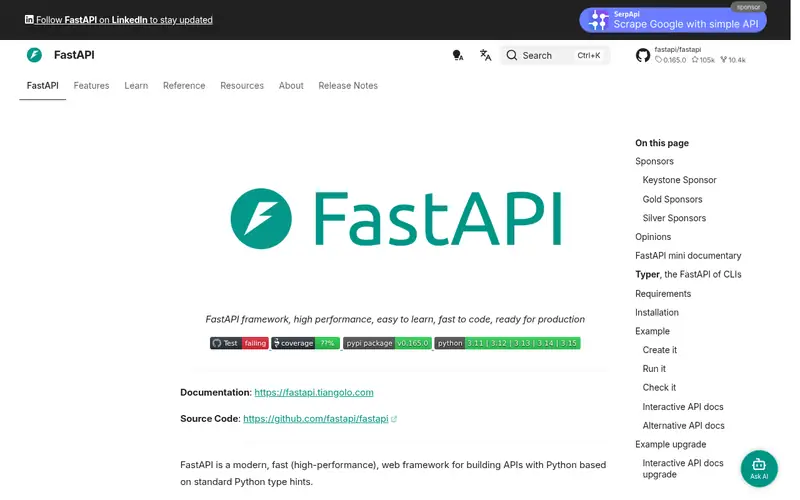
FastAPI is an ASGI web framework built on Starlette for the web layer and Pydantic for data validation. You declare request and response shapes with Python type hints, and the framework generates OpenAPI schemas and interactive docs from them. It runs on any ASGI server, most commonly Uvicorn, and supports both async and sync route handlers.
The framework fits JSON APIs, microservices and backend services that need clear contracts. Its dependency injection system covers authentication, database sessions and shared setup. Because it builds on Starlette and Pydantic, upgrades to those projects can affect your app, so pin versions and read release notes.
FastAPI is released under the MIT licence. There is no paid tier and no feature gating. Skip it if you need a full-stack framework with an admin panel and ORM bundled, or if you prefer to avoid heavy use of type hints and Pydantic models.
Standout: Type-hint driven validation and serialization
Free (open source), as listed by the vendor (FastAPI website). Confirm the current plan price before you buy.
Free plan. Plans change, so confirm on the vendor's pricing page before you buy.
Benefits
- Type-hint driven validation and serialization
- automatic interactive API docs
Drawbacks
- Built on Starlette and Pydantic, so you inherit two dependency layers
- less suited to server-rendered HTML apps
Skip it if this limit matters to you: built on Starlette and Pydantic, so you inherit two dependency layers.
Verdict. A sensible pick for typed async APIs with automatic OpenAPI documentation.
Starlette
Best for a lightweight ASGI toolkit for custom async services
What it is and where it fits
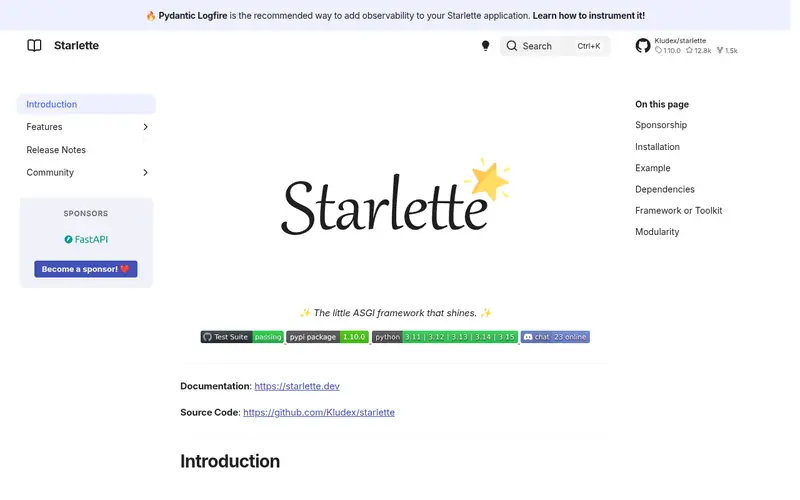
Starlette is a lightweight ASGI framework and toolkit. It provides routing, middleware, request and response classes, WebSocket support, background tasks, static files and test client utilities. It does not include data validation, an ORM or API documentation, which keeps the core small and the behavior predictable.
It suits developers who want control over each layer, or who are building libraries and services that FastAPI's typing layer would complicate. It runs on ASGI servers such as Uvicorn and Hypercorn. Documentation covers each component directly, and the project is maintained by the same author as FastAPI.
Starlette uses the BSD 3-Clause licence and is free. There is no paid edition. Skip it if you want request validation and generated API docs out of the box; FastAPI or Litestar will save you that work.
Standout: Small core with routing, middleware, WebSockets and background tasks
Free (open source), as listed by the vendor (Starlette website). Confirm the current plan price before you buy.
Free plan. Plans change, so confirm on the vendor's pricing page before you buy.
Benefits
- Small core with routing, middleware, WebSockets and background tasks
- the base layer under FastAPI
Drawbacks
- No built-in data validation or docs
- you assemble more pieces yourself
Skip it if this limit matters to you: no built-in data validation or docs.
Verdict. A sensible pick for A lightweight ASGI toolkit for custom async services.
Sanic
Best for async web apps that want a built-in server and extensions
What it is and where it fits
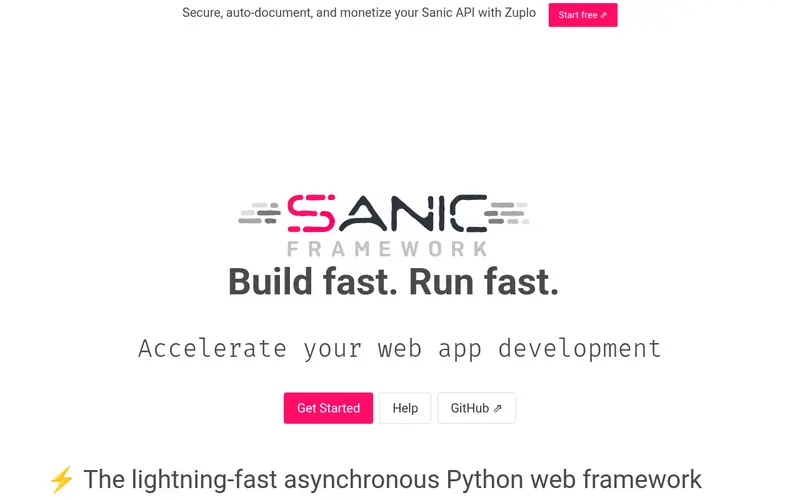
Sanic is an async web framework that includes its own server, so you can run an app without adding an ASGI server package. It supports routing, middleware, WebSockets, streaming responses and worker processes. The project also maintains extensions for templating, sessions and other common needs.
It fits teams that want a single framework to own both the app and the server, and projects that prefer Sanic's request and response style over ASGI-first tooling. Sanic apps can still run under ASGI servers, but the built-in server is the common path.
Sanic is MIT licensed and free with no paid tier. Major version upgrades have changed APIs in the past, so check migration notes before jumping versions. Skip it if you need the largest possible ecosystem of tutorials and third-party packages; FastAPI has more of that.
Standout: Ships its own server and worker model
Free (open source), as listed by the vendor (Sanic website). Confirm the current plan price before you buy.
Free plan. Plans change, so confirm on the vendor's pricing page before you buy.
Benefits
- Ships its own server and worker model
- extension ecosystem for common add-ons
Drawbacks
- Smaller community than FastAPI
- APIs have changed across major versions
Skip it if this limit matters to you: smaller community than FastAPI.
Verdict. A sensible pick for async web apps that want a built-in server and extensions.
aiohttp
Best for async HTTP clients and servers in one library
What it is and where it fits
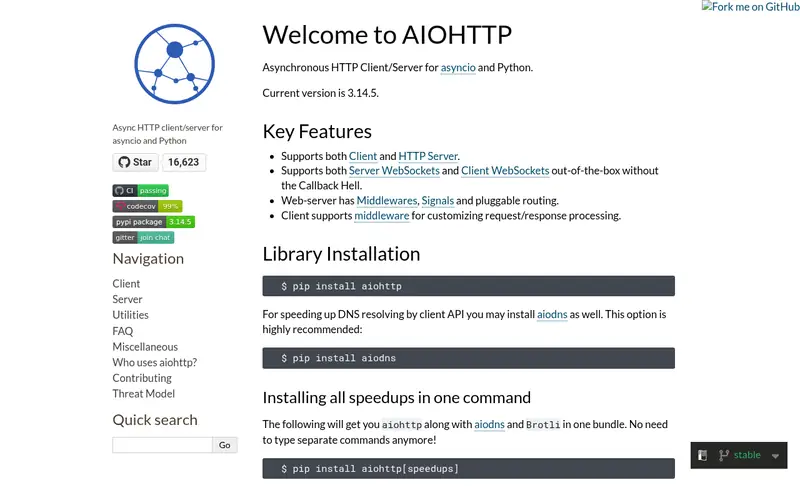
aiohttp provides both an asynchronous HTTP client and a web server built on asyncio. The client is widely used on its own for calling external APIs concurrently. The server side offers routing, middleware, WebSockets and static file handling.
It suits projects that need a client and server from the same library, or services that already depend on aiohttp's client and want to avoid a second HTTP stack. The server API is closer to the metal than FastAPI or Litestar, so expect more manual wiring for validation and docs.
aiohttp is Apache 2.0 licensed and free. It has no paid edition. Skip it if you want generated API documentation and typed request models without extra libraries; a framework built on ASGI with validation will be faster to start.
Standout: Mature async client and server in one package
Free (open source), as listed by the vendor (aiohttp website). Confirm the current plan price before you buy.
Free plan. Plans change, so confirm on the vendor's pricing page before you buy.
Benefits
- Mature async client and server in one package
- long track record in production networking code
Drawbacks
- Server API is lower level than full frameworks
- fewer built-in conveniences for API projects
Skip it if this limit matters to you: server API is lower level than full frameworks.
Verdict. A sensible pick for async HTTP clients and servers in one library.
Tornado
Best for long-lived async services and WebSocket-heavy applications
What it is and where it fits
Tornado is an async web framework and networking library that predates asyncio and now integrates with it. It includes an HTTP server, client, WebSocket support and templating. It is known for handling many long-lived connections, which is why it appears in real-time and streaming services.
It fits teams maintaining existing Tornado code, and projects that need WebSockets or long polling with a mature, stable stack. New projects often pick ASGI frameworks instead, so weigh ecosystem momentum when choosing.
Tornado is Apache 2.0 licensed and free. There is no paid tier. Its documentation is thorough but assumes familiarity with async patterns. Skip it for new API projects if you want the largest pool of current tutorials and integrations.
Standout: Mature async networking and WebSocket support
Free (open source), as listed by the vendor (Tornado website). Confirm the current plan price before you buy.
Free plan. Plans change, so confirm on the vendor's pricing page before you buy.
Benefits
- Mature async networking and WebSocket support
- runs its own IOLoop and integrates with asyncio
Drawbacks
- Older API style
- smaller new-project adoption than ASGI frameworks
Skip it if this limit matters to you: older API style.
Verdict. A sensible pick for long-lived async services and WebSocket-heavy applications.
Litestar
Best for typed async APIs with dependency injection and plugins
What it is and where it fits
Litestar is an ASGI framework focused on typed APIs. It provides routing, dependency injection, DTOs, plugins, OpenAPI generation and session handling. It supports multiple ASGI servers and offers features such as channels for WebSockets and SSE.
It suits teams that want FastAPI-style typed APIs with a more structured, batteries-included design, including built-in dependency injection and plugin hooks. The trade-off is a smaller ecosystem and fewer third-party examples than FastAPI.
Litestar is MIT licensed and free. There is no paid edition. Its feature set is broad, so read the docs before adopting it on a large codebase. Skip it if your team values the largest hiring pool and community answers over built-in structure.
Standout: Strict typing, DI and plugin system in one framework
Free (open source), as listed by the vendor (Litestar website). Confirm the current plan price before you buy.
Free plan. Plans change, so confirm on the vendor's pricing page before you buy.
Benefits
- Strict typing, DI and plugin system in one framework
- supports multiple server backends
Drawbacks
- Smaller community than FastAPI
- more opinionated structure to learn
Skip it if this limit matters to you: smaller community than FastAPI.
Verdict. A sensible pick for typed async APIs with dependency injection and plugins.
Quart
Best for async ports of Flask-style applications
What it is and where it fits
Quart is an async web framework that follows Flask's API style. It supports the Flask request and response model, blueprints, sessions and templates, but with async view functions. It runs on ASGI servers and is maintained under the Pallets project, the group behind Flask.
It fits teams with Flask experience who need async request handling, or projects that want to reuse Flask patterns while moving to ASGI. Existing Flask extensions may not work unchanged, so check compatibility before migrating.
Quart is MIT licensed and free. There is no paid tier. Skip it if you are starting fresh with no Flask background; FastAPI or Starlette will feel more direct. Also skip it if you depend on Flask extensions that have no async equivalent.
Standout: Flask-compatible API in an async framework
Free (open source), as listed by the vendor (Quart website). Confirm the current plan price before you buy.
Free plan. Plans change, so confirm on the vendor's pricing page before you buy.
Benefits
- Flask-compatible API in an async framework
- part of the Pallets project family
Drawbacks
- Smaller ecosystem than Flask itself
- async migration still requires code changes
Skip it if this limit matters to you: smaller ecosystem than Flask itself.
Verdict. A sensible pick for async ports of Flask-style applications.
Falcon
Best for lean, high-control async APIs and microservices
What it is and where it fits
Falcon is a minimalist web framework for building APIs and microservices. It supports both ASGI and WSGI, so the same app style can run in async or sync deployments. It provides routing, middleware, request and response media handling, and hooks.
It suits developers who want an explicit, small framework with little magic, and teams that need to support both async and sync deployment targets. The framework leaves validation, docs and ORM choices to you or to add-on packages.
Falcon is Apache 2.0 licensed and free. There is no paid edition. Skip it if you want automatic OpenAPI docs and typed request models without extra libraries; FastAPI, Litestar or Quart will cover more of that out of the box.
Standout: Minimal, explicit API with ASGI and WSGI support
Free (open source), as listed by the vendor (Falcon website). Confirm the current plan price before you buy.
Free plan. Plans change, so confirm on the vendor's pricing page before you buy.
Benefits
- Minimal, explicit API with ASGI and WSGI support
- few dependencies
Drawbacks
- Fewer built-in conveniences than larger frameworks
- smaller community
Skip it if this limit matters to you: fewer built-in conveniences than larger frameworks.
Verdict. A sensible pick for lean, high-control async APIs and microservices.
Who should use what
If you are building a JSON API and want typed requests plus generated docs, start with FastAPI. If you want a small ASGI core and plan to assemble your own validation and docs, choose Starlette. If you need an async HTTP client and server in one library, or you maintain networking code, aiohttp is the practical pick. If you have a Flask codebase and need async views, Quart keeps the patterns familiar. Teams that want strict typing, dependency injection and plugins in one framework should evaluate Litestar.
Questions to settle before you buy
What to check before you buy
- Confirm the framework supports your deployment target, such as ASGI servers, containers or serverless platforms.
- Check the Python version range and whether your dependencies support the same range.
- Read the licence and confirm it fits your distribution model.
- Review migration notes for major versions, especially if you depend on older APIs.
- Verify that validation, OpenAPI docs, authentication and ORM integration exist as first-party features or maintained add-ons.
FAQ
Are these Python async frameworks free?
Yes. All eight projects listed are open source and free to use under licences such as MIT, BSD 3-Clause or Apache 2.0. You pay for hosting, managed databases and other services you add around them, not for the framework itself.
What is the difference between ASGI and WSGI here?
ASGI supports async request handling and protocols such as WebSockets. WSGI is the older synchronous interface. FastAPI, Starlette, Sanic, Litestar and Quart are ASGI-first. Falcon supports both. Tornado and aiohttp use their own server models that integrate with asyncio.
Can I use FastAPI and Starlette together?
Yes. FastAPI is built on Starlette, so Starlette features such as middleware and WebSockets are available inside FastAPI apps. You can also mount Starlette or other ASGI apps inside a FastAPI application when you need lower-level control.
Which framework should I pick for WebSockets?
Starlette, FastAPI, Sanic, Tornado, Litestar and aiohttp all document WebSocket support. Tornado and aiohttp have long track records with long-lived connections. Check the docs for the specific features you need, such as channels, backpressure or authentication hooks.
Do I need to paste secrets or production data anywhere to use these?
No. These are libraries you install and run locally or on your own servers. Avoid pasting credentials, tokens or production data into third-party web tools such as online formatters or API testers; prefer local tools or ones that run in your browser.
Sources we checked
Method: how we score · editorial policy.
Change log. First published 27 Nov 2026.