Stage 01 · Write · Researched comparison
Best Kotlin Web Frameworks in 2026
Ktor is the first pick for most teams that want a Kotlin-first server framework with coroutines built in and a small default footprint. Spring Boot with Kotlin suits teams that need the wider Spring ecosystem and existing Java libraries. http4k is a strong alternative when you want a functional style and plain functions instead of annotations or a container.

By Shihab Mia
Published 27 Nov 2026 · 6 tools compared
We run no ads and no affiliate links at launch. The order of a list follows our published method. See how we score.
Prices are the starting prices vendors list publicly. Plans change, so confirm the current price on the vendor page before you buy.
Key takeaways
- Ktor, http4k and Javalin are free and open source under Apache 2.0, and Spring Boot, Micronaut and Quarkus are also free and open source.
- Ktor and http4k are written in Kotlin and treat coroutines and functional routing as core design choices, not add-ons.
- Spring Boot, Micronaut and Quarkus are Java frameworks with first-class Kotlin support, so you inherit their ecosystems and their conventions.
- All six frameworks run on the JVM, and several support GraalVM native images, which changes startup time and memory use.
Who each pick is for
- Kotlin-first teams that want coroutines and a light coreKtor
- Teams that need the Spring ecosystem and Java library supportSpring Boot with Kotlin
- Teams that prefer functional composition over annotationshttp4k
- Small services and developers who want a minimal, simple APIJavalin
- Teams that want fast startup and ahead-of-time compilationMicronaut
- Kubernetes and native deployments where startup time mattersQuarkus with Kotlin
Comparison
| Tool | Best for | Standout feature | Listed starting price | Free plan or trial |
|---|---|---|---|---|
| 1Ktor | Kotlin-first teams that want coroutines and a light core | Written in Kotlin with coroutine-based request handling | Free (open source) | Free plan |
| 2Spring Boot with Kotlin | Teams that need the Spring ecosystem and Java library support | Official Kotlin support with extensions for routing and coroutines | Free (open source) | Free plan |
| 3http4k | Teams that prefer functional composition over annotations | Applications are plain functions, which makes testing straightforward | Free (open source) | Free plan |
| 4Javalin | Small services and developers who want a minimal, simple API | Very small API surface that is quick to learn | Free (open source) | Free plan |
| 5Micronaut | Teams that want fast startup and ahead-of-time compilation | Dependency injection and configuration resolved at compile time | Free (open source) | Free plan |
| 6Quarkus with Kotlin | Kubernetes and native deployments where startup time matters | Official Kotlin extension with coroutine support | Free (open source) | Free plan |
How we picked
We picked frameworks that are actively maintained, support Kotlin officially, and can serve a production HTTP API or web app. Criteria were fit for server-side Kotlin work, supported platforms and deployment targets, licence and price, and the main practical limits such as ecosystem size and startup characteristics. Sources are vendor pages, official documentation and project repositories. Prices and licence terms can change, so confirm details on the vendor site before you commit.
The tools, one by one
Ktor
Best for kotlin-first teams that want coroutines and a light core
What it is and where it fits
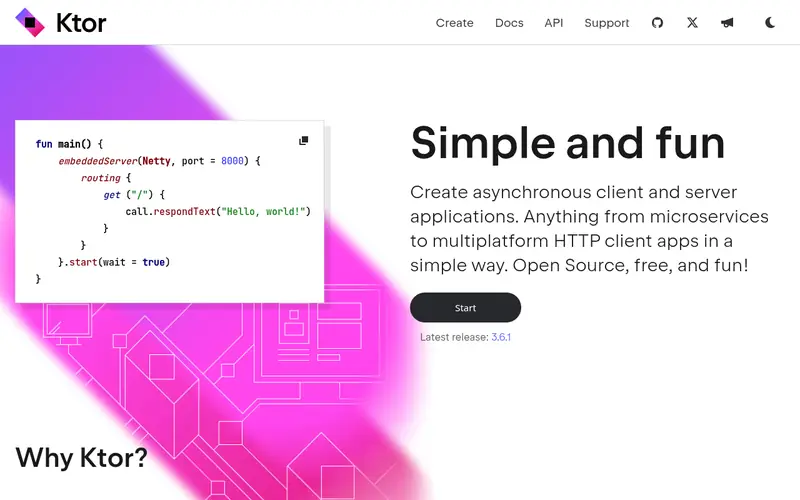
Ktor is built by JetBrains and designed around Kotlin coroutines. Routing, content negotiation, authentication, WebSockets and templating are installed as plugins, so a minimal server stays small. It runs on the JVM and also targets Kotlin/Native, which lets you build native binaries for other platforms.
You can start a project with the Ktor project generator, choose a server engine such as Netty or CIO, and add plugins as needed. The framework is Apache 2.0 licensed with no paid tier. Documentation is solid and the sample projects are practical, but you will make more architecture decisions than with Spring Boot. Teams that want a full stack with dependency injection and data access built in may find Ktor too bare. Teams that want control over what ships in the binary tend to prefer it.
Standout: Written in Kotlin with coroutine-based request handling
Free (open source), as listed by the vendor (Ktor website). Confirm the current plan price before you buy.
Free plan. Plans change, so confirm on the vendor's pricing page before you buy.
Benefits
- Written in Kotlin with coroutine-based request handling
- modular design lets you add only the plugins you need
Drawbacks
- Fewer built-in conventions than Spring, so you assemble more pieces yourself
- plugin ecosystem is smaller than Spring's
Skip it if this limit matters to you: fewer built-in conventions than Spring, so you assemble more pieces yourself.
Verdict. A sensible pick for kotlin-first teams that want coroutines and a light core.
Alternatives in this guide: Spring Boot with Kotlin, http4k, Javalin
Spring Boot with Kotlin
Best for teams that need the Spring ecosystem and Java library support
What it is and where it fits
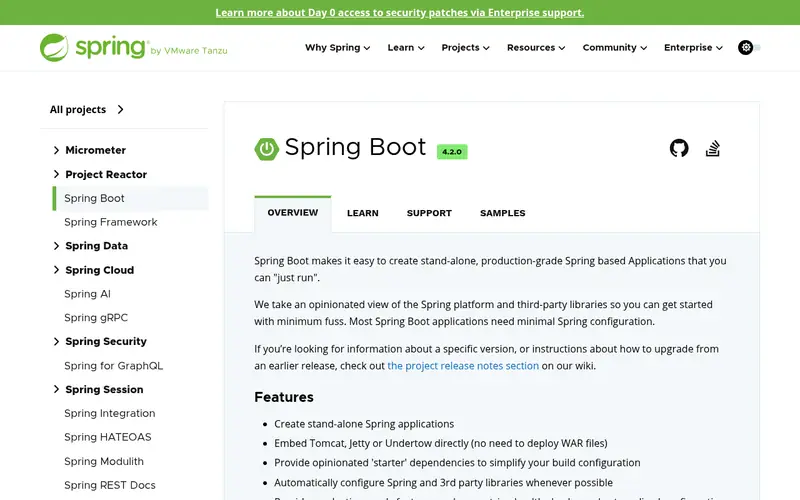
Spring Boot is a Java framework, but Spring provides official Kotlin support. That includes Kotlin extensions for Spring MVC and WebFlux, coroutine support, and a Kotlin DSL for bean definitions. You get dependency injection, data access, security, validation and actuator endpoints from one project.
Spring Boot is Apache 2.0 licensed and free to use. Commercial support and training are available from VMware and partners, but the framework itself has no paid tier. It runs on the JVM and supports GraalVM native images. The tradeoff is weight: startup is slower than Ktor or Javalin, and the configuration surface is large. Teams already using Spring, or that need a specific Java library, usually find the integration cost lower than switching. New small services may be better served by a lighter framework.
Standout: Official Kotlin support with extensions for routing and coroutines
Free (open source), as listed by the vendor (Spring Boot with Kotlin website). Confirm the current plan price before you buy.
Free plan. Plans change, so confirm on the vendor's pricing page before you buy.
Benefits
- Official Kotlin support with extensions for routing and coroutines
- huge ecosystem of starters, data access and security modules
Drawbacks
- Heavier default footprint and slower startup than minimal frameworks
- more configuration surface to learn
Skip it if this limit matters to you: heavier default footprint and slower startup than minimal frameworks.
Verdict. A sensible pick for teams that need the Spring ecosystem and Java library support.
http4k
Best for teams that prefer functional composition over annotations
What it is and where it fits
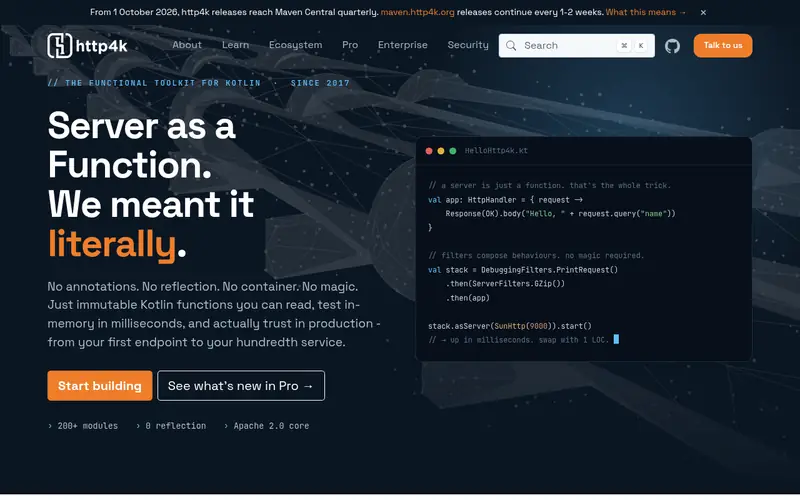
http4k models an application as a function from request to response. Routing, filters and handlers compose as ordinary Kotlin functions, so you can test a whole app without starting a server. The same abstractions work for server and client code, and the library supports multiple server backends.
It is Apache 2.0 licensed and free. The project is maintained by a small team, and documentation covers the core concepts well. The functional approach is a strength for teams that like it and a hurdle for teams that expect annotations and a container. If your team is comfortable with higher-order functions and wants fast, dependency-light tests, http4k is worth a serious look. If you need a large hiring pool familiar with the framework, Spring remains easier to staff.
Standout: Applications are plain functions, which makes testing straightforward
Free (open source), as listed by the vendor (http4k website). Confirm the current plan price before you buy.
Free plan. Plans change, so confirm on the vendor's pricing page before you buy.
Benefits
- Applications are plain functions, which makes testing straightforward
- server and client abstractions are symmetric
Drawbacks
- Functional style has a learning curve for developers used to annotation frameworks
- smaller community than Spring or Ktor
Skip it if this limit matters to you: functional style has a learning curve for developers used to annotation frameworks.
Verdict. A sensible pick for teams that prefer functional composition over annotations.
Alternatives in this guide: Ktor, Spring Boot with Kotlin, Javalin
Javalin
Best for small services and developers who want a minimal, simple API
What it is and where it fits
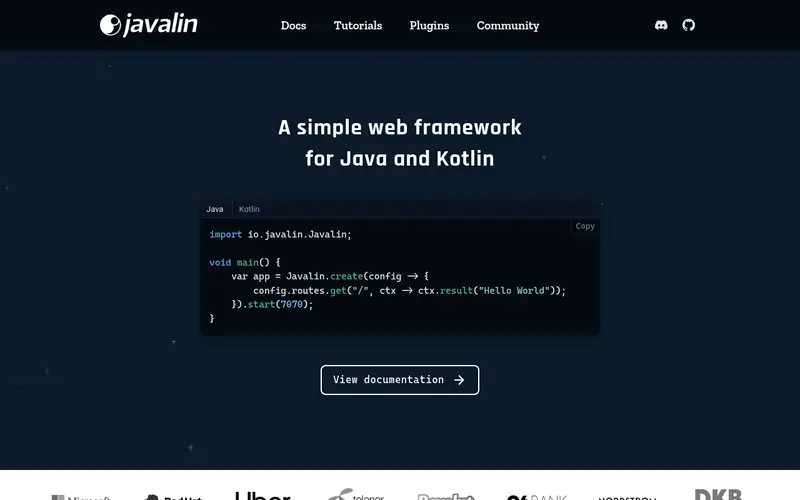
Javalin is a lightweight Java and Kotlin web framework built on Jetty. It focuses on a small, readable API for routing, JSON handling and WebSockets. Kotlin support is documented and the framework works well for small services, internal tools and prototypes.
It is Apache 2.0 licensed and free. There is no paid tier and no hosted offering from the project. The framework does less for you than Spring Boot: you add your own dependency injection, database layer and configuration approach. That keeps the learning curve short but puts more decisions on your team. For a large application with many modules and a big team, a more opinionated framework may reduce coordination cost. For a focused API, Javalin is a reasonable fit.
Standout: Very small API surface that is quick to learn
Free (open source), as listed by the vendor (Javalin website). Confirm the current plan price before you buy.
Free plan. Plans change, so confirm on the vendor's pricing page before you buy.
Benefits
- Very small API surface that is quick to learn
- runs on Jetty and supports Kotlin well
Drawbacks
- Fewer built-in features than larger frameworks
- less structure for large multi-module applications
Skip it if this limit matters to you: fewer built-in features than larger frameworks.
Verdict. A sensible pick for small services and developers who want a minimal, simple API.
Alternatives in this guide: Ktor, Spring Boot with Kotlin, http4k
Micronaut
Best for teams that want fast startup and ahead-of-time compilation
What it is and where it fits
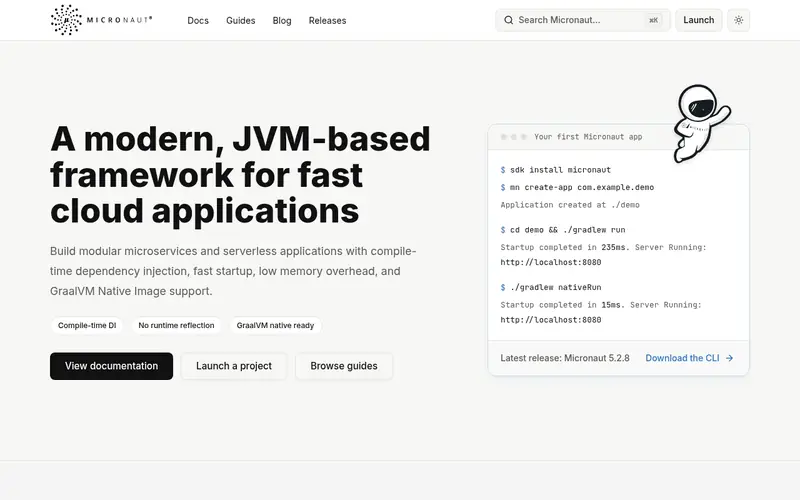
Micronaut is a JVM framework designed for low memory use and fast startup. It resolves dependency injection at compile time rather than through runtime reflection, which helps with native images and serverless deployments. Kotlin is a supported language, with dedicated guides and Kotlin-specific APIs.
The framework is Apache 2.0 licensed and free. Commercial support and training are offered by the company behind the project, but the core framework has no paid tier. Micronaut runs on the JVM and supports GraalVM native images. It is a good fit for microservices and functions where cold start matters. Teams that depend on Spring-specific libraries may find integration work adds up, and the community is smaller, so fewer answers exist for unusual problems.
Standout: Dependency injection and configuration resolved at compile time
Free (open source), as listed by the vendor (Micronaut website). Confirm the current plan price before you buy.
Free plan. Plans change, so confirm on the vendor's pricing page before you buy.
Benefits
- Dependency injection and configuration resolved at compile time
- strong GraalVM native image support
Drawbacks
- Smaller ecosystem than Spring
- some libraries need Micronaut-specific integration
Skip it if this limit matters to you: smaller ecosystem than Spring.
Verdict. A sensible pick for teams that want fast startup and ahead-of-time compilation.
Alternatives in this guide: Ktor, Spring Boot with Kotlin, http4k
Quarkus with Kotlin
Best for kubernetes and native deployments where startup time matters
What it is and where it fits
Quarkus is a Kubernetes-native Java framework with an official Kotlin extension. It supports Kotlin coroutines, and many Quarkus extensions work with Kotlin code. The framework moves work to build time where it can, which improves startup and memory use, especially in native mode.
Quarkus is Apache 2.0 licensed and free. Red Hat offers commercial support as part of its product subscriptions, but the framework itself has no paid tier. It runs on the JVM and compiles to native images with GraalVM. Native builds take longer and need more setup than JVM builds, so the benefit shows up at deploy time, not in the inner loop. Teams already on Red Hat middleware often find Quarkus a natural fit. Teams that want the broadest library compatibility may prefer Spring Boot.
Standout: Official Kotlin extension with coroutine support
Free (open source), as listed by the vendor (Quarkus with Kotlin website). Confirm the current plan price before you buy.
Free plan. Plans change, so confirm on the vendor's pricing page before you buy.
Benefits
- Official Kotlin extension with coroutine support
- designed for fast startup and low memory in native mode
Drawbacks
- Extension ecosystem is large but not identical to Spring's
- native builds add tooling complexity
Skip it if this limit matters to you: extension ecosystem is large but not identical to Spring's.
Verdict. A sensible pick for kubernetes and native deployments where startup time matters.
Alternatives in this guide: Ktor, Spring Boot with Kotlin, http4k
Who should use what
A team starting a new Kotlin API with no legacy Java code should look at Ktor first. A company with existing Spring services and Java libraries should use Spring Boot with Kotlin to reuse that investment. A team that values functional code and fast tests should evaluate http4k. A team deploying many small services to Kubernetes, where startup and memory matter, should compare Micronaut and Quarkus. A developer building a small internal tool or prototype can use Javalin and skip most configuration.
Questions to settle before you buy
What to check before you buy
- Confirm the framework has official Kotlin support and current documentation, not just Java examples.
- Check that the libraries you need, such as database drivers and auth, have integrations for your chosen framework.
- Decide whether you need GraalVM native images, and test a native build early if you do.
- Review the licence and any commercial support terms for your organization.
- Measure startup time and memory on your own hardware before choosing for serverless or high-density deployments.
FAQ
Is Ktor better than Spring Boot for Kotlin?
Neither is universally better. Ktor is Kotlin-first, lighter and coroutine-based by design. Spring Boot has a much larger ecosystem and more built-in features. Choose Ktor for small, focused services and control over dependencies. Choose Spring Boot when you need Spring libraries, data access and security out of the box.
Do these frameworks cost anything?
All six are free and open source under permissive licences. Spring Boot, Micronaut and Quarkus have companies behind them that sell support and training, but the frameworks themselves have no paid tier. You pay for hosting and any commercial support you choose to buy.
Can I use Kotlin coroutines with these frameworks?
Ktor is built around coroutines. Spring Boot supports coroutines in WebFlux and in Kotlin extensions. Quarkus has coroutine support through its Kotlin extension. http4k and Javalin work with coroutines but do not require them. Check the current documentation for the specific version you plan to use.
Which framework is best for GraalVM native images?
Micronaut and Quarkus are designed with native images in mind and document the process. Spring Boot also supports native images through Spring Native integration in recent versions. Ktor and Javalin can run in native mode but need more manual setup. Test your dependencies early, since not every library works in native mode.
Do I need to paste secrets into any online tool to use these frameworks?
No. These are server-side frameworks you install and run locally or on your own infrastructure. Project generators such as the Ktor generator run in the browser, but you should not paste production secrets, tokens or credentials into any third-party web page. Keep secrets in environment variables or a secrets manager.
Sources we checked
Method: how we score · editorial policy.
Change log. First published 27 Nov 2026.