Stage 01 · Write · Researched comparison
Best JavaScript Virtual Scrolling Libraries in 2026
TanStack Virtual is the first pick for most teams because it is headless, framework-agnostic and free under the MIT licence. React teams that want a small, stable API should look at react-window. Teams that need variable-height rows, grouping or auto-measurement in React should look at react-virtuoso. All three are open source and run in the browser, so list data stays on the client.

By Shihab Mia
Published 27 Nov 2026 · 6 tools compared
We run no ads and no affiliate links at launch. The order of a list follows our published method. See how we score.
Prices are the starting prices vendors list publicly. Plans change, so confirm the current price on the vendor page before you buy.
Key takeaways
- Every library in this guide is free and open source, so there is no per-seat cost to evaluate.
- TanStack Virtual, virtua and vue-virtual-scroller ship their own adapters; react-window, react-virtuoso and react-virtualized are React only.
- react-virtualized is in maintenance mode, so new projects should treat it as a legacy choice.
- Virtual scrolling changes rendering only; it does not add server-side pagination or reduce API payload size.
Who each pick is for
- Teams that want a headless virtualizer across frameworksTanStack Virtual
- React apps that need a small, stable list and grid APIreact-window
- React apps with variable heights, grouping and chat-style feedsreact-virtuoso
- Maintaining older React codebases that already depend on itreact-virtualized
- Vue 2 and Vue 3 apps that need ready-made scroller componentsvue-virtual-scroller
- React, Vue and Svelte apps that want a small headless-style APIvirtua
Comparison
| Tool | Best for | Standout feature | Listed starting price | Free plan or trial |
|---|---|---|---|---|
| 1TanStack Virtual | Teams that want a headless virtualizer across frameworks | Headless design works with React, Vue, Svelte, Solid and vanilla JS | Free (open source) | Free plan |
| 2react-window | React apps that need a small, stable list and grid API | Small API surface with FixedSizeList, VariableSizeList and Grid | Free (open source) | Free plan |
| 3react-virtuoso | React apps with variable heights, grouping and chat-style feeds | Measures unknown row heights automatically | Free (open source) | Free plan |
| 4react-virtualized | Maintaining older React codebases that already depend on it | Broad component set including lists, tables, grids and masonry | Free (open source) | Free plan |
| 5vue-virtual-scroller | Vue 2 and Vue 3 apps that need ready-made scroller components | Drop-in components for lists, grids and dynamic heights | Free (open source) | Free plan |
| 6virtua | React, Vue and Svelte apps that want a small headless-style API | One API across React, Vue, Svelte and Solid | Free (open source) | Free plan |
How we picked
We picked libraries that are currently maintained, have a public repository and genuinely implement windowed rendering rather than pagination. Criteria were framework fit, API style (headless versus component), handling of variable heights, licence, and known limits such as React-only support or maintenance status. Sources are the official documentation, project repositories and public licence files. Prices and licences can change, so confirm on the vendor or repository page before you adopt one.
The tools, one by one
TanStack Virtual
Best for teams that want a headless virtualizer across frameworks
What it is and where it fits
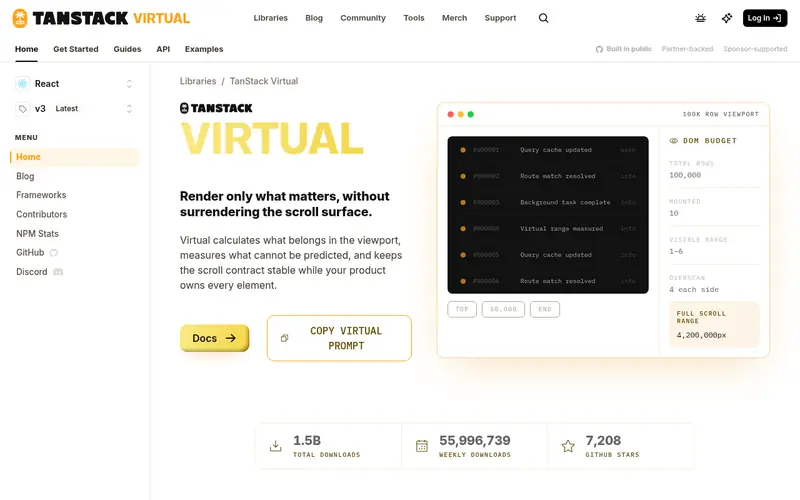
TanStack Virtual is a headless virtualizer. It computes which rows are visible and returns offsets and sizes, but it does not render a list component for you. Adapters exist for React, Vue, Svelte, Solid and Angular, plus a core package for plain JavaScript. That makes it the most portable option in this list when a codebase mixes frameworks or uses none.
Because it is headless, you control the DOM, the scroll container and the CSS. Vertical, horizontal and grid layouts are supported. Dynamic row sizes work through measurement, but you need to wire that up correctly or rows will jump. The licence is MIT and the project is maintained by the TanStack team.
Skip it if you want a ready-made component with built-in styling, or if your team is small and would rather not own the rendering layer. It suits teams that already have a design system.
Standout: Headless design works with React, Vue, Svelte, Solid and vanilla JS
Free (open source), as listed by the vendor (TanStack Virtual website). Confirm the current plan price before you buy.
Free plan. Plans change, so confirm on the vendor's pricing page before you buy.
Benefits
- Headless design works with React, Vue, Svelte, Solid and vanilla JS
- MIT licence with active maintenance
Drawbacks
- You write the markup and styling yourself
- dynamic measurement needs extra configuration
Skip it if this limit matters to you: you write the markup and styling yourself.
Verdict. A sensible pick for teams that want a headless virtualizer across frameworks.
Alternatives in this guide: react-window, react-virtuoso, react-virtualized
react-window
Best for react apps that need a small, stable list and grid API
What it is and where it fits
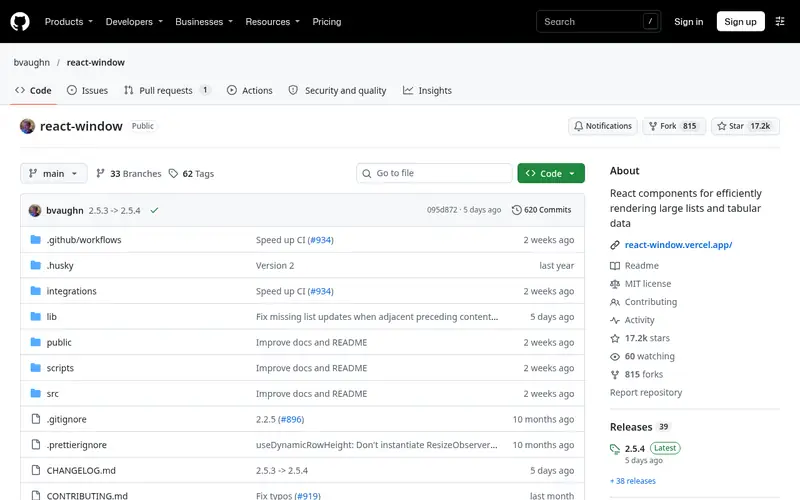
react-window is a rewrite of react-virtualized by the same author, focused on a smaller footprint. It exposes a few components: fixed-size lists, variable-size lists and grids, plus a windowing hook. You pass an item count, an item size function and a row renderer, and it mounts only the visible rows.
The API is deliberately narrow. That keeps it easy to learn but means features like sticky group headers, auto-measured rows or infinite loading are your responsibility. Variable heights require you to supply a size per index, usually from cached measurements. It is React only and does not target React Native.
The package is MIT licensed and remains a common default for straightforward long lists and tables. It is a good fit when the row height is known ahead of time. If you need unknown heights measured automatically, look at react-virtuoso or virtua instead.
Standout: Small API surface with FixedSizeList, VariableSizeList and Grid
Free (open source), as listed by the vendor (react-window website). Confirm the current plan price before you buy.
Free plan. Plans change, so confirm on the vendor's pricing page before you buy.
Benefits
- Small API surface with FixedSizeList, VariableSizeList and Grid
- MIT licence and widely used in production
Drawbacks
- React only
- no built-in grouping or auto-measurement of unknown row heights
Skip it if this limit matters to you: react only.
Verdict. A sensible pick for react apps that need a small, stable list and grid API.
Alternatives in this guide: TanStack Virtual, react-virtuoso, react-virtualized
react-virtuoso
Best for react apps with variable heights, grouping and chat-style feeds
What it is and where it fits
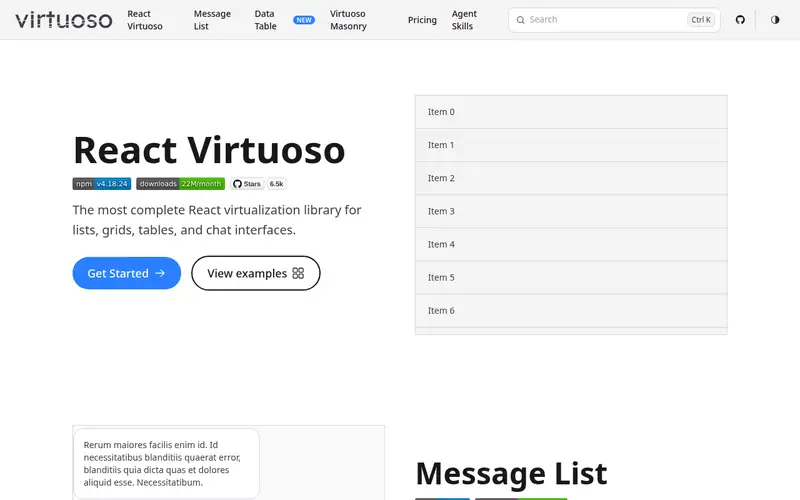
react-virtuoso is a React component library built around automatic size measurement. You render a list, table or grid and it measures rows as they mount, so you do not have to supply heights up front. That matters for feeds with mixed content such as text, images and embedded cards.
It also covers cases that simpler libraries leave to you: grouped lists with sticky headers, reverse scrolling for chat, follow-output mode for logs, and a table component. The package is MIT licensed. The main cost is API surface: there are many props, and the docs are the place to start rather than guesswork.
It is React only. Vue and Svelte teams should use vue-virtual-scroller, virtua or TanStack Virtual. If your list has a fixed row height and simple content, react-window is lighter. Choose react-virtuoso when measurement and edge cases are the hard part.
Standout: Measures unknown row heights automatically
Free (open source), as listed by the vendor (react-virtuoso website). Confirm the current plan price before you buy.
Free plan. Plans change, so confirm on the vendor's pricing page before you buy.
Benefits
- Measures unknown row heights automatically
- supports grouped lists, tables and reverse chat feeds
Drawbacks
- React only
- the component API has many props to learn
Skip it if this limit matters to you: react only.
Verdict. A sensible pick for react apps with variable heights, grouping and chat-style feeds.
Alternatives in this guide: TanStack Virtual, react-window, react-virtualized
react-virtualized
Best for maintaining older React codebases that already depend on it
What it is and where it fits
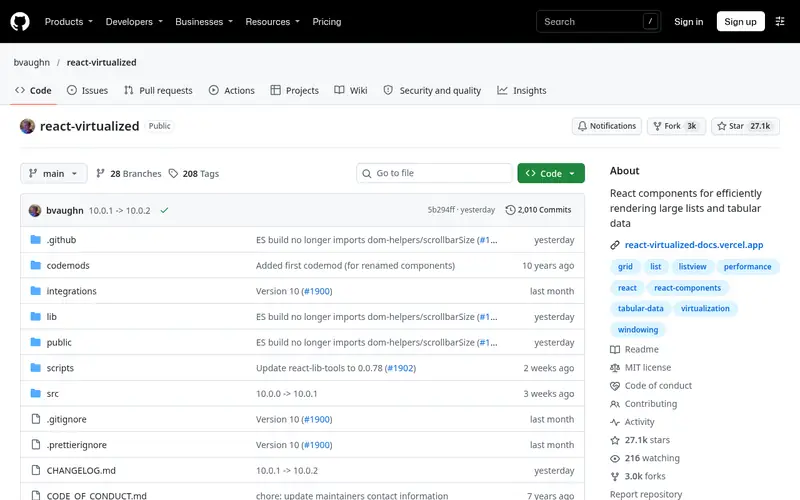
react-virtualized is the older, larger library from the same author as react-window. It ships a wide set of components: List, Table, Grid, Collection, Masonry and more. For years it was the default choice for large React lists and data tables, and a lot of production code still imports it.
The project is now in maintenance mode. The repository states that new work goes into react-window and react-virtuoso, and that react-virtualized is kept for existing users. It still receives fixes, but you should not start a new project on it in 2026. Bundle size and API complexity are higher than the newer options.
Keep it if your codebase already depends on its table or masonry components and a migration is not worth the cost. For new work, pick react-window for simple lists or react-virtuoso for measured rows. The licence is MIT either way.
Standout: Broad component set including lists, tables, grids and masonry
Free (open source), as listed by the vendor (react-virtualized website). Confirm the current plan price before you buy.
Free plan. Plans change, so confirm on the vendor's pricing page before you buy.
Benefits
- Broad component set including lists, tables, grids and masonry
- MIT licence
Drawbacks
- In maintenance mode with no new features
- heavier bundle than react-window
Skip it if this limit matters to you: in maintenance mode with no new features.
Verdict. A sensible pick for maintaining older React codebases that already depend on it.
Alternatives in this guide: TanStack Virtual, react-window, react-virtuoso
vue-virtual-scroller
Best for vue 2 and Vue 3 apps that need ready-made scroller components
What it is and where it fits
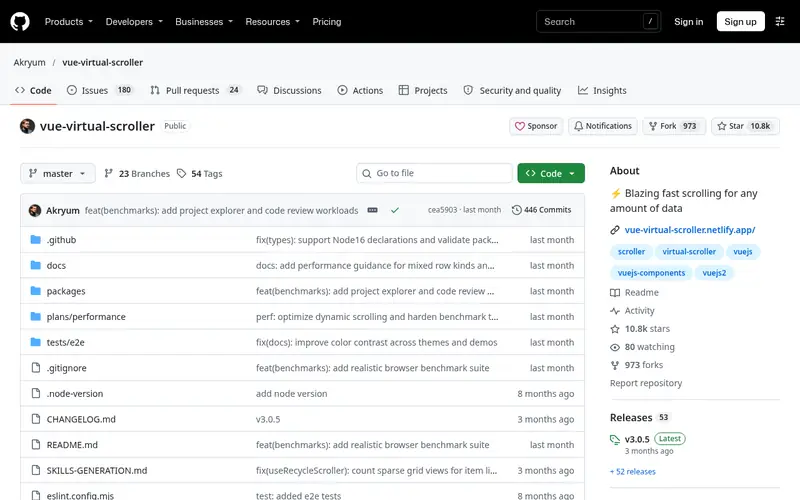
vue-virtual-scroller provides Vue components for virtual lists and grids. The main pieces are RecycleScroller for fixed-size items and DynamicScroller for variable heights, plus a DynamicScrollerItem wrapper. You register the component and pass your items, and it handles the visible window.
It supports Vue 2 and Vue 3, but the two are published on different branches and package versions, so check which one your project needs before installing. Dynamic height mode costs more per row than the fixed-size mode because it measures items. The licence is MIT.
This is the practical choice for Vue teams that want components rather than a headless core. If you prefer to own the markup, TanStack Virtual has a Vue adapter. If you are on Vue and need chat-style reverse scrolling, check the docs for the current options before committing.
Standout: Drop-in components for lists, grids and dynamic heights
Free (open source), as listed by the vendor (vue-virtual-scroller website). Confirm the current plan price before you buy.
Free plan. Plans change, so confirm on the vendor's pricing page before you buy.
Benefits
- Drop-in components for lists, grids and dynamic heights
- supports Vue 2 and Vue 3
Drawbacks
- Vue only
- the Vue 3 build lives on a separate branch and package line
Skip it if this limit matters to you: vue only.
Verdict. A sensible pick for vue 2 and Vue 3 apps that need ready-made scroller components.
Alternatives in this guide: TanStack Virtual, react-window, react-virtuoso
virtua
Best for react, Vue and Svelte apps that want a small headless-style API
What it is and where it fits
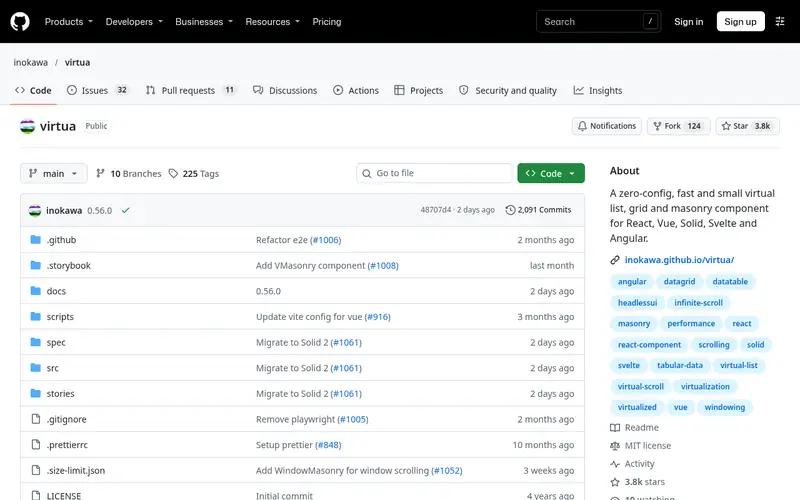
virtua is a virtual scrolling library with bindings for React, Vue, Svelte and Solid. It exposes components such as VList, VGrid and Virtualizer, and it measures variable-size items so you do not have to supply heights. It also supports horizontal lists and window-based scrolling.
The API is closer to a component library than a fully headless core, but it stays small. Because the same concepts carry across frameworks, it is a reasonable pick for a team that maintains apps in more than one framework. The licence is MIT.
The trade-off is ecosystem size. There are fewer tutorials and third-party examples than for react-window or react-virtuoso, so unusual cases may need reading the source. For standard long lists, grids and variable heights it covers the job. Check the repository for the current framework support matrix before you commit.
Standout: One API across React, Vue, Svelte and Solid
Free (open source), as listed by the vendor (virtua website). Confirm the current plan price before you buy.
Free plan. Plans change, so confirm on the vendor's pricing page before you buy.
Benefits
- One API across React, Vue, Svelte and Solid
- handles variable sizes and grid layouts
Drawbacks
- Smaller community than react-window
- fewer worked examples for edge cases
Skip it if this limit matters to you: smaller community than react-window.
Verdict. A sensible pick for react, Vue and Svelte apps that want a small headless-style API.
Alternatives in this guide: TanStack Virtual, react-window, react-virtuoso
Who should use what
A React team with fixed-height rows and a small bundle budget should start with react-window. A React team rendering feeds with images, unknown heights or grouped headers should use react-virtuoso. A team that mixes React, Vue or Svelte, or wants full control of markup, should use TanStack Virtual. A Vue team that wants ready-made components should use vue-virtual-scroller. Anyone maintaining an older React codebase on react-virtualized should plan a migration rather than add new features on it.
Questions to settle before you buy
What to check before you buy
- Confirm the library supports your framework version, including Vue 2 versus Vue 3 and React 18 or 19.
- Check whether row heights are fixed or measured, since measurement adds per-row work.
- Verify the licence file in the repository, not just the README.
- Test keyboard navigation, screen reader output and focus handling in a virtualized list.
- Confirm the project has commits and releases in the last year before you depend on it.
FAQ
Do virtual scrolling libraries reduce data fetching?
No. They reduce the number of DOM nodes rendered. You still need pagination or incremental loading on the server or API to avoid fetching a large dataset at once.
Which library works outside React?
TanStack Virtual and virtua both support multiple frameworks, and vue-virtual-scroller covers Vue. react-window, react-virtuoso and react-virtualized are React only.
Is react-virtualized still a good choice for new projects?
No. The repository describes it as in maintenance mode, with new work going into react-window and react-virtuoso. Use it only to support existing code.
Do these libraries send list data to a server?
No. They run in the browser and render local data. The privacy risk is in your own API calls, not in the virtualizer. Do not paste production data into unrelated online demos.
Can virtual scrolling break accessibility?
It can if focus or screen reader position is lost when rows unmount. Test with a keyboard and a screen reader, and keep row counts and labels stable.
Sources we checked
Method: how we score · editorial policy.
Change log. First published 27 Nov 2026.