Stage 01 · Write · Researched comparison
Best JavaScript Utility Libraries in 2026
Lodash is the first pick for most teams that want a broad, well-known set of array, object and string helpers, and it suits projects of any size. Ramda fits teams that prefer immutable, curried functions and point-free pipelines. es-toolkit is the better choice when you want small, tree-shakeable imports and a modern TypeScript-first design.

By Shihab Mia
Published 27 Nov 2026 · 5 tools compared
We run no ads and no affiliate links at launch. The order of a list follows our published method. See how we score.
Prices are the starting prices vendors list publicly. Plans change, so confirm the current price on the vendor page before you buy.
Key takeaways
- Lodash, Ramda, Underscore, RxJS and es-toolkit are all free and open source.
- Lodash ships a large all-in-one bundle, while es-toolkit favors small per-function imports.
- RxJS composes asynchronous event streams with observables and operators.
- es-toolkit offers Lodash-style helpers with a smaller bundle and TypeScript-first design.
Who each pick is for
- Teams that want a broad, familiar helper setLodash
- Functional programmers who want curried, immutable helpersRamda
- Legacy projects already built on UnderscoreUnderscore
- Handling async event streams with observable patternsRxJS
- Modern projects that want small, tree-shakeable helperses-toolkit
Comparison
| Tool | Best for | Standout feature | Listed starting price | Free plan or trial |
|---|---|---|---|---|
| 1Lodash | Teams that want a broad, familiar helper set | Very wide helper coverage | Free (open source) | Free plan |
| 2Ramda | Functional programmers who want curried, immutable helpers | Curried functions by default | Free (open source) | Free plan |
| 3Underscore | Legacy projects already built on Underscore | Small and stable API | Free (open source) | Free plan |
| 4RxJS | Handling async event streams with observable patterns | Rich set of stream operators | Free (open source) | Free plan |
| 5es-toolkit | Modern projects that want small, tree-shakeable helpers | Small bundle with per-function imports | Free (open source) | Free plan |
How we picked
We compared libraries on fit for common JavaScript jobs, platform support in browsers and Node.js, licence and price, TypeScript support, bundle size and documented limits. Sources are vendor pages, official documentation and project repositories. All listed projects are free and open source. Prices and plans can change, so confirm details on each vendor site before you commit.
The tools, one by one
Lodash
Best for teams that want a broad, familiar helper set
What it is and where it fits
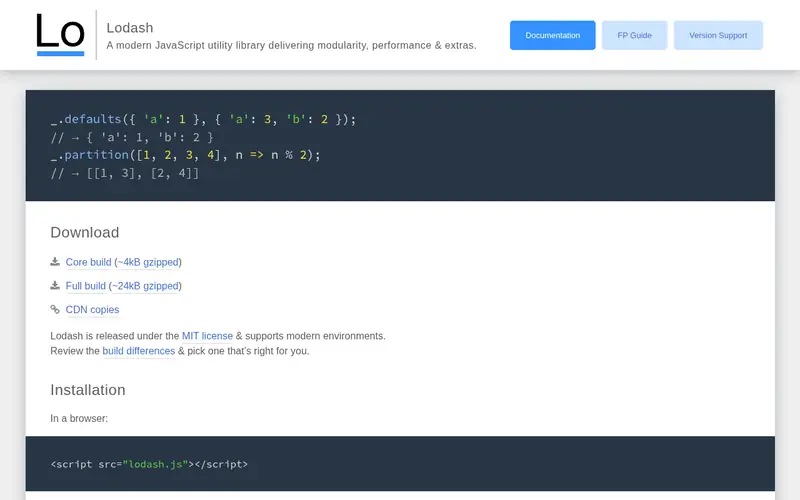
Lodash provides array, object, string, number and function utilities such as `get`, `merge`, `debounce`, `cloneDeep` and `groupBy`. It runs in browsers and Node.js and has TypeScript type definitions through the separate `@types/lodash` package. The project is maintained on GitHub under the MIT licence.
The main limit is size. Importing the full build adds weight, so many teams import single functions from `lodash/` paths or use `babel-plugin-lodash` to trim the bundle. Some helpers now overlap with native methods like `Array.prototype.flat` and `Object.entries`. Skip Lodash if you want a minimal dependency and only need a few helpers you can write yourself.
Standout: Very wide helper coverage
Free (open source), as listed by the vendor (Lodash website). Confirm the current plan price before you buy.
Free plan. Plans change, so confirm on the vendor's pricing page before you buy.
Benefits
- Very wide helper coverage
- Familiar API across many codebases
Drawbacks
- Large full bundle
- Many helpers are now built into modern JavaScript
Skip it if this limit matters to you: large full bundle.
Verdict. A sensible pick for teams that want a broad, familiar helper set.
Alternatives in this guide: Ramda, Underscore, RxJS
Ramda
Best for functional programmers who want curried, immutable helpers
What it is and where it fits
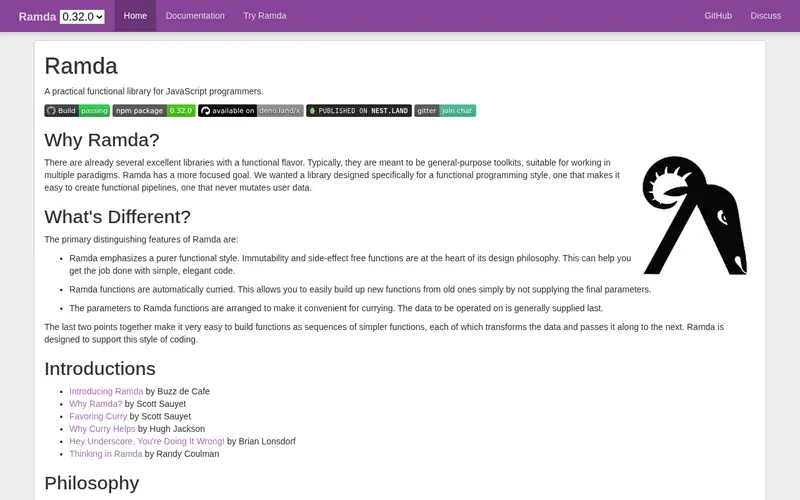
Ramda is a functional utility library built around immutability and composition. Every function is curried, so partial application and pipelines with `pipe` and `compose` work without extra wrappers. It runs in browsers and Node.js and is published under the MIT licence.
Ramda suits codebases that already lean on functional patterns. The API differs from Lodash in argument order, which trips up developers moving between the two. Documentation is solid but the community is smaller, so fewer third-party answers exist. Skip it if your team is not comfortable with currying and point-free style.
Standout: Curried functions by default
Free (open source), as listed by the vendor (Ramda website). Confirm the current plan price before you buy.
Free plan. Plans change, so confirm on the vendor's pricing page before you buy.
Benefits
- Curried functions by default
- Data-first and data-last variants
Drawbacks
- Steeper learning curve
- Smaller community than Lodash
Skip it if this limit matters to you: steeper learning curve.
Verdict. A sensible pick for functional programmers who want curried, immutable helpers.
Alternatives in this guide: Lodash, Underscore, RxJS
Underscore
Best for legacy projects already built on Underscore
What it is and where it fits
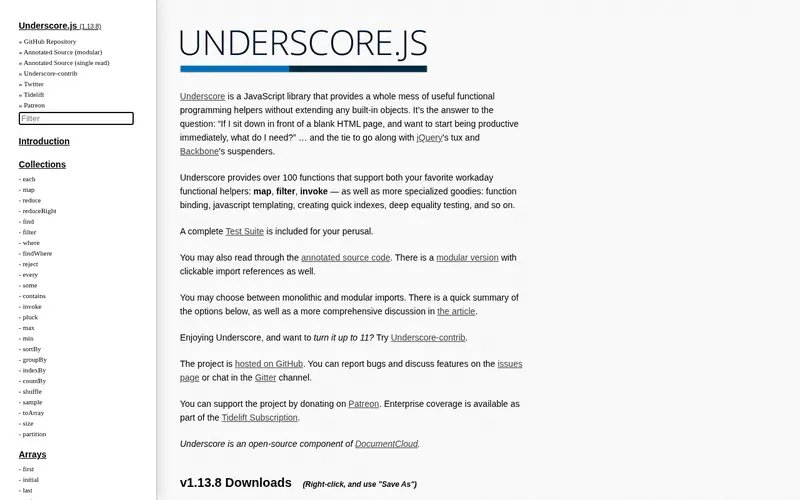
Underscore is one of the older JavaScript utility libraries, offering helpers for collections, arrays, functions and objects. It runs in browsers and Node.js and is published under the MIT licence. Lodash began as a fork of Underscore and now covers more ground.
Underscore remains a reasonable choice for existing codebases that already depend on it. For new projects, Lodash or es-toolkit usually offer better coverage and active development. Check the repository for recent releases before adopting it for new work.
Standout: Small and stable API
Free (open source), as listed by the vendor (Underscore website). Confirm the current plan price before you buy.
Free plan. Plans change, so confirm on the vendor's pricing page before you buy.
Benefits
- Small and stable API
- Long maintenance history
Drawbacks
- Overlaps heavily with Lodash
- Fewer updates than Lodash
Skip it if this limit matters to you: overlaps heavily with Lodash.
Verdict. A sensible pick for legacy projects already built on Underscore.
RxJS
Best for handling async event streams with observable patterns
What it is and where it fits
RxJS is a reactive programming library built on observables. It provides operators like `map`, `filter`, `debounceTime` and `switchMap` for composing asynchronous event streams. It runs in browsers and Node.js and is published under the Apache-2.0 licence.
RxJS is the standard choice in Angular and works well for complex event handling, such as search inputs or websocket streams. It is not a general helper library, and its concepts take time to learn. Skip it for one-off promises or simple callbacks where native async code is clearer.
Standout: Rich set of stream operators
Free (open source), as listed by the vendor (RxJS website). Confirm the current plan price before you buy.
Free plan. Plans change, so confirm on the vendor's pricing page before you buy.
Benefits
- Rich set of stream operators
- Strong fit for Angular projects
Drawbacks
- Steep learning curve
- Overkill for simple async tasks
Skip it if this limit matters to you: steep learning curve.
Verdict. A sensible pick for handling async event streams with observable patterns.
Alternatives in this guide: Lodash, Ramda, Underscore
es-toolkit
Best for modern projects that want small, tree-shakeable helpers
What it is and where it fits
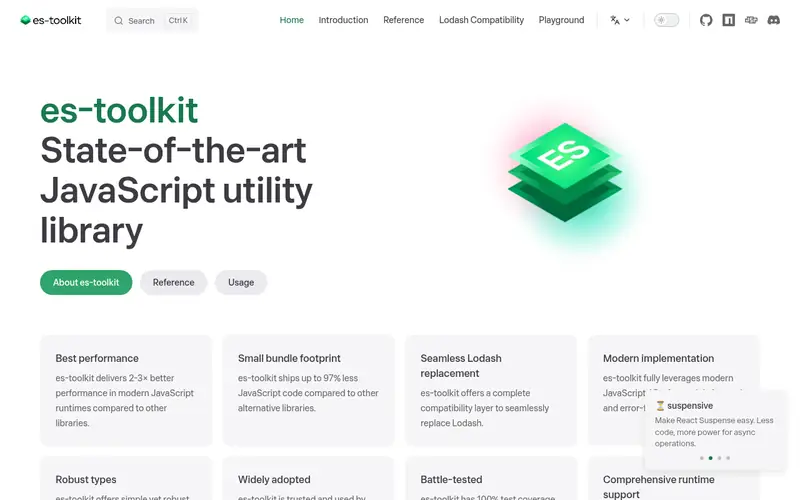
es-toolkit is a modern utility library that offers Lodash-style helpers with a focus on small bundles and TypeScript. It provides functions for arrays, objects, math, promises and strings, and each function can be imported separately. It runs in browsers and Node.js and is published under the MIT licence.
The library targets code that wants Lodash-like helpers without the full bundle weight. Its ecosystem is smaller, so fewer plugins and community answers exist. It is a reasonable pick for new projects that can adopt a newer dependency. Check the repository for current coverage before replacing Lodash wholesale.
Standout: Small bundle with per-function imports
Free (open source), as listed by the vendor (es-toolkit website). Confirm the current plan price before you buy.
Free plan. Plans change, so confirm on the vendor's pricing page before you buy.
Benefits
- Small bundle with per-function imports
- TypeScript-first design
Drawbacks
- Smaller ecosystem than Lodash
- Fewer legacy integrations
Skip it if this limit matters to you: smaller ecosystem than Lodash.
Verdict. A sensible pick for modern projects that want small, tree-shakeable helpers.
Alternatives in this guide: Lodash, Ramda, Underscore
Who should use what
Teams starting a general-purpose project should pick Lodash for coverage or es-toolkit for a smaller bundle. Functional programmers who want curried, immutable helpers should use Ramda. Angular or event-heavy apps should consider RxJS. Legacy codebases already on Underscore can stay there while planning a migration.
Questions to settle before you buy
What to check before you buy
- Check bundle size after tree-shaking for the functions you actually import.
- Confirm TypeScript types are maintained for your framework version.
- Review the licence and the repository's recent release activity.
- Test whether native methods already cover the helpers you need.
- Check how the library handles immutability and mutation.
FAQ
Are these JavaScript utility libraries free?
Yes. Lodash, Ramda, Underscore, RxJS and es-toolkit are all open source and free to use. Licences vary: most use MIT, while RxJS uses Apache-2.0. Check each repository for the exact licence terms before shipping.
Can I use more than one utility library in a project?
Yes, and many projects do. A common mix is Lodash or es-toolkit for general helpers alongside RxJS for event streams. Watch total bundle size and avoid overlapping libraries that duplicate the same helpers.
Is Lodash still worth using in 2026?
Lodash remains widely used and covers many helpers that native JavaScript lacks. Some functions now overlap with built-in methods. Import single functions or use a bundler plugin to keep the bundle small, and consider es-toolkit if you want a lighter modern alternative.
Do these libraries work in Node.js and the browser?
Most do. Lodash, Ramda, Underscore, RxJS and es-toolkit run in both browsers and Node.js. Check each project's documentation for any environment-specific notes.
What is the difference between a utility library and a reactive library?
A utility library provides general helpers for arrays, objects, strings and functions. A reactive library like RxJS composes asynchronous event streams with observables and operators. They solve different problems, and many projects use both.
Sources we checked
Method: how we score · editorial policy.
Change log. First published 27 Nov 2026.