Stage 01 · Write · Researched comparison
Best JavaScript i18n Libraries in 2026
i18next is the first pick for most teams because it works across frameworks and has a large plugin ecosystem. react-i18next suits React apps that want hooks and a mature API. FormatJS (react-intl) is a strong alternative when you need strict ICU MessageFormat support and locale data from the browser. Teams on Next.js should also look at next-intl, which is built around the App Router.

By Shihab Mia
Published 27 Nov 2026 · 7 tools compared
We run no ads and no affiliate links at launch. The order of a list follows our published method. See how we score.
Prices are the starting prices vendors list publicly. Plans change, so confirm the current price on the vendor page before you buy.
Key takeaways
- i18next, FormatJS, LinguiJS, vue-i18n, next-intl and Paraglide JS are all free and open source.
- i18next works with React, Vue, Angular, Svelte and plain JavaScript through framework bindings.
- FormatJS follows ICU MessageFormat syntax and relies on the native Intl API for formatting.
- Libraries handle message lookup and formatting only; translation management is a separate service.
Who each pick is for
- Cross-framework apps that need one translation layeri18next
- React apps that want hooks and a mature APIreact-i18next
- Teams standardized on ICU MessageFormatFormatJS (react-intl)
- Teams that want extracted messages and compile-time checksLinguiJS
- Vue 3 apps that want an official-style i18n layervue-i18n
- Next.js App Router projects with locale routingnext-intl
- Projects that want compiled, type-safe messagesParaglide JS
Comparison
| Tool | Best for | Standout feature | Listed starting price | Free plan or trial |
|---|---|---|---|---|
| 1i18next | Cross-framework apps that need one translation layer | Works with many frameworks through bindings | Free (open source) | Free plan |
| 2react-i18next | React apps that want hooks and a mature API | useTranslation hook and HOC support | Free (open source) | Free plan |
| 3FormatJS (react-intl) | Teams standardized on ICU MessageFormat | Full ICU MessageFormat support | Free (open source) | Free plan |
| 4LinguiJS | Teams that want extracted messages and compile-time checks | Message extraction from source code | Free (open source) | Free plan |
| 5vue-i18n | Vue 3 apps that want an official-style i18n layer | Deep integration with Vue reactivity and templates | Free (open source) | Free plan |
| 6next-intl | Next.js App Router projects with locale routing | Built for the App Router and server components | Free (open source) | Free plan |
| 7Paraglide JS | Projects that want compiled, type-safe messages | Compiles messages into tree-shakable functions | Free (open source) | Free plan |
How we picked
We picked libraries that handle message lookup, plural rules, interpolation and locale formatting for JavaScript apps. Criteria were fit for common frameworks, supported platforms, licence and price, and the main limits such as message syntax and build steps. Sources are vendor documentation, project repositories and public pricing pages. All listed projects are free and open source. Prices and features change, so confirm details on the vendor site.
The tools, one by one
i18next
Best for cross-framework apps that need one translation layer
What it is and where it fits
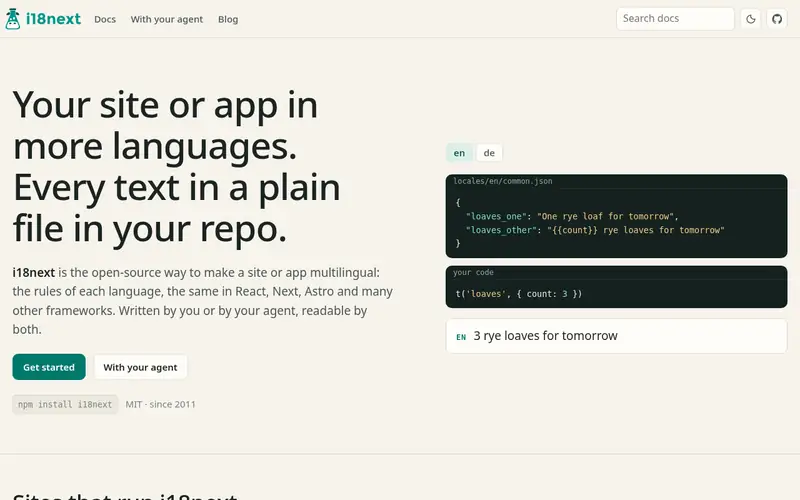
i18next is a framework-agnostic internationalization library. It loads translation resources from JSON or other backends, handles interpolation, context, plurals and namespaces, and ships bindings for React, Vue, Angular, Svelte and others. The core package is small, and features like language detection, caching and backend loading are separate plugins.
It runs in browsers, Node.js and React Native. The project is MIT licensed. Plural rules come from its own format rather than ICU MessageFormat, so teams that already use ICU strings need to convert them. The number of configuration options is large, and a new project can spend time choosing plugins and loaders.
Skip i18next if your team has standardized on ICU MessageFormat everywhere, or if you want a single package with no plugin decisions. It fits projects that expect to change frameworks or share translation code across web and mobile.
Standout: Works with many frameworks through bindings
Free (open source), as listed by the vendor (i18next website). Confirm the current plan price before you buy.
Free plan. Plans change, so confirm on the vendor's pricing page before you buy.
Benefits
- Works with many frameworks through bindings
- large plugin and backend ecosystem
Drawbacks
- Configuration has many options
- plural handling differs from plain ICU
Skip it if this limit matters to you: configuration has many options.
Verdict. A sensible pick for cross-framework apps that need one translation layer.
Alternatives in this guide: react-i18next, FormatJS (react-intl), LinguiJS
react-i18next
Best for react apps that want hooks and a mature API
What it is and where it fits
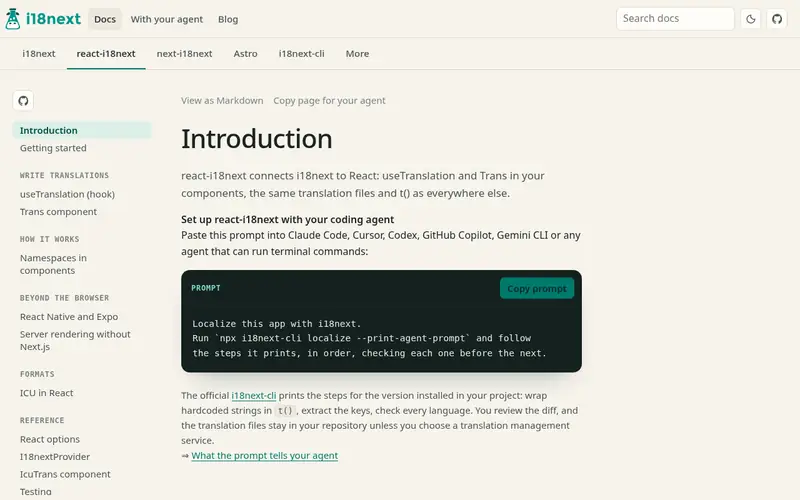
react-i18next is the official React binding for i18next. It provides the useTranslation hook, a Trans component for embedded markup, and higher-order components for class components. It uses the i18next core for loading, plurals and interpolation, so behavior matches other i18next bindings.
It runs wherever React runs, including React Native with additional setup. The package is MIT licensed. Because it sits on top of i18next, you configure both the core and the binding, and Suspense-based loading needs correct fallback handling to avoid flicker.
Choose it when your app is React-only and you want hooks plus the i18next ecosystem. If you prefer ICU MessageFormat syntax, FormatJS is a closer fit. If you use Next.js App Router, check next-intl before adding a client-side loader.
Standout: useTranslation hook and HOC support
Free (open source), as listed by the vendor (react-i18next website). Confirm the current plan price before you buy.
Free plan. Plans change, so confirm on the vendor's pricing page before you buy.
Benefits
- useTranslation hook and HOC support
- shares resources with the i18next core
Drawbacks
- Adds a dependency layer over i18next
- Suspense setup needs care
Skip it if this limit matters to you: adds a dependency layer over i18next.
Verdict. A sensible pick for react apps that want hooks and a mature API.
Alternatives in this guide: i18next, FormatJS (react-intl), LinguiJS
FormatJS (react-intl)
Best for teams standardized on ICU MessageFormat
What it is and where it fits
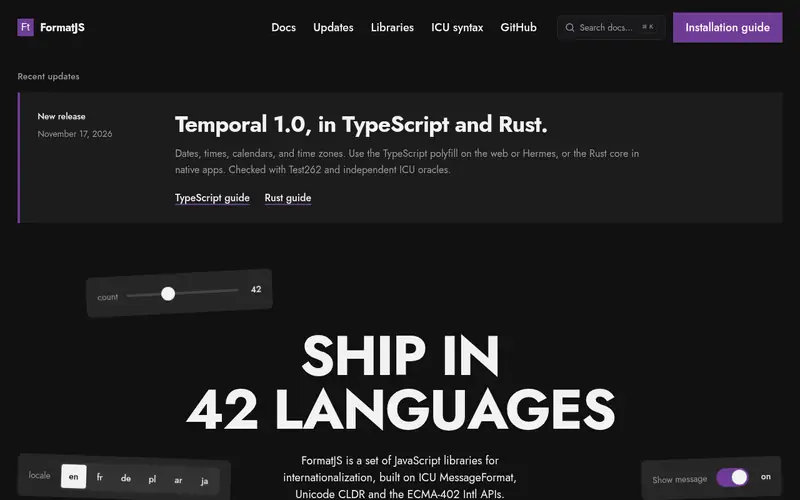
FormatJS is a set of packages for internationalization, with react-intl as the React binding. Messages use ICU MessageFormat syntax, which covers plurals, select, selectordinal and rich text. Number, date and relative time formatting use the browser's native Intl API, so locale data comes from the runtime.
It runs in browsers and Node.js, and the packages are MIT licensed. The ICU syntax is precise but wordy, and translators need tooling that understands it. Non-React bindings exist but get less attention than react-intl, so Vue or Svelte teams may prefer another library.
Pick FormatJS when ICU MessageFormat is a requirement or when you want formatting to follow the platform Intl implementation. Skip it if your translators work in plain key-value JSON and the ICU syntax would slow them down.
Standout: Full ICU MessageFormat support
Free (open source), as listed by the vendor (FormatJS (react-intl) website). Confirm the current plan price before you buy.
Free plan. Plans change, so confirm on the vendor's pricing page before you buy.
Benefits
- Full ICU MessageFormat support
- built on the native Intl API
Drawbacks
- Message syntax is verbose
- React binding is the best-supported path
Skip it if this limit matters to you: message syntax is verbose.
Verdict. A sensible pick for teams standardized on ICU MessageFormat.
Alternatives in this guide: i18next, react-i18next, LinguiJS
LinguiJS
Best for teams that want extracted messages and compile-time checks
What it is and where it fits
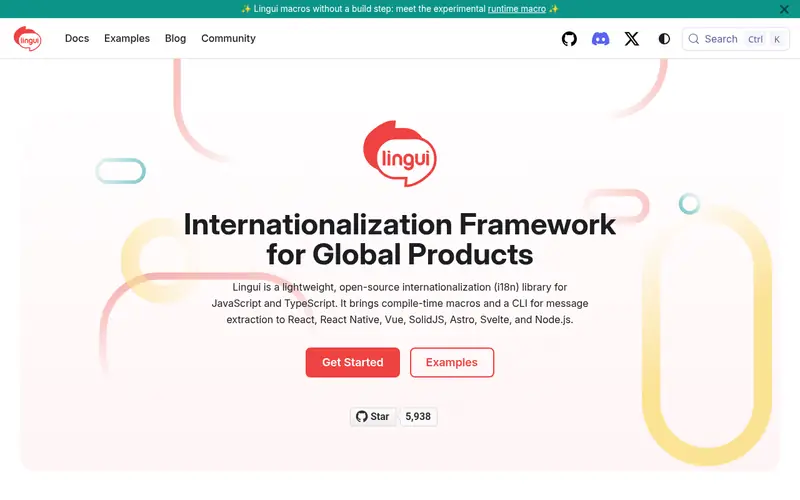
LinguiJS is an internationalization framework with a CLI that extracts messages from source code into catalogs. Messages use ICU MessageFormat syntax, and a compile step validates and compiles catalogs before runtime. It provides bindings for React and support for plain JavaScript.
It runs in browsers and Node.js and is MIT licensed. The extraction and compile steps fit well into CI, catching missing or broken messages before release. The tradeoff is build configuration: you add CLI commands and a compile step, which is more setup than a runtime-only library.
Choose LinguiJS when you want message catalogs generated from code and checked at build time. Skip it for small projects where a runtime loader and hand-edited JSON are enough.
Standout: Message extraction from source code
Free (open source), as listed by the vendor (LinguiJS website). Confirm the current plan price before you buy.
Free plan. Plans change, so confirm on the vendor's pricing page before you buy.
Benefits
- Message extraction from source code
- compile-time validation of messages
Drawbacks
- Build-step setup adds complexity
- smaller ecosystem than i18next
Skip it if this limit matters to you: build-step setup adds complexity.
Verdict. A sensible pick for teams that want extracted messages and compile-time checks.
Alternatives in this guide: i18next, react-i18next, FormatJS (react-intl)
vue-i18n
Best for vue 3 apps that want an official-style i18n layer
What it is and where it fits
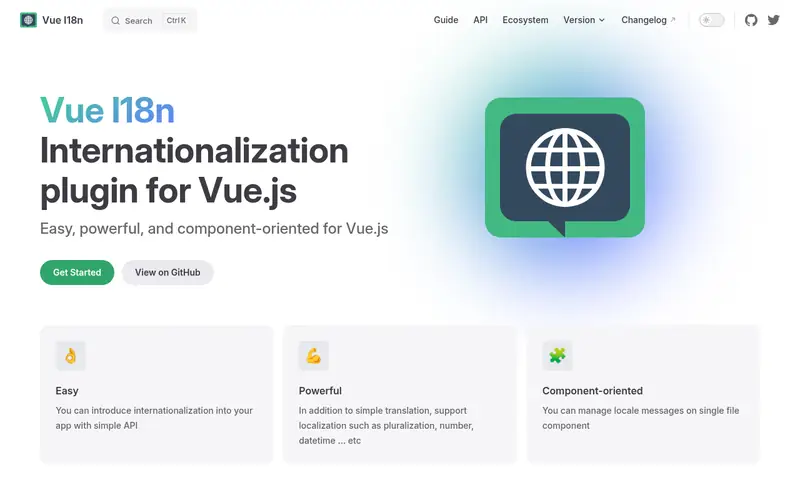
vue-i18n is the internationalization library maintained for Vue. It provides a $t function in templates, a Composition API useI18n hook, pluralization, interpolation, datetime and number formatting, and lazy loading of locale messages. It tracks the active locale reactively, so components update when the language changes.
It runs in Vue 3 apps in the browser and in server-side rendering setups. The project is MIT licensed. Message syntax is vue-i18n's own linked-message format rather than ICU, so strings are not portable to FormatJS without conversion.
Pick it for Vue projects. If you need the same translation files across a Vue frontend and a React or server codebase, a framework-agnostic library like i18next may be simpler.
Standout: Deep integration with Vue reactivity and templates
Free (open source), as listed by the vendor (vue-i18n website). Confirm the current plan price before you buy.
Free plan. Plans change, so confirm on the vendor's pricing page before you buy.
Benefits
- Deep integration with Vue reactivity and templates
- supports Composition and Options API
Drawbacks
- Vue-specific, so it does not port to other frameworks
- message syntax is its own format
Skip it if this limit matters to you: vue-specific, so it does not port to other frameworks.
Verdict. A sensible pick for vue 3 apps that want an official-style i18n layer.
Alternatives in this guide: i18next, react-i18next, FormatJS (react-intl)
next-intl
Best for next.js App Router projects with locale routing
What it is and where it fits
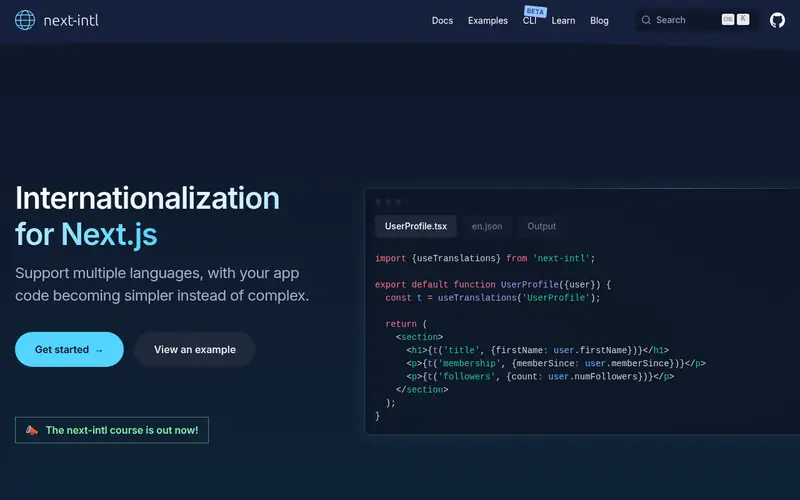
next-intl is an internationalization library for Next.js. It supports the App Router, server components and client components, and provides middleware for locale-based routing. Messages use ICU syntax, and the library handles formatting for dates, numbers and relative time.
It runs only in Next.js projects and is MIT licensed. Because it is tied to one framework, it is not a fit for mixed stacks. Setup involves routing configuration and message loading per request, which is more work than a client-only library but fits server rendering.
Choose next-intl when your app is on the Next.js App Router and you want locale routing and server rendering handled together. For Pages Router projects or non-Next stacks, use i18next or FormatJS instead.
Standout: Built for the App Router and server components
Free (open source), as listed by the vendor (next-intl website). Confirm the current plan price before you buy.
Free plan. Plans change, so confirm on the vendor's pricing page before you buy.
Benefits
- Built for the App Router and server components
- handles locale-based routing
Drawbacks
- Tied to Next.js
- ICU messages need care with rich text
Skip it if this limit matters to you: tied to Next.js.
Verdict. A sensible pick for next.js App Router projects with locale routing.
Alternatives in this guide: i18next, react-i18next, FormatJS (react-intl)
Paraglide JS
Best for projects that want compiled, type-safe messages
What it is and where it fits
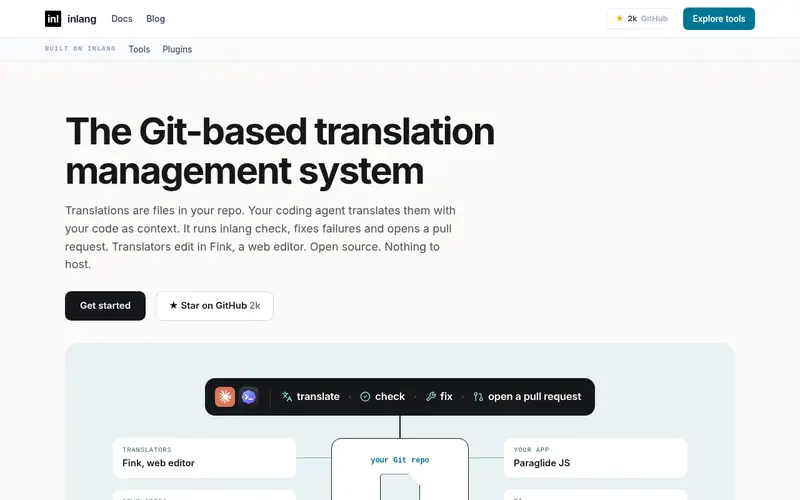
Paraglide JS is an i18n library from the inlang project. It compiles translation files into JavaScript functions at build time, so message keys are type-checked and unused messages are dropped from the bundle. It works with several frameworks, including SvelteKit, Next.js and plain JavaScript.
It runs in browsers and Node.js and is MIT licensed. The compile step means translations are validated during the build rather than at runtime. The tradeoff is dependence on the inlang toolchain and a younger ecosystem than i18next or FormatJS.
Pick Paraglide JS when bundle size and type safety matter and you are willing to add a build step. Skip it if you need a runtime loader that fetches translations after deploy without rebuilding.
Standout: Compiles messages into tree-shakable functions
Free (open source), as listed by the vendor (Paraglide JS website). Confirm the current plan price before you buy.
Free plan. Plans change, so confirm on the vendor's pricing page before you buy.
Benefits
- Compiles messages into tree-shakable functions
- type-safe message keys
Drawbacks
- Requires a build step and the inlang toolchain
- newer than established options
Skip it if this limit matters to you: requires a build step and the inlang toolchain.
Verdict. A sensible pick for projects that want compiled, type-safe messages.
Alternatives in this guide: i18next, react-i18next, FormatJS (react-intl)
Who should use what
A React team with a long-lived app and many contributors should start with react-i18next for hooks and the i18next ecosystem. A team that already writes ICU MessageFormat strings, or needs formatting to follow the browser Intl API, should use FormatJS. A Vue 3 project should use vue-i18n for reactive templates and Composition API support. A Next.js App Router project should use next-intl so locale routing and server rendering are handled together. Teams that want compile-time message checks can add LinguiJS or Paraglide JS.
Questions to settle before you buy
What to check before you buy
- Confirm the library supports your framework version and rendering mode, including server rendering.
- Check the message syntax: ICU MessageFormat, a custom format, or compiled functions.
- Verify plural and gender handling for the languages you ship, not just English.
- Review how translations load: bundled at build time, fetched at runtime, or compiled.
- Check the licence and whether the project is actively maintained.
FAQ
Are these JavaScript i18n libraries free?
Yes. i18next, react-i18next, FormatJS, LinguiJS, vue-i18n, next-intl and Paraglide JS are all open source under the MIT licence. You pay nothing for the libraries. Costs come from translation services, translators or hosting, which are separate from the library.
Do i18n libraries translate my text for me?
No. These libraries look up messages, apply plural rules and format dates and numbers. You supply the translated strings, either by writing them or by using a translation service. The library decides which string to show for the active locale.
Can I use one library across React and Vue?
i18next is the most practical choice for mixed stacks because it has bindings for several frameworks and shares translation resources. Framework-specific libraries like react-i18next and vue-i18n only work in their own framework. FormatJS has non-React bindings but they get less support.
What is the difference between ICU MessageFormat and i18next plurals?
ICU MessageFormat uses a single string syntax with plural, select and selectordinal blocks. i18next uses its own plural suffixes and context keys in JSON. ICU strings are more portable across tools, while i18next JSON is simpler for translators who work in key-value files.
Do these libraries send my data anywhere?
The libraries run in your app and do not send translation data to a third party by themselves. If you use a runtime backend plugin or a translation management service, data leaves your app according to that service's terms. Check the backend configuration before shipping.
Sources we checked
Method: how we score · editorial policy.
Change log. First published 27 Nov 2026.