Stage 01 · Write · Researched comparison
Best Java YAML Libraries in 2026
SnakeYAML is the first pick for most JVM projects that need a general-purpose YAML parser and emitter, and it suits teams that want a small, direct API. Jackson dataformat-yaml is the better fit when you already use Jackson and want data binding to POJOs. eo-yaml is a reasonable alternative if you prefer an immutable, object-oriented API over SnakeYAML's node model.

By Shihab Mia
Published 27 Nov 2026 · 5 tools compared
We run no ads and no affiliate links at launch. The order of a list follows our published method. See how we score.
Prices are the starting prices vendors list publicly. Plans change, so confirm the current price on the vendor page before you buy.
Key takeaways
- SnakeYAML and SnakeYAML Engine are open source and remain the common low-level YAML parsers for Java.
- Jackson dataformat-yaml adds YAML support to the Jackson databind stack, so it fits projects already using Jackson for JSON.
- eo-yaml offers an immutable object model and targets Java 8 and later.
- YamlBeans is older and less actively maintained, so check its repository status before adopting it for new work.
Who each pick is for
- General YAML parsing and emitting on the JVMSnakeYAML
- YAML 1.2 parsing with a modern APISnakeYAML Engine
- YAML data binding inside an existing Jackson stackJackson dataformat-yaml
- Immutable, object-oriented YAML handling in Javaeo-yaml
- Legacy projects already using its bean bindingYamlBeans
Comparison
| Tool | Best for | Standout feature | Listed starting price | Free plan or trial |
|---|---|---|---|---|
| 1SnakeYAML | General YAML parsing and emitting on the JVM | Widely used and stable | Free (open source) | Free plan |
| 2SnakeYAML Engine | YAML 1.2 parsing with a modern API | Targets YAML 1.2 | Free (open source) | Free plan |
| 3Jackson dataformat-yaml | YAML data binding inside an existing Jackson stack | Reuses Jackson annotations and ObjectMapper patterns | Free (open source) | Free plan |
| 4eo-yaml | Immutable, object-oriented YAML handling in Java | Immutable object model | Free (open source) | Free plan |
| 5YamlBeans | Legacy projects already using its bean binding | Simple bean binding API | Free (open source) | Free plan |
How we picked
We selected libraries that are real, currently published JVM projects with a public repository or documentation page. Criteria were fit for parsing, emitting and binding YAML in Java, licence and dependency footprint, API style, and the main limits documented by each project. Sources are vendor and project pages, repository READMEs and public documentation. Prices and licences can change, so confirm the current terms on each project page before you commit. We did not run benchmarks or hands-on tests for this guide.
The tools, one by one
SnakeYAML
Best for general YAML parsing and emitting on the JVM
What it is and where it fits
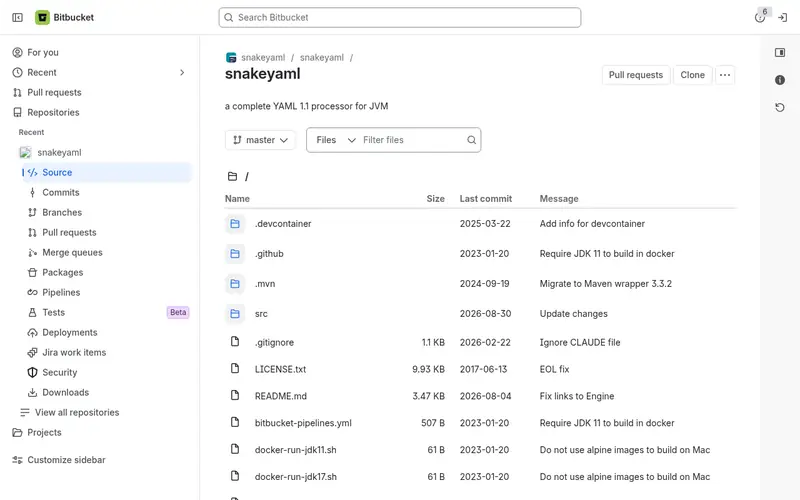
SnakeYAML is a YAML 1.1 parser and emitter for Java. It reads YAML into maps, lists and scalars, and it can also instantiate JavaBeans through its constructor and property utilities. It runs on the standard JVM with no extra runtime dependencies.
The library is distributed under the Apache License 2.0. It is the parser behind several other tools, including some Spring Boot configuration paths, so its behavior is familiar to many Java developers. The main limit is that its object instantiation can create arbitrary types if you feed it untrusted YAML, so restrict the types you allow.
Choose SnakeYAML when you want a small, direct parser with a long track record. Skip it if you need a full data-binding framework with annotations and module support; Jackson covers that.
Standout: Widely used and stable
Free (open source), as listed by the vendor (SnakeYAML website). Confirm the current plan price before you buy.
Free plan. Plans change, so confirm on the vendor's pricing page before you buy.
Benefits
- Widely used and stable
- supports parsing to Java objects and dumping back to YAML
Drawbacks
- Constructor-based instantiation needs care for untrusted input
- API is lower level than full binding frameworks
Skip it if this limit matters to you: constructor-based instantiation needs care for untrusted input.
Verdict. A sensible pick for general YAML parsing and emitting on the JVM.
Alternatives in this guide: SnakeYAML Engine, Jackson dataformat-yaml, eo-yaml
SnakeYAML Engine
Best for yAML 1.2 parsing with a modern API
What it is and where it fits
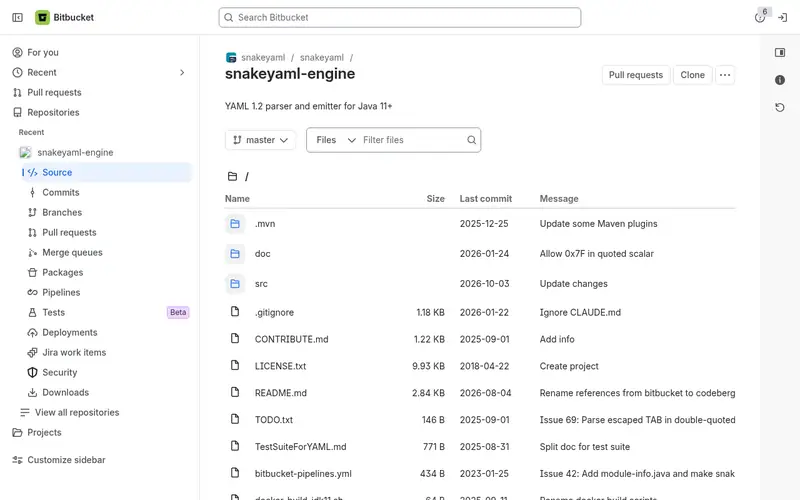
SnakeYAML Engine is a YAML 1.2 processor for Java 8 and later. It parses YAML into a node graph and can emit YAML from that graph. The API is designed around the YAML 1.2 specification, which differs from the 1.1 behavior of the original SnakeYAML in areas such as booleans and timestamps.
It is Apache 2.0 licensed and has no runtime dependencies. The project is maintained separately from SnakeYAML, so version numbers and release cadence differ. It does not include the JavaBean construction helpers of the original library, which keeps it focused on parsing and emitting.
Pick SnakeYAML Engine when YAML 1.2 conformance matters, such as when you exchange documents with tools that follow that spec. If you depend on libraries that expect the original SnakeYAML API, stay with SnakeYAML.
Standout: Targets YAML 1.2
Free (open source), as listed by the vendor (SnakeYAML Engine website). Confirm the current plan price before you buy.
Free plan. Plans change, so confirm on the vendor's pricing page before you buy.
Benefits
- Targets YAML 1.2
- cleaner API than the original SnakeYAML
Drawbacks
- Fewer integrations than SnakeYAML
- separate project to track
Skip it if this limit matters to you: fewer integrations than SnakeYAML.
Verdict. A sensible pick for YAML 1.2 parsing with a modern API.
Alternatives in this guide: SnakeYAML, Jackson dataformat-yaml, eo-yaml
Jackson dataformat-yaml
Best for yAML data binding inside an existing Jackson stack
What it is and where it fits
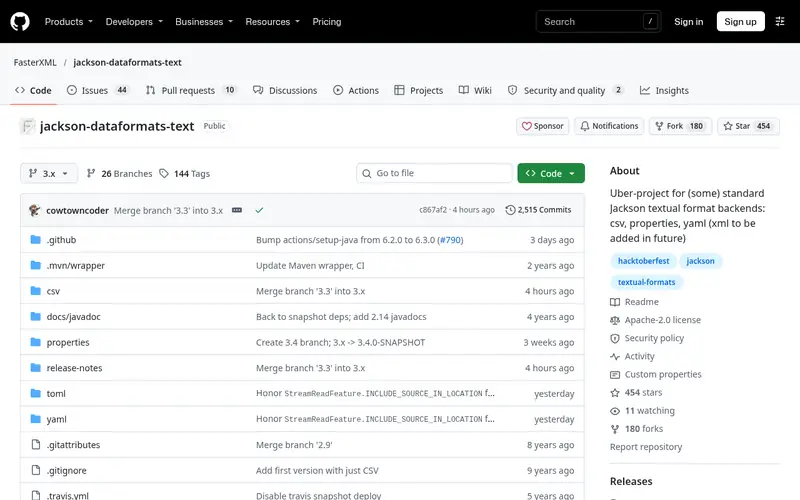
Jackson dataformat-yaml is the YAML backend for Jackson. It lets an ObjectMapper read and write YAML, so the same annotations, modules and configuration you use for JSON apply to YAML. It is useful when an application already depends on Jackson and wants one binding model for both formats.
The module is Apache 2.0 licensed and published as part of the jackson-dataformats-text project. It depends on jackson-core and jackson-databind, so it is not a standalone parser. YAML-specific features such as anchors and tags are handled by the underlying parser, and some advanced YAML constructs may not map cleanly to POJOs.
Choose it when consistency with an existing Jackson setup matters more than a minimal dependency footprint. Skip it for a tiny utility that only needs to read a few YAML keys; SnakeYAML is lighter there.
Standout: Reuses Jackson annotations and ObjectMapper patterns
Free (open source), as listed by the vendor (Jackson dataformat-yaml website). Confirm the current plan price before you buy.
Free plan. Plans change, so confirm on the vendor's pricing page before you buy.
Benefits
- Reuses Jackson annotations and ObjectMapper patterns
- handles POJO binding
Drawbacks
- Pulls in Jackson core and databind
- YAML support is one module of a larger project
Skip it if this limit matters to you: pulls in Jackson core and databind.
Verdict. A sensible pick for YAML data binding inside an existing Jackson stack.
Alternatives in this guide: SnakeYAML, SnakeYAML Engine, eo-yaml
eo-yaml
Best for immutable, object-oriented YAML handling in Java
What it is and where it fits
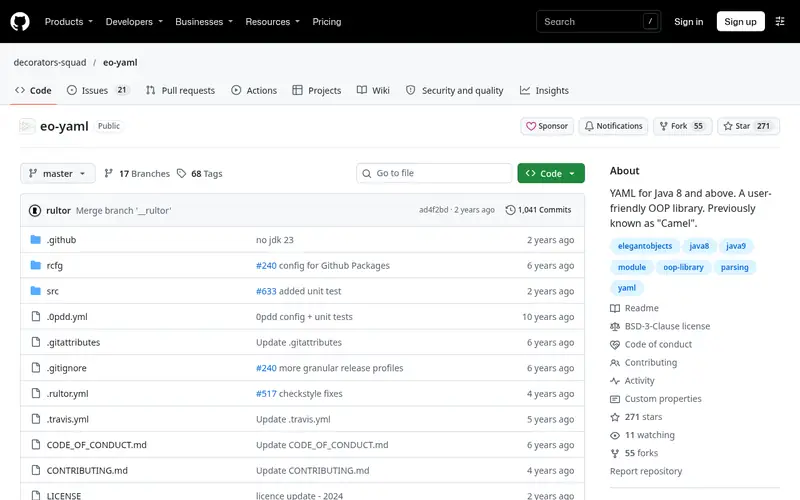
eo-yaml is a YAML library with an object-oriented, immutable API. You work with YamlMapping, YamlSequence and scalar objects rather than raw maps. It supports reading and writing YAML and is designed to make document construction explicit.
The project is MIT licensed and targets Java 8 and later. Its API style appeals to teams that prefer immutable values and fluent construction over mutable maps. The trade-off is a smaller ecosystem and fewer integrations than SnakeYAML or Jackson, so check that its feature set covers the YAML constructs you need.
Use eo-yaml when you want a typed, immutable representation and do not need the widest possible compatibility. For maximum interoperability with other JVM tools, SnakeYAML remains the safer default.
Standout: Immutable object model
Free (open source), as listed by the vendor (eo-yaml website). Confirm the current plan price before you buy.
Free plan. Plans change, so confirm on the vendor's pricing page before you buy.
Benefits
- Immutable object model
- readable API for building and reading YAML
Drawbacks
- Smaller community than SnakeYAML
- not a drop-in replacement for other parsers
Skip it if this limit matters to you: smaller community than SnakeYAML.
Verdict. A sensible pick for immutable, object-oriented YAML handling in Java.
Alternatives in this guide: SnakeYAML, SnakeYAML Engine, Jackson dataformat-yaml
YamlBeans
Best for legacy projects already using its bean binding
What it is and where it fits
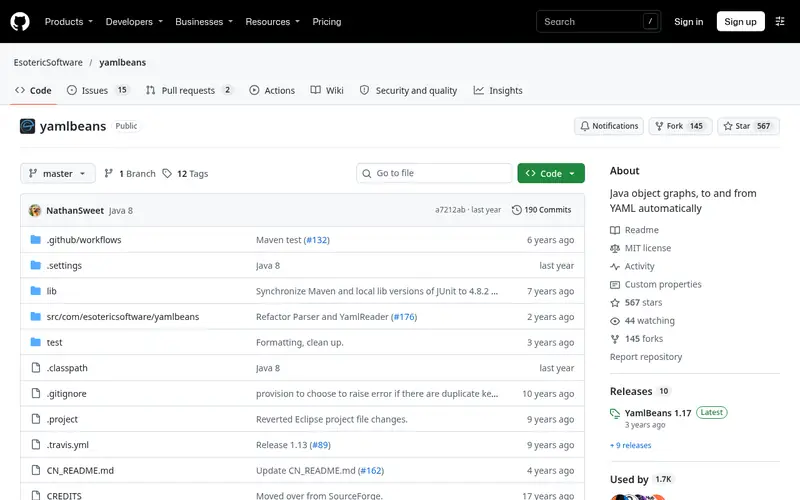
YamlBeans reads and writes YAML and maps it to JavaBeans. It was designed as a small library for bean serialization, and its API is straightforward for simple configuration files.
The project is BSD licensed. Its release activity is lower than SnakeYAML and Jackson, so verify the current state of the repository before starting new work with it. It does not aim for full YAML 1.2 coverage, and complex documents may need another parser.
Consider YamlBeans only for existing codebases that already depend on it. For new projects, SnakeYAML or Jackson dataformat-yaml offer more active maintenance and broader adoption.
Standout: Simple bean binding API
Free (open source), as listed by the vendor (YamlBeans website). Confirm the current plan price before you buy.
Free plan. Plans change, so confirm on the vendor's pricing page before you buy.
Benefits
- Simple bean binding API
- small codebase
Drawbacks
- Less active maintenance
- fewer YAML 1.2 features
Skip it if this limit matters to you: less active maintenance.
Verdict. A sensible pick for legacy projects already using its bean binding.
Alternatives in this guide: SnakeYAML, SnakeYAML Engine, Jackson dataformat-yaml
Who should use what
If you need a general parser for configuration or data files, start with SnakeYAML. If you need YAML 1.2 behavior, use SnakeYAML Engine. If your application already uses Jackson and you want one binding model for JSON and YAML, choose Jackson dataformat-yaml. If you prefer an immutable object API, try eo-yaml. Spring Boot teams get YAML configuration through the framework and only need a separate library for arbitrary documents. Legacy projects on YamlBeans should plan a migration rather than adopt it for new code.
Questions to settle before you buy
What to check before you buy
- Confirm the library supports the YAML version your documents use, especially YAML 1.2 boolean and timestamp rules.
- Check how the library handles untrusted input, including type instantiation and alias expansion limits.
- Review the dependency footprint; Jackson-based options pull in core and databind.
- Verify the licence matches your distribution requirements.
- Check the repository's recent release activity before adopting it for new work.
FAQ
Which Java YAML library should I start with?
SnakeYAML is the common starting point for general parsing and emitting. It is open source, widely used and has a small API. If you already use Jackson, Jackson dataformat-yaml lets you reuse the same ObjectMapper and annotations for YAML.
Is SnakeYAML Engine a replacement for SnakeYAML?
They are separate projects. SnakeYAML Engine targets YAML 1.2 and has a different API. SnakeYAML targets YAML 1.1 and includes JavaBean construction helpers. Choose based on the YAML version and API style you need, and check which one your dependencies expect.
Can I use Jackson to read YAML into POJOs?
Yes. Jackson dataformat-yaml provides a YAMLFactory and works with ObjectMapper, so Jackson annotations and modules apply. It depends on jackson-core and jackson-databind, so it is not a standalone parser.
Is eo-yaml a drop-in replacement for SnakeYAML?
No. eo-yaml has its own immutable object model and API. It is MIT licensed and targets Java 8 and later, but it is not API-compatible with SnakeYAML. Porting code requires changes.
Should I use YamlBeans for a new project?
YamlBeans is older and less actively maintained than SnakeYAML and Jackson. For new work, prefer a library with current releases and broader adoption. Keep YamlBeans only where existing code already depends on it.
Sources we checked
Method: how we score · editorial policy.
Change log. First published 27 Nov 2026.