Stage 01 · Write · Researched comparison
Best Java Template Engines in 2026
Thymeleaf is the first pick for most server-rendered Spring applications because it renders natural HTML templates and integrates with Spring MVC. FreeMarker suits teams that want a mature, general-purpose engine with strong macro support. Pebble is a good alternative when you want a Twig-like syntax with strict separation between logic and markup. All three are open source.

By Shihab Mia
Published 27 Nov 2026 · 8 tools compared
We run no ads and no affiliate links at launch. The order of a list follows our published method. See how we score.
Prices are the starting prices vendors list publicly. Plans change, so confirm the current price on the vendor page before you buy.
Key takeaways
- Thymeleaf, FreeMarker, Velocity, Pebble, JTE, Mustache.java, Handlebars.java and JStachio are all free and open source.
- Thymeleaf and FreeMarker are the most common choices for server-side HTML in Spring projects.
- JTE and JStachio compile templates to Java code, which changes how you build and deploy.
- None of these engines need a third-party web page, so templates and data stay on your own machine.
Who each pick is for
- Spring MVC server-rendered HTML pagesThymeleaf
- General-purpose templating with macros and includesApache FreeMarker
- Simple text and email templating in legacy stacksApache Velocity
- Twig-like syntax with strict template separationPebble
- Compiled, type-safe templates in Java projectsJTE
- Logic-less templates shared across languagesMustache.java
- Handlebars syntax in Java server applicationsHandlebars.java
- Type-safe Mustache templates checked at compile timeJStachio
Comparison
| Tool | Best for | Standout feature | Listed starting price | Free plan or trial |
|---|---|---|---|---|
| 1Thymeleaf | Spring MVC server-rendered HTML pages | Natural HTML templates that open in a browser | Free (open source) | Free plan |
| 2Apache FreeMarker | General-purpose templating with macros and includes | Mature and widely used | Free (open source) | Free plan |
| 3Apache Velocity | Simple text and email templating in legacy stacks | Simple syntax | Free (open source) | Free plan |
| 4Pebble | Twig-like syntax with strict template separation | Clean syntax similar to Twig | Free (open source) | Free plan |
| 5JTE | Compiled, type-safe templates in Java projects | Templates compile to Java classes | Free (open source) | Free plan |
| 6Mustache.java | Logic-less templates shared across languages | Logic-less syntax | Free (open source) | Free plan |
| 7Handlebars.java | Handlebars syntax in Java server applications | Familiar Handlebars syntax | Free (open source) | Free plan |
| 8JStachio | Type-safe Mustache templates checked at compile time | Compile-time type checking | Free (open source) | Free plan |
How we picked
We compared engines on fit for server-side Java templating, supported platforms, licence and price, and main limits such as syntax complexity, compile steps and community size. We also considered whether templates stay local rather than passing through a third-party web page. Sources are vendor pages, project documentation and public repositories. Prices and licences can change, so confirm details on the official site before you commit.
The tools, one by one
Thymeleaf
Best for spring MVC server-rendered HTML pages
What it is and where it fits
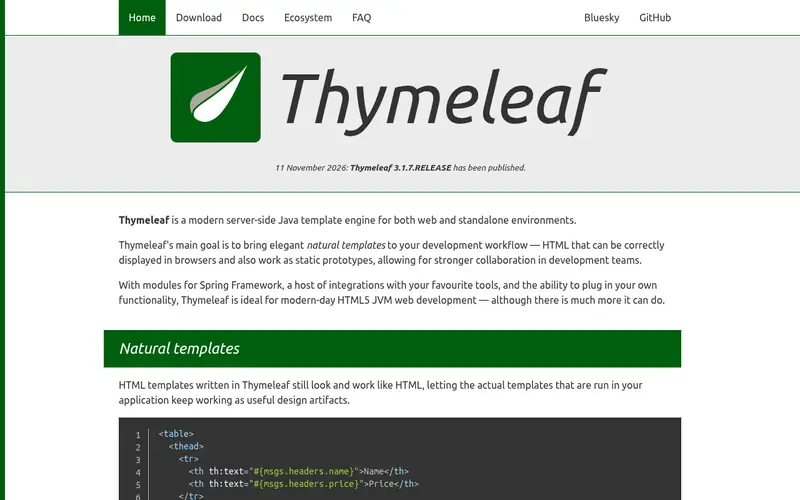
Thymeleaf is a server-side template engine for Java. It works with plain HTML files, so a template can be previewed in a browser without a running server. It integrates with Spring MVC and Spring Boot through a dedicated starter, and it is the default view technology in many Spring projects.
The engine runs on the JVM and is distributed under the Apache License 2.0. It supports expression languages for variables, messages, links and fragments. Template caching is configurable, and in development you can disable it to see changes without a restart.
Thymeleaf is a good fit for teams already on Spring that want readable markup and a large community. Skip it if you need maximum render throughput or a minimal template syntax.
Standout: Natural HTML templates that open in a browser
Free (open source), as listed by the vendor (Thymeleaf website). Confirm the current plan price before you buy.
Free plan. Plans change, so confirm on the vendor's pricing page before you buy.
Benefits
- Natural HTML templates that open in a browser
- deep Spring integration
Drawbacks
- Slower than compiled engines
- attribute-heavy syntax
Skip it if this limit matters to you: slower than compiled engines.
Verdict. A sensible pick for spring MVC server-rendered HTML pages.
Alternatives in this guide: Apache FreeMarker, Apache Velocity, Pebble
Apache FreeMarker
Best for general-purpose templating with macros and includes
What it is and where it fits
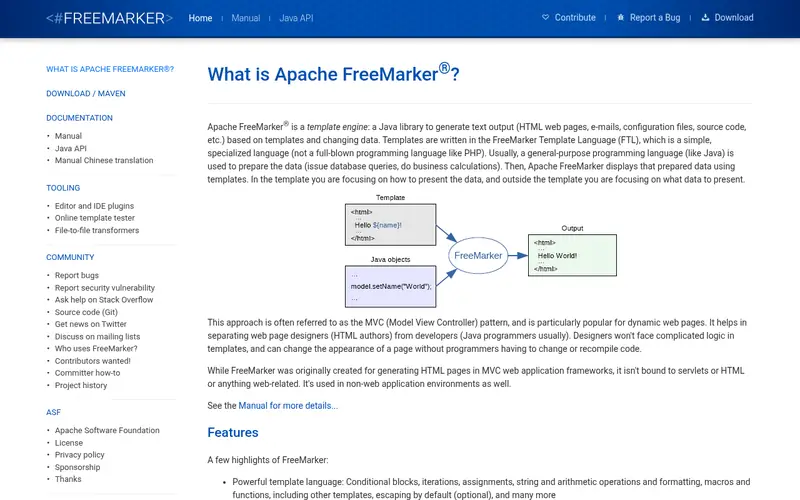
Apache FreeMarker is a general-purpose template engine for Java. It is used for HTML pages, emails, configuration files and code generation. The template language has directives for loops, conditionals, macros and includes, and it separates the data model from the template.
FreeMarker runs on the JVM and is licensed under the Apache License 2.0. It integrates with Spring MVC and can be used standalone. The project has a long release history and extensive documentation.
Choose FreeMarker when you want one engine for many output types and a mature macro system. It is less natural for HTML designers than Thymeleaf, and its error output can take time to read.
Standout: Mature and widely used
Free (open source), as listed by the vendor (Apache FreeMarker website). Confirm the current plan price before you buy.
Free plan. Plans change, so confirm on the vendor's pricing page before you buy.
Benefits
- Mature and widely used
- strong macro and include system
Drawbacks
- Syntax is not HTML-native
- error messages can be verbose
Skip it if this limit matters to you: syntax is not HTML-native.
Verdict. A sensible pick for general-purpose templating with macros and includes.
Alternatives in this guide: Thymeleaf, Apache Velocity, Pebble
Apache Velocity
Best for simple text and email templating in legacy stacks
What it is and where it fits
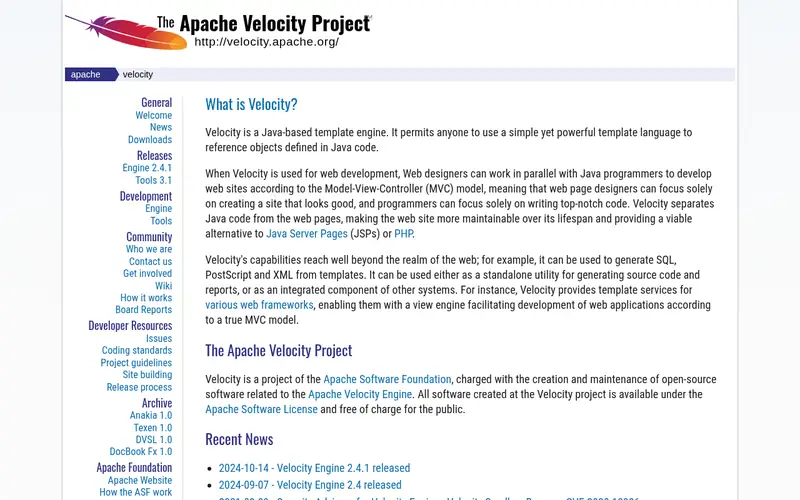
Apache Velocity is a template engine for Java that focuses on simple references and directives. It is often used for text output such as emails, reports and generated source files. The syntax uses references like $variable and directives like #if and #foreach.
Velocity runs on the JVM and is licensed under the Apache License 2.0. It has been part of many Java web stacks and is still maintained by the Apache project. Integration with Spring is possible but less common than with Thymeleaf or FreeMarker.
Velocity suits projects that already use it or need a small, plain syntax for text output. For new HTML work, other engines on this list offer better tooling and community support.
Standout: Simple syntax
Free (open source), as listed by the vendor (Apache Velocity website). Confirm the current plan price before you buy.
Free plan. Plans change, so confirm on the vendor's pricing page before you buy.
Benefits
- Simple syntax
- long track record in Java projects
Drawbacks
- Limited modern tooling
- smaller active community
Skip it if this limit matters to you: limited modern tooling.
Verdict. A sensible pick for simple text and email templating in legacy stacks.
Alternatives in this guide: Thymeleaf, Apache FreeMarker, Pebble
Pebble
Best for twig-like syntax with strict template separation
What it is and where it fits
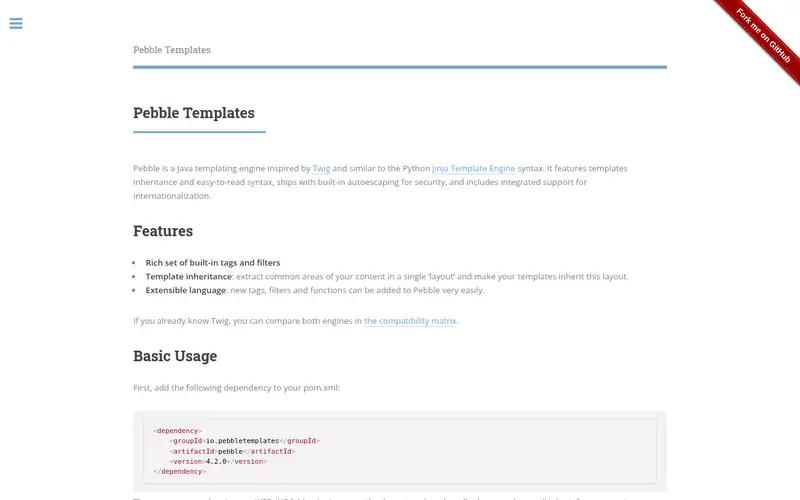
Pebble is a Java template engine with a syntax modeled on Twig. It supports template inheritance, blocks, filters and auto-escaping by default. The engine encourages keeping logic out of templates and putting it in Java code.
Pebble runs on the JVM and is distributed under a BSD-style license. It can be used with Spring MVC and standalone. Auto-escaping helps reduce cross-site scripting mistakes in HTML output.
Pebble is a good choice if your team knows Twig or wants a concise syntax with inheritance. It has a smaller ecosystem than Thymeleaf, so expect fewer ready-made examples for Spring.
Standout: Clean syntax similar to Twig
Free (open source), as listed by the vendor (Pebble website). Confirm the current plan price before you buy.
Free plan. Plans change, so confirm on the vendor's pricing page before you buy.
Benefits
- Clean syntax similar to Twig
- template inheritance and auto-escaping
Drawbacks
- Smaller ecosystem than Thymeleaf
- fewer Spring examples
Skip it if this limit matters to you: smaller ecosystem than Thymeleaf.
Verdict. A sensible pick for twig-like syntax with strict template separation.
Alternatives in this guide: Thymeleaf, Apache FreeMarker, Apache Velocity
JTE
Best for compiled, type-safe templates in Java projects
What it is and where it fits
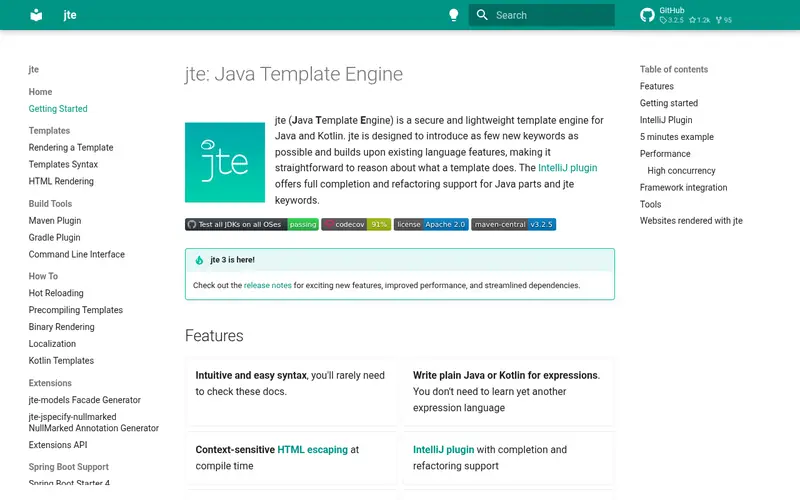
JTE is a template engine that compiles templates into Java classes at build time. This gives compile-time checking of template code and fast rendering at runtime. It integrates with Spring Boot and can be used in plain Java projects.
JTE runs on the JVM and is open source under the Apache License 2.0. Because templates become Java code, your build tool must run the template compiler. This adds a step to the build but catches errors before deployment.
JTE suits teams that want type safety and fast rendering and are comfortable adding a compile step. It has a smaller community than Thymeleaf, so fewer third-party examples are available.
Standout: Templates compile to Java classes
Free (open source), as listed by the vendor (JTE website). Confirm the current plan price before you buy.
Free plan. Plans change, so confirm on the vendor's pricing page before you buy.
Benefits
- Templates compile to Java classes
- compile-time error checking
Drawbacks
- Build step required
- smaller community
Skip it if this limit matters to you: build step required.
Verdict. A sensible pick for compiled, type-safe templates in Java projects.
Alternatives in this guide: Thymeleaf, Apache FreeMarker, Apache Velocity
Mustache.java
Best for logic-less templates shared across languages
What it is and where it fits
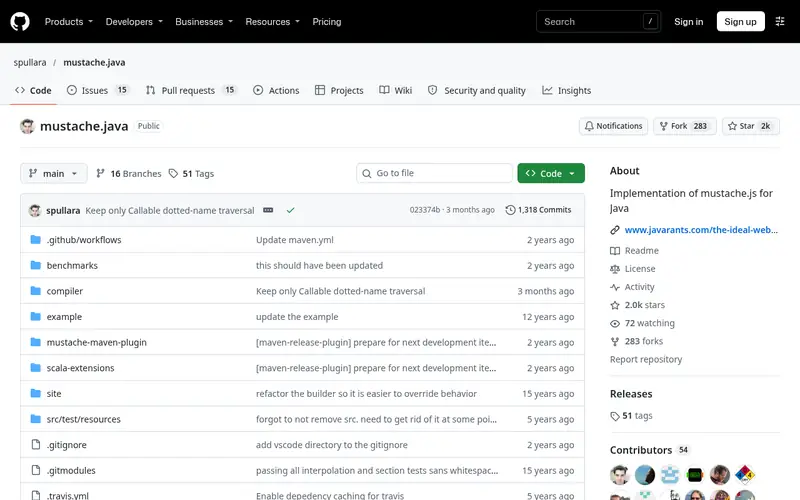
Mustache.java is a Java implementation of the Mustache template specification. Mustache is logic-less: templates contain tags for variables and sections but no arbitrary code. This keeps templates simple and portable between languages that support Mustache.
The library runs on the JVM and is open source under the Apache License 2.0. It can render HTML, text and other formats. Because it follows a shared specification, templates can often be reused with Mustache implementations in other languages.
Mustache.java fits projects that want minimal template logic and cross-language template reuse. If you need complex conditionals or heavy formatting, a fuller engine is a better match.
Standout: Logic-less syntax
Free (open source), as listed by the vendor (Mustache.java website). Confirm the current plan price before you buy.
Free plan. Plans change, so confirm on the vendor's pricing page before you buy.
Benefits
- Logic-less syntax
- templates portable across Mustache implementations
Drawbacks
- Limited logic by design
- fewer Java-specific features
Skip it if this limit matters to you: limited logic by design.
Verdict. A sensible pick for logic-less templates shared across languages.
Alternatives in this guide: Thymeleaf, Apache FreeMarker, Apache Velocity
Handlebars.java
Best for handlebars syntax in Java server applications
What it is and where it fits
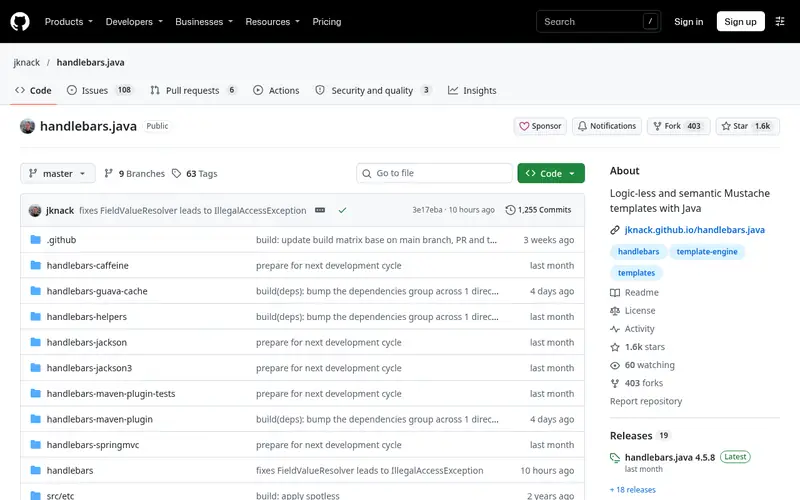
Handlebars.java is a Java implementation of the Handlebars template language. It supports helpers, partials and block expressions. Teams that already use Handlebars in JavaScript can keep a similar syntax on the server.
The library runs on the JVM and is open source under the Apache License 2.0. It can be used in web applications and for text output. Helpers let you add reusable formatting logic without putting code in templates.
Handlebars.java suits teams standardizing on Handlebars across client and server. It has a smaller Java community than Thymeleaf or FreeMarker, so check that your framework has an integration path.
Standout: Familiar Handlebars syntax
Free (open source), as listed by the vendor (Handlebars.java website). Confirm the current plan price before you buy.
Free plan. Plans change, so confirm on the vendor's pricing page before you buy.
Benefits
- Familiar Handlebars syntax
- helpers and partials
Drawbacks
- Smaller Java community
- fewer Spring integrations
Skip it if this limit matters to you: smaller Java community.
Verdict. A sensible pick for handlebars syntax in Java server applications.
Alternatives in this guide: Thymeleaf, Apache FreeMarker, Apache Velocity
JStachio
Best for type-safe Mustache templates checked at compile time
What it is and where it fits
JStachio is a Java template engine that uses Mustache syntax and generates type-safe Java code at compile time. Templates are checked against your model classes during the build, so type errors surface before runtime.
JStachio runs on the JVM and is open source under the BSD 2-Clause License. It works through an annotation processor, which means your build must run annotation processing. Rendering is fast because templates become Java code.
JStachio fits teams that like Mustache syntax but want compile-time safety and speed. It is narrower than a full web framework view layer, so check integration with your stack before adopting it.
Standout: Compile-time type checking
Free (open source), as listed by the vendor (JStachio website). Confirm the current plan price before you buy.
Free plan. Plans change, so confirm on the vendor's pricing page before you buy.
Benefits
- Compile-time type checking
- fast rendering
Drawbacks
- Annotation processor setup
- narrow scope by design
Skip it if this limit matters to you: annotation processor setup.
Verdict. A sensible pick for type-safe Mustache templates checked at compile time.
Alternatives in this guide: Thymeleaf, Apache FreeMarker, Apache Velocity
Who should use what
Spring teams building server-rendered HTML should start with Thymeleaf. Teams that need one engine for HTML, email and code generation should look at FreeMarker. Developers who want Twig-like syntax and strict separation should try Pebble. Projects that want compile-time type safety should compare JTE and JStachio, and teams standardizing on Mustache or Handlebars syntax should evaluate Mustache.java and Handlebars.java.
Questions to settle before you buy
What to check before you buy
- Confirm the engine integrates with your framework version, such as Spring Boot or plain Servlet.
- Check whether templates are interpreted at runtime or compiled during the build.
- Review auto-escaping behavior for HTML output to avoid cross-site scripting.
- Verify the licence matches your organization's policy.
- Test template caching and reload behavior in both development and production.
FAQ
Are these Java template engines free?
Yes. All eight engines listed here are open source and free to use. Each has its own licence, such as Apache License 2.0 or BSD. Check the licence terms if you redistribute code or need patent language.
Which engine is best for Spring Boot?
Thymeleaf is the most common choice for Spring Boot server-rendered pages because of its dedicated starter and natural HTML templates. FreeMarker is also well supported. Pebble and JTE can be integrated but have fewer ready-made examples.
Do template engines affect performance?
Yes. Interpreted engines render at runtime, while JTE and JStachio compile templates to Java code and can render faster. Measure with your own templates and data before choosing, since results depend on the workload.
Can I use these engines outside web applications?
Yes. FreeMarker, Velocity, Mustache.java and Handlebars.java are often used for emails, reports and code generation. Thymeleaf and Pebble can also render non-HTML text.
Is it safe to paste template data into online tools?
Avoid pasting secrets, tokens or production data into third-party web pages. These engines run locally in your Java process, so templates and data stay on your machine. Prefer local or offline tools when handling sensitive content.
Sources we checked
Method: how we score · editorial policy.
Change log. First published 27 Nov 2026.