Stage 01 · Write · Researched comparison
Best Go Web Frameworks in 2026
Gin is the first pick for most teams building JSON APIs and web services in Go, thanks to its speed, middleware ecosystem and large community. Echo suits teams that want a fuller feature set with built-in binding, validation and templating. Chi is the better fit when you want a lightweight router that stays close to the standard library.

By Shihab Mia
Published 27 Nov 2026 · 6 tools compared
We run no ads and no affiliate links at launch. The order of a list follows our published method. See how we score.
Prices are the starting prices vendors list publicly. Plans change, so confirm the current price on the vendor page before you buy.
Key takeaways
- Gin, Echo, Fiber, Chi, Beego and Gorilla Mux are all free and open source, so cost is not a deciding factor.
- Gin and Echo both ship middleware, routing and request binding; Chi focuses on routing and stays close to net/http.
- Fiber uses the fasthttp stack, so it is not a drop-in replacement for handlers written against net/http.
- All of these run on any platform that supports Go, and none require pasting code or data into a third-party web page.
Who each pick is for
- Teams building JSON APIs and microservices in GoGin
- Teams that want a fuller framework with built-in featuresEcho
- Developers who want an Express-style API on fasthttpFiber
- Teams that want a lightweight router close to net/httpChi
- Teams that want an all-in-one framework with ORM and toolingBeego
- Projects that need advanced URL routing on net/httpGorilla Mux
Comparison
| Tool | Best for | Standout feature | Listed starting price | Free plan or trial |
|---|---|---|---|---|
| 1Gin | Teams building JSON APIs and microservices in Go | Fast routing with a large middleware ecosystem | Free (open source) | Free plan |
| 2Echo | Teams that want a fuller framework with built-in features | Built-in binding, validation and templating | Free (open source) | Free plan |
| 3Fiber | Developers who want an Express-style API on fasthttp | Familiar Express-like syntax | Free (open source) | Free plan |
| 4Chi | Teams that want a lightweight router close to net/http | Idiomatic net/http handlers | Free (open source) | Free plan |
| 5Beego | Teams that want an all-in-one framework with ORM and tooling | Includes ORM, sessions, caching and a CLI tool | Free (open source) | Free plan |
| 6Gorilla Mux | Projects that need advanced URL routing on net/http | Rich route matching with variables, regex and host matching | Free (open source) | Free plan |
How we picked
We compared frameworks on fit for common Go web jobs (APIs, microservices, full web apps), platform support, licence, how closely they follow net/http, built-in features versus dependencies, and community activity. Sources are official project sites, documentation and repositories. Prices and licences can change, so confirm details on each vendor or project page before you commit.
The tools, one by one
Gin
Best for teams building JSON APIs and microservices in Go
What it is and where it fits
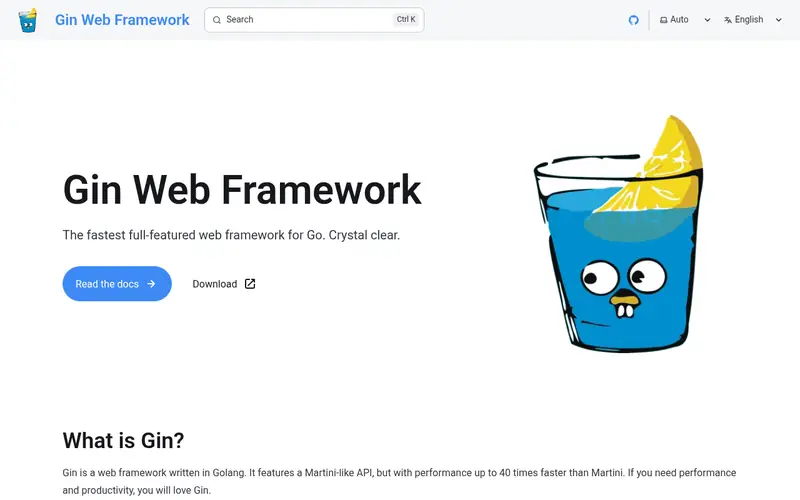
Gin is an HTTP web framework built on net/http with a Radix-tree router and a middleware chain. It handles routing, request binding, JSON rendering and grouped routes. It is the most widely used Go web framework, which means plenty of examples and third-party middleware.
Gin runs anywhere Go runs: Linux, macOS, Windows and containers. It is licensed under MIT. The project does not impose a project layout, so you choose your own structure for handlers, services and models. Teams that want built-in ORM, admin panels or scaffolding should look at Beego instead. Gin fits API services and microservices best.
Standout: Fast routing with a large middleware ecosystem
Free (open source), as listed by the vendor (Gin website). Confirm the current plan price before you buy.
Free plan. Plans change, so confirm on the vendor's pricing page before you buy.
Benefits
- Fast routing with a large middleware ecosystem
- clear documentation and wide adoption
Drawbacks
- Less built-in structure than full frameworks
- error handling is manual
Skip it if this limit matters to you: less built-in structure than full frameworks.
Verdict. A sensible pick for teams building JSON APIs and microservices in Go.
Echo
Best for teams that want a fuller framework with built-in features
What it is and where it fits
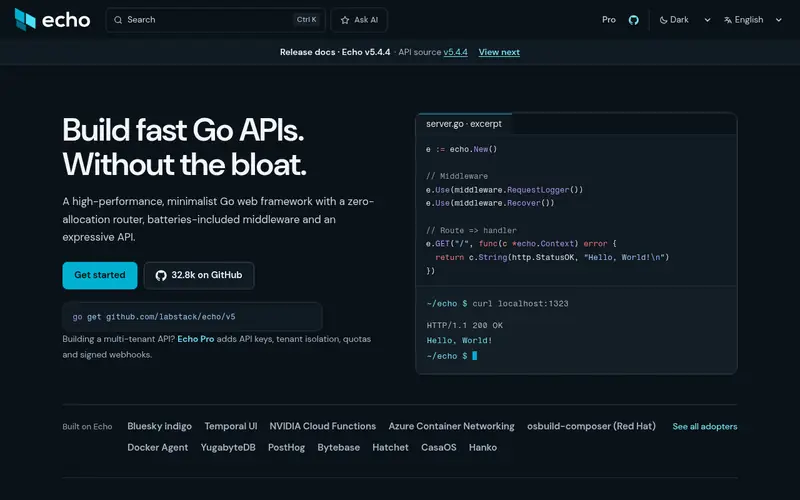
Echo is a high-performance, extensible web framework for Go. It includes routing, middleware, request binding, data rendering, static file serving and template rendering. It also ships helpers for JWT, CORS, CSRF and rate limiting as official middleware.
Echo runs on any Go-supported platform and is MIT licensed. It has a stable API and a documented upgrade path between major versions. The framework is a good fit for REST APIs and small web apps that want these features without assembling many libraries. Teams that prefer minimal dependencies may find the feature set larger than needed.
Standout: Built-in binding, validation and templating
Free (open source), as listed by the vendor (Echo website). Confirm the current plan price before you buy.
Free plan. Plans change, so confirm on the vendor's pricing page before you buy.
Benefits
- Built-in binding, validation and templating
- extensive middleware set
Drawbacks
- Larger API surface to learn
- some features overlap with the standard library
Skip it if this limit matters to you: larger API surface to learn.
Verdict. A sensible pick for teams that want a fuller framework with built-in features.
Fiber
Best for developers who want an Express-style API on fasthttp
What it is and where it fits
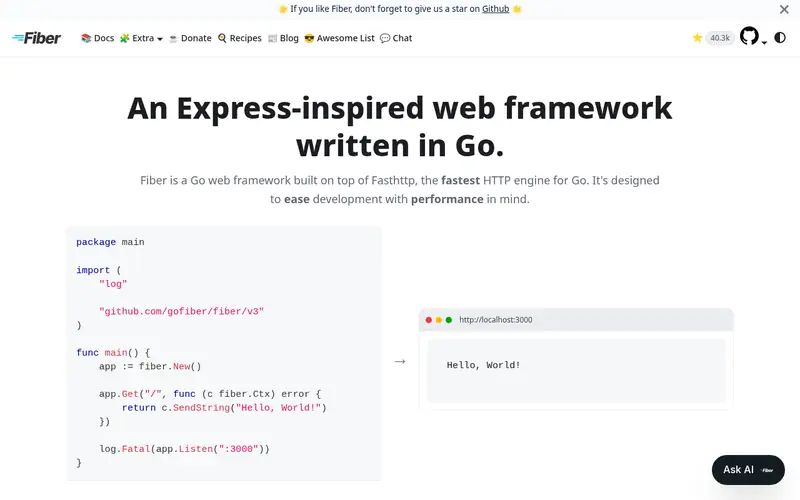
Fiber is an Express-inspired web framework built on fasthttp. It offers routing, middleware, static files, templating and WebSocket support through adapters. The API will feel familiar to developers coming from Node.js.
Fiber runs on any Go-supported platform and is MIT licensed. The main trade-off is that it does not use net/http, so standard middleware and handlers that depend on http.Handler do not plug in directly. Fiber provides adapters, but they add a layer. Choose Fiber when raw throughput and an Express-style API matter more than standard-library compatibility.
Standout: Familiar Express-like syntax
Free (open source), as listed by the vendor (Fiber website). Confirm the current plan price before you buy.
Free plan. Plans change, so confirm on the vendor's pricing page before you buy.
Benefits
- Familiar Express-like syntax
- built on fasthttp for low allocation
Drawbacks
- Not compatible with net/http handlers
- smaller ecosystem than Gin
Skip it if this limit matters to you: not compatible with net/http handlers.
Verdict. A sensible pick for developers who want an Express-style API on fasthttp.
Chi
Best for teams that want a lightweight router close to net/http
What it is and where it fits
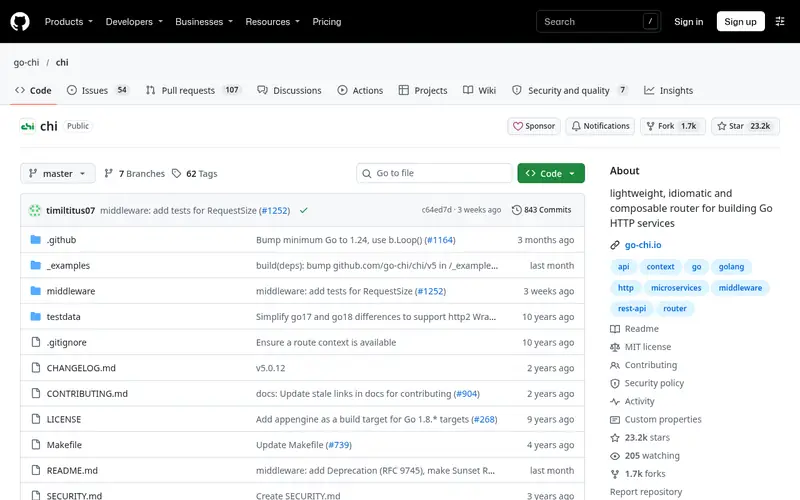
Chi is a lightweight, idiomatic router for building Go HTTP services. It is built on the standard library's net/http and uses http.Handler throughout, so existing middleware and handlers work without adapters. It supports sub-routers, route groups and a set of small middleware packages.
Chi runs on any Go-supported platform and is MIT licensed. It is a router, not a full framework: request binding, validation and rendering are left to other libraries. That keeps the dependency footprint small. Teams that want more structure out of the box should consider Echo or Gin. Chi suits services that want to stay close to the standard library.
Standout: Idiomatic net/http handlers
Free (open source), as listed by the vendor (Chi website). Confirm the current plan price before you buy.
Free plan. Plans change, so confirm on the vendor's pricing page before you buy.
Benefits
- Idiomatic net/http handlers
- small and composable middleware
Drawbacks
- No built-in binding or validation
- fewer batteries included
Skip it if this limit matters to you: no built-in binding or validation.
Verdict. A sensible pick for teams that want a lightweight router close to net/http.
Beego
Best for teams that want an all-in-one framework with ORM and tooling
What it is and where it fits
Beego is a full-stack web framework for Go. It includes an ORM, session handling, caching, logging, configuration and a command-line tool for generating projects and code. It follows an MVC-style structure with controllers and models.
Beego runs on any Go-supported platform and is licensed under Apache 2.0. The framework is opinionated, which speeds up teams that accept its conventions but can feel heavy for small APIs. It is a reasonable choice for traditional web applications and admin back ends. Teams building small microservices often prefer Gin or Chi.
Standout: Includes ORM, sessions, caching and a CLI tool
Free (open source), as listed by the vendor (Beego website). Confirm the current plan price before you buy.
Free plan. Plans change, so confirm on the vendor's pricing page before you buy.
Benefits
- Includes ORM, sessions, caching and a CLI tool
- batteries-included design
Drawbacks
- Heavier than minimal routers
- opinionated project layout
Skip it if this limit matters to you: heavier than minimal routers.
Verdict. A sensible pick for teams that want an all-in-one framework with ORM and tooling.
Gorilla Mux
Best for projects that need advanced URL routing on net/http
What it is and where it fits
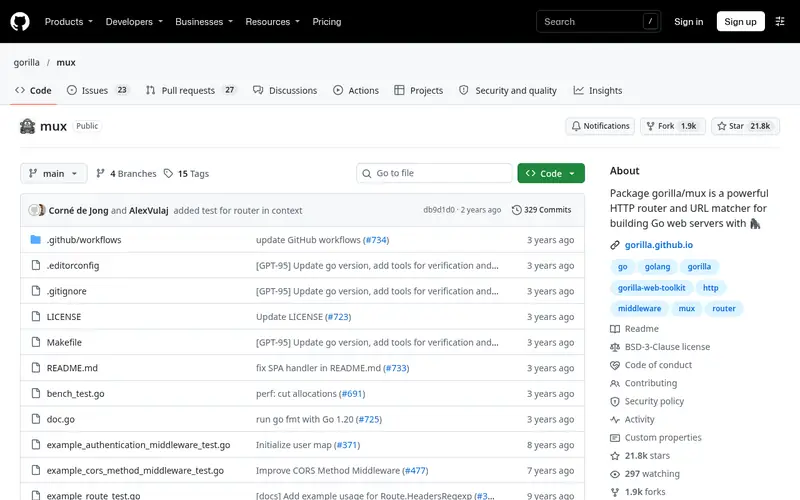
Gorilla Mux is a request router and dispatcher for Go that works with net/http. It supports named routes, route variables, regex constraints, host and method matching, and sub-routers. It has been used in many Go projects over the years.
Gorilla Mux runs on any Go-supported platform and is licensed under BSD-3-Clause. It is a router, not a framework, so binding, validation and rendering come from other packages. The project has gone through periods of reduced maintenance, so check recent commit activity before adopting it for new work. Chi is a common alternative for similar needs.
Standout: Rich route matching with variables, regex and host matching
Free (open source), as listed by the vendor (Gorilla Mux website). Confirm the current plan price before you buy.
Free plan. Plans change, so confirm on the vendor's pricing page before you buy.
Benefits
- Rich route matching with variables, regex and host matching
- works with net/http
Drawbacks
- Router only, no binding or middleware suite
- maintenance has slowed at times
Skip it if this limit matters to you: router only, no binding or middleware suite.
Verdict. A sensible pick for projects that need advanced URL routing on net/http.
Who should use what
If you are building a JSON API or microservice and want a large middleware ecosystem, start with Gin. If you want binding, validation and templating in one framework, choose Echo. If you want to stay close to net/http with a small router, use Chi. If you need an all-in-one stack with ORM and tooling, consider Beego. If you want an Express-style API and can accept fasthttp compatibility limits, try Fiber.
Questions to settle before you buy
What to check before you buy
- Confirm the framework's router works with net/http if you rely on standard middleware.
- Check that request binding, validation and rendering are included or plan the extra libraries.
- Review the licence and the recent commit activity on the repository.
- Test the upgrade path between major versions before adopting.
- Confirm the framework runs on your target platforms and deployment setup.
FAQ
Is Gin the fastest Go web framework?
Raw speed claims vary by benchmark and workload. Gin, Echo and Fiber all report high throughput. Measure with your own routes and payloads rather than relying on published numbers.
Do I need a framework, or can I use net/http?
The standard library handles routing and handlers for many services. Frameworks add middleware, binding and helpers. Small services often work fine on net/http or a lightweight router like Chi.
Is Fiber compatible with net/http middleware?
No. Fiber is built on fasthttp and does not use http.Handler. It provides adapters, but standard middleware does not plug in directly. Choose Gin, Echo or Chi if net/http compatibility matters.
Are these Go web frameworks free?
Yes. Gin, Echo, Fiber, Chi, Beego and Gorilla Mux are all open source and free to use under their respective licences. There are no paid tiers for the frameworks themselves.
Which framework is best for a full web application?
Beego includes MVC structure, templating and ORM. Echo also covers templating and binding. For APIs, Gin and Chi are more common choices.
Sources we checked
Method: how we score · editorial policy.
Change log. First published 27 Nov 2026.