Stage 01 · Write · Researched comparison
Best Go Template Engines in 2026
The Go standard library `html/template` and `text/template` packages are the default pick for most teams because they ship with Go, get security fixes, and need no extra dependency. Choose templ when you want type-safe, compiled HTML components. Choose pongo2 or Jet when you need Django- or Jinja-style syntax. The rest of this list covers faster code generation and component-style alternatives.

By Shihab Mia
Published 27 Nov 2026 · 7 tools compared
We run no ads and no affiliate links at launch. The order of a list follows our published method. See how we score.
Prices are the starting prices vendors list publicly. Plans change, so confirm the current price on the vendor page before you buy.
Key takeaways
- `html/template` and `text/template` are free, part of the Go toolchain, and cover most server-side rendering needs.
- templ, quicktemplate and gomponents generate or compile Go code, so template errors surface at build time.
- pongo2 and Jet are free open-source engines that bring Django- and Jinja-like syntax to Go.
- All seven options are free or open source, so the choice comes down to syntax, compile-time safety and output speed.
Who each pick is for
- Teams that want the default, dependency-free Go templatinghtml/template and text/template
- Go developers who want type-safe HTML componentstempl
- Teams porting Django or Jinja templates to Gopongo2
- Developers who want a fast engine with Jinja-like syntaxJet
- Projects that need fast, compiled HTML outputquicktemplate
- Go developers who prefer writing HTML as Go functionsgomponents
- Buffalo framework users and teams that want a small expression-based enginePlush
Comparison
| Tool | Best for | Standout feature | Listed starting price | Free plan or trial |
|---|---|---|---|---|
| 1html/template and text/template | Teams that want the default, dependency-free Go templating | Ships with Go and needs no dependency | Free (open source) | Free plan |
| 2templ | Go developers who want type-safe HTML components | Templates are Go functions, so the compiler catches errors | Free (open source) | Free plan |
| 3pongo2 | Teams porting Django or Jinja templates to Go | Django-like syntax with tags, filters and inheritance | Free (open source) | Free plan |
| 4Jet | Developers who want a fast engine with Jinja-like syntax | Jinja-inspired syntax with inheritance and macros | Free (open source) | Free plan |
| 5quicktemplate | Projects that need fast, compiled HTML output | Templates compile to Go code, avoiding runtime parsing | Free (open source) | Free plan |
| 6gomponents | Go developers who prefer writing HTML as Go functions | Pure Go with no template language or generation step | Free (open source) | Free plan |
| 7Plush | Buffalo framework users and teams that want a small expression-based engine | Simple syntax with helpers and partials | Free (open source) | Free plan |
How we picked
We compared engines on fit for server-side HTML and text rendering in Go, supported platforms (all run anywhere Go runs), licence and price, how escaping is handled, and the main limits such as runtime parsing versus code generation. Sources are the official documentation, project repositories and vendor pages listed below. All entries are free or open source as of 2026. Prices and project status can change, so confirm on the official site before you commit.
The tools, one by one
html/template and text/template
Best for teams that want the default, dependency-free Go templating
What it is and where it fits
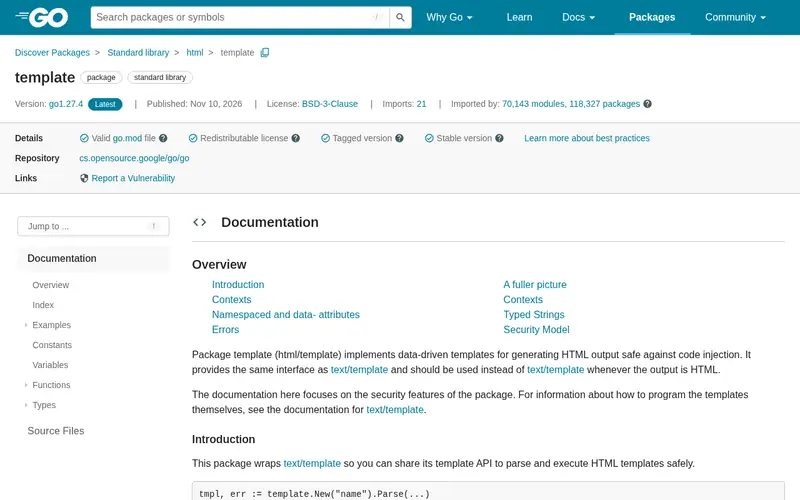
The `html/template` package is the standard choice for rendering HTML in Go web servers. It parses templates at runtime, escapes values based on context (HTML, attribute, URL, JavaScript), and integrates with `net/http`. The sibling `text/template` package handles plain text output such as emails, config files and code generation. Both are maintained by the Go team and documented on pkg.go.dev.
Because they are part of the standard library, there is no version to pin and no licence to review. The main limits are syntax and structure: you get `{{if}}`, `{{range}}`, `{{with}}` and named templates, but no macros with typed arguments and no compile-time checking of field names. Teams with large template trees often pair them with a layout convention or move to a compiled engine. Skip them if you need strong typing in templates or very high render throughput.
Standout: Ships with Go and needs no dependency
Free (open source), as listed by the vendor (html/template and text/template website). Confirm the current plan price before you buy.
Free plan. Plans change, so confirm on the vendor's pricing page before you buy.
Benefits
- Ships with Go and needs no dependency
- html/template applies contextual auto-escaping
Drawbacks
- Limited syntax and no built-in inheritance beyond template blocks
- logic-heavy templates get awkward
Skip it if this limit matters to you: limited syntax and no built-in inheritance beyond template blocks.
Verdict. A sensible pick for teams that want the default, dependency-free Go templating.
templ
Best for go developers who want type-safe HTML components
What it is and where it fits
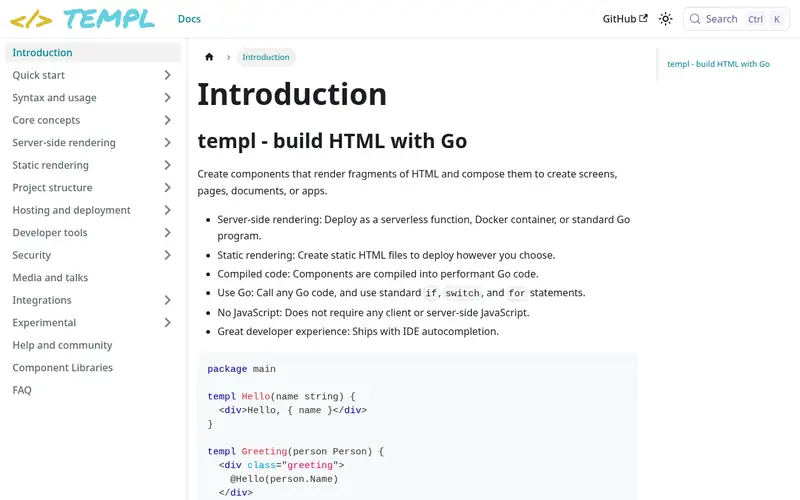
templ is a templating language and code generator for Go. You write components in `.templ` files, run the `templ generate` command, and get Go functions that write HTML. Because components are Go functions, you get type checking, editor support and compile-time errors for bad field names. It supports components, children, attributes and CSS scoping.
templ runs anywhere Go runs, since the output is ordinary Go code. The project is open source under the MIT licence. The main cost is the generation step: you need it in your build pipeline, and generated files should be committed or regenerated consistently. It suits teams building server-rendered HTML apps who want compiler feedback. Skip it if you want a zero-build workflow or need a template syntax that non-Go developers can edit.
Standout: Templates are Go functions, so the compiler catches errors
Free (open source), as listed by the vendor (templ website). Confirm the current plan price before you buy.
Free plan. Plans change, so confirm on the vendor's pricing page before you buy.
Benefits
- Templates are Go functions, so the compiler catches errors
- generates plain Go with no runtime reflection
Drawbacks
- Requires a code generation step in the build
- template syntax is its own language you must learn
Skip it if this limit matters to you: requires a code generation step in the build.
Verdict. A sensible pick for go developers who want type-safe HTML components.
Alternatives in this guide: html/template and text/template, pongo2, Jet
pongo2
Best for teams porting Django or Jinja templates to Go
What it is and where it fits
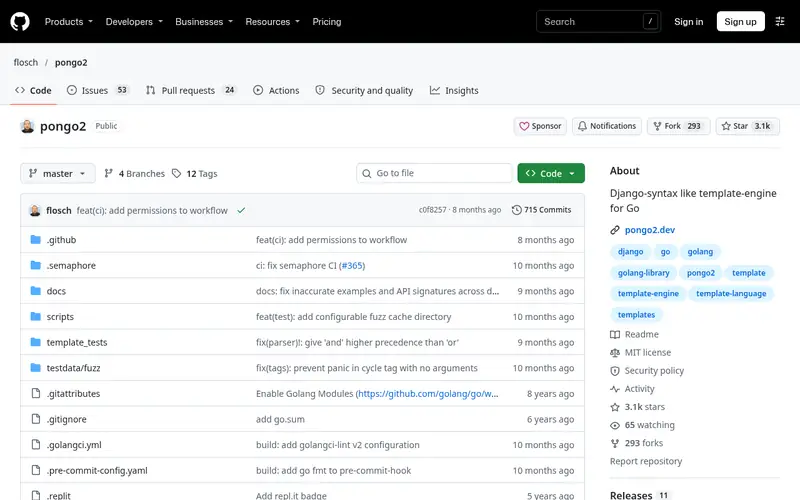
pongo2 is a Django-syntax template engine for Go. It supports template inheritance with `{% extends %}` and `{% block %}`, filters, macros and auto-escaping. If your team already knows Django templates, the syntax will look familiar, which lowers the cost of moving a Python service to Go.
Templates are parsed at runtime, and values are resolved through reflection, so you do not get compile-time checks. The project is open source and hosted on GitHub. It is a good fit for content-heavy sites and for teams migrating from Python. Skip it if you need the strongest possible escaping guarantees out of the box or want compile-time template validation; `html/template` and templ are better there.
Standout: Django-like syntax with tags, filters and inheritance
Free (open source), as listed by the vendor (pongo2 website). Confirm the current plan price before you buy.
Free plan. Plans change, so confirm on the vendor's pricing page before you buy.
Benefits
- Django-like syntax with tags, filters and inheritance
- familiar to Python web developers
Drawbacks
- Runtime parsing and reflection
- smaller maintainer base than the standard library
Skip it if this limit matters to you: runtime parsing and reflection.
Verdict. A sensible pick for teams porting Django or Jinja templates to Go.
Alternatives in this guide: html/template and text/template, templ, Jet
Jet
Best for developers who want a fast engine with Jinja-like syntax
What it is and where it fits
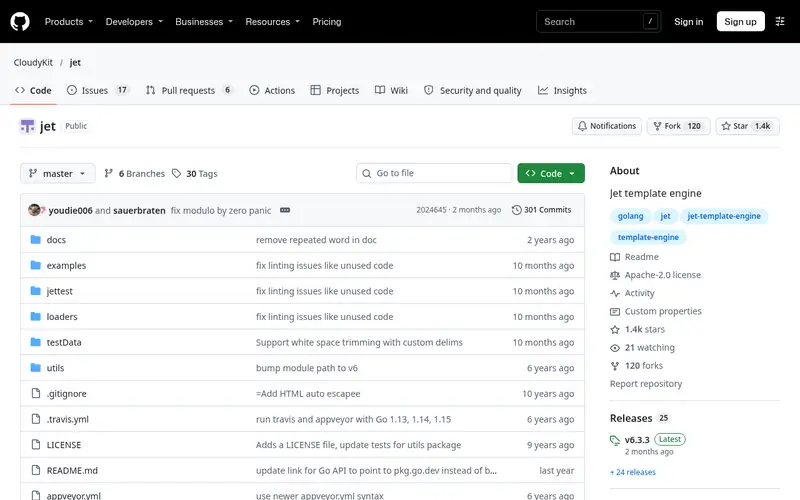
Jet is a template engine for Go with syntax modelled on Python's Jinja2. It supports template inheritance, blocks, macros, includes and custom functions. Templates can be loaded from the filesystem or embedded with `embed`, which makes single-binary deployment possible.
Jet parses and executes templates at runtime. The project is open source and maintained on GitHub. It is a reasonable middle ground for teams that like Jinja syntax but want to stay in Go. The trade-offs are the same as other runtime engines: no compile-time field checks, and errors appear when a template executes. Skip it if you want generated Go code or the smallest possible dependency surface.
Standout: Jinja-inspired syntax with inheritance and macros
Free (open source), as listed by the vendor (Jet website). Confirm the current plan price before you buy.
Free plan. Plans change, so confirm on the vendor's pricing page before you buy.
Benefits
- Jinja-inspired syntax with inheritance and macros
- templates can be loaded from disk or embedded
Drawbacks
- Runtime evaluation with reflection
- smaller community than the standard library
Skip it if this limit matters to you: runtime evaluation with reflection.
Verdict. A sensible pick for developers who want a fast engine with Jinja-like syntax.
Alternatives in this guide: html/template and text/template, templ, pongo2
quicktemplate
Best for projects that need fast, compiled HTML output
What it is and where it fits
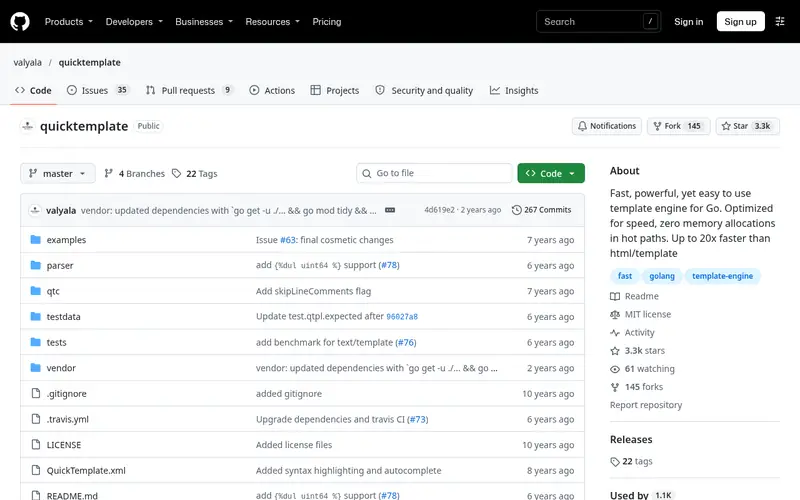
quicktemplate converts `.qtpl` template files into Go code. Because rendering is plain Go, there is no runtime template parsing and no reflection on the hot path. The project documents this as its main design goal. It supports inheritance, includes and helper functions.
The generation step means template changes require a rebuild, and the template syntax is closer to Go than to HTML-with-placeholders. That can be a poor fit for teams where designers edit templates directly. quicktemplate is open source and hosted on GitHub. It suits high-traffic services where render cost matters and the team is comfortable with code generation. Skip it for small projects where the standard library is simpler.
Standout: Templates compile to Go code, avoiding runtime parsing
Free (open source), as listed by the vendor (quicktemplate website). Confirm the current plan price before you buy.
Free plan. Plans change, so confirm on the vendor's pricing page before you buy.
Benefits
- Templates compile to Go code, avoiding runtime parsing
- designed for high-throughput rendering
Drawbacks
- Templates are Go-like and less friendly to designers
- requires a generation step
Skip it if this limit matters to you: templates are Go-like and less friendly to designers.
Verdict. A sensible pick for projects that need fast, compiled HTML output.
Alternatives in this guide: html/template and text/template, templ, pongo2
gomponents
Best for go developers who prefer writing HTML as Go functions
What it is and where it fits
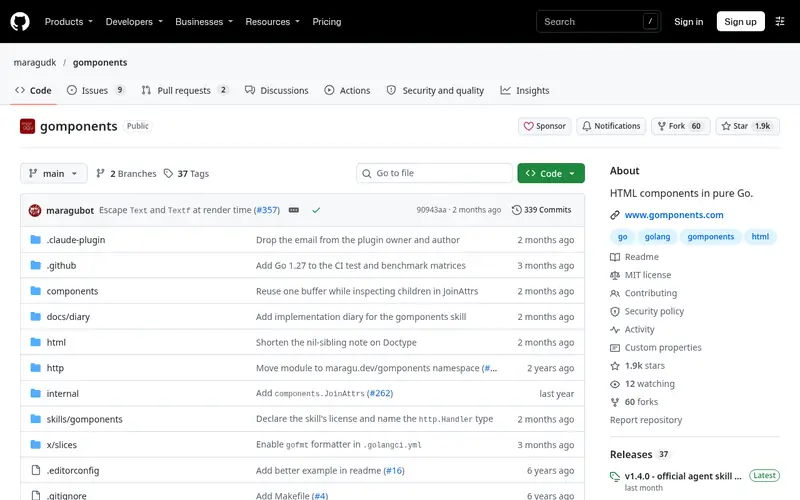
gomponents lets you build HTML with Go functions. Instead of a template file, you write `div(Text("hello"))` and render the result. There is no separate template syntax and no code generation step. The compiler checks your component calls, and the library handles escaping.
It is open source and hosted on GitHub. Because markup lives in Go, you get editor tooling, refactoring and tests for free, but you lose the separation between templates and code that some teams rely on. It suits small to medium server-rendered apps and teams that already prefer Go everywhere. Skip it if designers or content editors need to change markup without touching Go code.
Standout: Pure Go with no template language or generation step
Free (open source), as listed by the vendor (gomponents website). Confirm the current plan price before you buy.
Free plan. Plans change, so confirm on the vendor's pricing page before you buy.
Benefits
- Pure Go with no template language or generation step
- composable functions and full type checking
Drawbacks
- HTML lives in Go code, which some teams dislike
- no template files for designers to edit
Skip it if this limit matters to you: HTML lives in Go code, which some teams dislike.
Verdict. A sensible pick for go developers who prefer writing HTML as Go functions.
Alternatives in this guide: html/template and text/template, templ, pongo2
Plush
Best for buffalo framework users and teams that want a small expression-based engine
What it is and where it fits
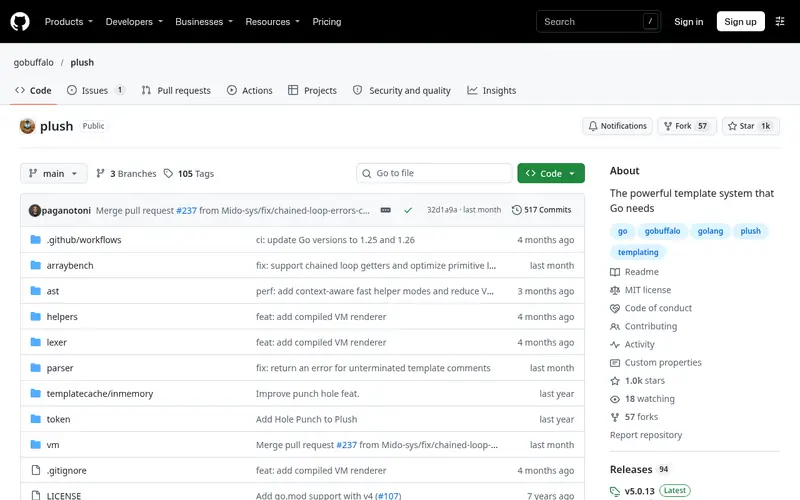
Plush is the template engine from the Buffalo web framework. It uses `<%= %>` style tags, supports helpers, partials and iteration, and can be used as a standalone package. It is open source and hosted on GitHub.
Plush parses templates at runtime and evaluates them with reflection. It is a practical choice if you are already in the Buffalo ecosystem, and it works for small standalone projects too. The main drawback is reach: fewer users and less third-party material than `html/template` or templ. Skip it if you want the largest community, the strongest escaping guarantees, or compile-time template checks.
Standout: Simple syntax with helpers and partials
Free (open source), as listed by the vendor (Plush website). Confirm the current plan price before you buy.
Free plan. Plans change, so confirm on the vendor's pricing page before you buy.
Benefits
- Simple syntax with helpers and partials
- usable outside the Buffalo framework
Drawbacks
- Smaller ecosystem and fewer users than the standard library
- runtime evaluation only
Skip it if this limit matters to you: smaller ecosystem and fewer users than the standard library.
Verdict. A sensible pick for buffalo framework users and teams that want a small expression-based engine.
Alternatives in this guide: html/template and text/template, templ, pongo2
Who should use what
If you want the default with no extra dependency, use `html/template`. If you want compiler-checked components, use templ. If your team knows Django or Jinja syntax, look at pongo2 or Jet. If render throughput is the priority and you accept a generation step, use quicktemplate. If you prefer plain Go functions over a template language, use gomponents. Buffalo users can stay with Plush.
Questions to settle before you buy
What to check before you buy
- Confirm the engine's escaping model, especially for HTML attributes, URLs and JavaScript contexts.
- Check whether templates are parsed at runtime or compiled, and add the matching build step if needed.
- Review the licence and the project's recent commit activity before adding a dependency.
- Test how the engine handles missing fields and nil values, since these differ between engines.
- Decide whether designers need to edit templates outside Go code; that rules out some options.
FAQ
Is html/template enough for most Go projects?
Yes, for most server-rendered apps. It ships with Go, escapes by context and is maintained by the Go team. You only need another engine when you want compile-time checks, Jinja-style syntax or higher render throughput.
Which Go template engine is fastest?
Engines that compile templates to Go code, such as quicktemplate and templ, avoid runtime parsing and reflection. That usually makes them faster than runtime engines. Measure with your own templates before switching, since the gap depends on the workload.
Can I use these engines for text, not just HTML?
`text/template` is built for plain text. pongo2, Jet and Plush are mainly aimed at HTML. For emails and config files, the standard library's `text/template` is the simplest choice.
Do any of these engines cost money?
No. All seven options in this guide are free or open source. The cost is in build steps and learning the syntax, not licences.
Are these engines safe for user-supplied templates?
Running user-supplied templates is risky with any engine. `html/template` escapes output by context, but arbitrary template execution can still expose data or cause denial of service. Avoid letting untrusted users author templates.
Sources we checked
Method: how we score · editorial policy.
Change log. First published 27 Nov 2026.