Stage 01 · Write · Researched comparison
Best Go GUI Frameworks in 2026
Fyne is the first pick for most teams that want a pure-Go toolkit with one codebase for desktop and mobile. Wails suits developers who prefer to build the interface in HTML and JavaScript and keep Go on the backend. Gio UI is the alternative for custom, immediate-mode drawing and broad platform reach. All three are open source, so the main cost is learning time, not licence fees.

By Shihab Mia
Published 27 Nov 2026 · 6 tools compared
We run no ads and no affiliate links at launch. The order of a list follows our published method. See how we score.
Prices are the starting prices vendors list publicly. Plans change, so confirm the current price on the vendor page before you buy.
Key takeaways
- Fyne, Wails, Gio UI, gotk4, Cogent Core and giu are all free and open source, so none of them requires a paid licence.
- Fyne, Wails and Gio UI build desktop apps on Windows, macOS and Linux.
- gotk4 and Cogent Core depend on C libraries or system graphics stacks, which adds setup work on some platforms.
- giu wraps Dear ImGui and fits tool-style interfaces better than full consumer desktop apps.
Who each pick is for
- Pure-Go desktop and mobile apps with a standard widget setFyne
- Go backends paired with HTML, CSS and JavaScript frontendsWails
- Custom immediate-mode interfaces with wide platform coverageGio UI
- Go apps that need native GTK4 widgetsgotk4
- Go apps that need a rich widget set and 2D/3D renderingCogent Core
- Tool-style and debug interfaces built on Dear ImGuigiu
Comparison
| Tool | Best for | Standout feature | Listed starting price | Free plan or trial |
|---|---|---|---|---|
| 1Fyne | Pure-Go desktop and mobile apps with a standard widget set | Single Go codebase for desktop and mobile | Free (open source) | Free plan |
| 2Wails | Go backends paired with HTML, CSS and JavaScript frontends | Reuses existing web skills and frontend frameworks | Free (open source) | Free plan |
| 3Gio UI | Custom immediate-mode interfaces with wide platform coverage | One API across desktop, mobile and WebAssembly | Free (open source) | Free plan |
| 4gotk4 | Go apps that need native GTK4 widgets | Access to the full GTK4 widget set | Free (open source) | Free plan |
| 5Cogent Core | Go apps that need a rich widget set and 2D/3D rendering | Large widget library plus scene and 3D support | Free (open source) | Free plan |
| 6giu | Tool-style and debug interfaces built on Dear ImGui | Fast to build dense control panels | Free (open source) | Free plan |
How we picked
We compared frameworks on fit for building Go desktop apps, supported platforms, licence and dependency model, and the main limits each one documents. Sources are official project sites, documentation and public repositories. No hands-on testing or benchmarks were run. Licences and platform support change, so confirm details on the project site before you commit.
The tools, one by one
Fyne
Best for pure-Go desktop and mobile apps with a standard widget set
What it is and where it fits
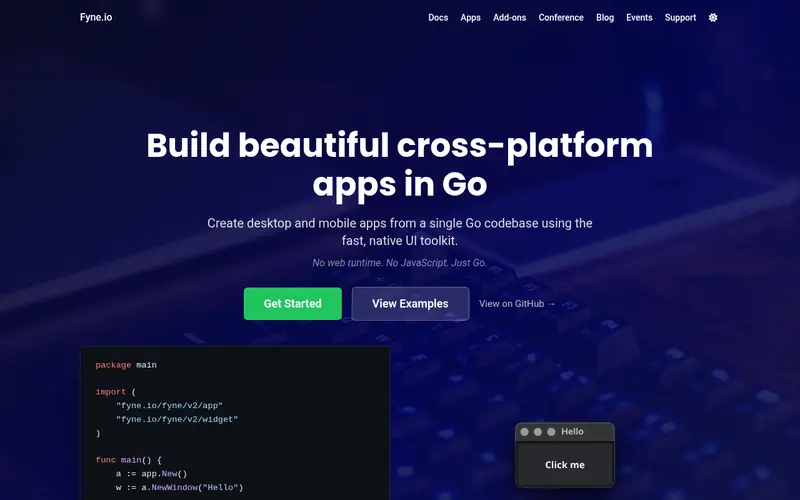
Fyne is a UI toolkit written in Go that aims for a consistent API across platforms. It renders through its own graphics layer and ships a set of standard widgets such as buttons, lists, forms and dialogs. Apps build for Windows, macOS, Linux, Android and iOS, plus a browser target through WebAssembly. The project is open source under a permissive licence and is developed on GitHub.
Fyne suits developers who want to stay in Go and avoid HTML or C bindings. The trade-off is a fixed widget model: highly custom interfaces take more work, and very large data views need care. Teams that need pixel-level control or native platform widgets should look at Gio UI or gotk4 instead.
Standout: Single Go codebase for desktop and mobile
Free (open source), as listed by the vendor (Fyne website). Confirm the current plan price before you buy.
Free plan. Plans change, so confirm on the vendor's pricing page before you buy.
Benefits
- Single Go codebase for desktop and mobile
- built-in widget library and theme support
Drawbacks
- Custom drawing is limited compared with immediate-mode toolkits
- some advanced widgets need third-party packages
Skip it if this limit matters to you: custom drawing is limited compared with immediate-mode toolkits.
Verdict. A sensible pick for pure-Go desktop and mobile apps with a standard widget set.
Wails
Best for go backends paired with HTML, CSS and JavaScript frontends
What it is and where it fits
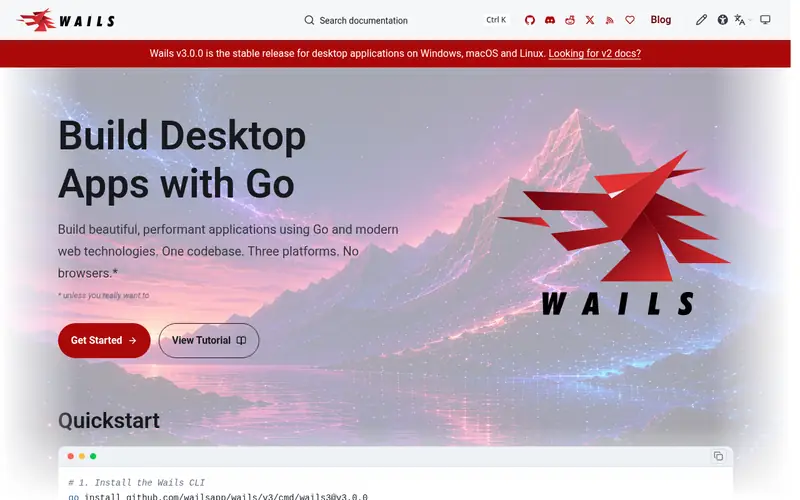
Wails lets you write the backend in Go and the interface in web technologies. Go methods are bound to the frontend and called from JavaScript, and the app is packaged as a native desktop binary. It uses the system webview rather than bundling a browser engine, which keeps installers smaller. Supported targets are Windows, macOS and Linux.
Wails fits teams that already know web development and want Go for file access, networking and system integration. It is a poor match if you want a pure-Go UI with no web layer, or if you need mobile targets. Webview differences across operating systems can affect rendering, so test on each platform you ship.
Standout: Reuses existing web skills and frontend frameworks
Free (open source), as listed by the vendor (Wails website). Confirm the current plan price before you buy.
Free plan. Plans change, so confirm on the vendor's pricing page before you buy.
Benefits
- Reuses existing web skills and frontend frameworks
- small binaries compared with bundling a full browser stack
Drawbacks
- Requires JavaScript or TypeScript knowledge
- UI behaviour depends on the platform webview
Skip it if this limit matters to you: requires JavaScript or TypeScript knowledge.
Verdict. A sensible pick for go backends paired with HTML, CSS and JavaScript frontends.
Gio UI
Best for custom immediate-mode interfaces with wide platform coverage
What it is and where it fits
Gio is an immediate-mode GUI library written in Go. You describe the interface on each frame, which gives precise control over layout, animation and custom drawing. It targets Windows, macOS, Linux, Android, iOS and the web through WebAssembly. The project is open source and maintained on its own Git repository.
Gio suits developers who want a small dependency footprint and full control over rendering, such as drawing tools or custom visual interfaces. It is less suited to teams that want ready-made widgets and fast form-based apps, since you assemble most components yourself. Expect to spend time learning its layout and event model.
Standout: One API across desktop, mobile and WebAssembly
Free (open source), as listed by the vendor (Gio UI website). Confirm the current plan price before you buy.
Free plan. Plans change, so confirm on the vendor's pricing page before you buy.
Benefits
- One API across desktop, mobile and WebAssembly
- fine control over layout and drawing
Drawbacks
- No standard widget set, so you build or borrow components
- steeper learning curve
Skip it if this limit matters to you: no standard widget set, so you build or borrow components.
Verdict. A sensible pick for custom immediate-mode interfaces with wide platform coverage.
gotk4
Best for go apps that need native GTK4 widgets
What it is and where it fits
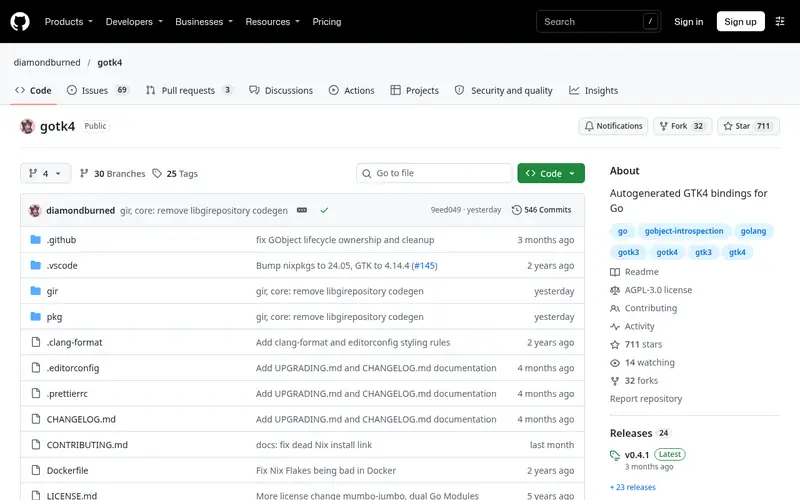
gotk4 provides Go bindings for GTK4. It exposes GTK widgets, and related libraries such as gio and glib, to Go code. Apps look native on Linux desktops and can run on Windows and macOS when GTK4 is installed. The bindings are generated from GObject introspection data and the project is open source on GitHub.
Choose gotk4 when you need real GTK widgets and your users are mostly on Linux. It is a weak fit for single-binary distribution, because GTK and its dependencies must be present or bundled. Setup on Windows and macOS takes extra steps, and debugging generated bindings is harder than debugging plain Go code.
Standout: Access to the full GTK4 widget set
Free (open source), as listed by the vendor (gotk4 website). Confirm the current plan price before you buy.
Free plan. Plans change, so confirm on the vendor's pricing page before you buy.
Benefits
- Access to the full GTK4 widget set
- native look on Linux desktops
Drawbacks
- Requires GTK4 libraries at build and run time
- generated bindings can be harder to debug
Skip it if this limit matters to you: requires GTK4 libraries at build and run time.
Verdict. A sensible pick for go apps that need native GTK4 widgets.
Cogent Core
Best for go apps that need a rich widget set and 2D/3D rendering
What it is and where it fits
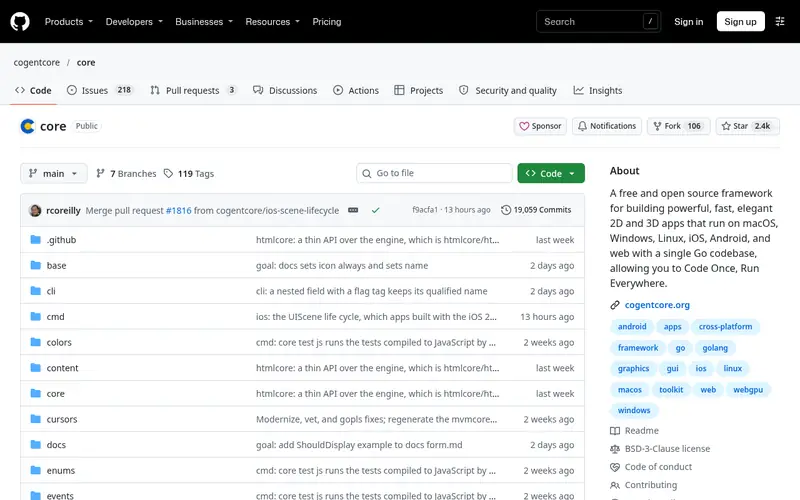
Cogent Core is a Go framework for building apps and 2D or 3D scenes. It includes a broad widget set, layout system and rendering based on its own scene graph. It targets desktop platforms and the web through WebAssembly, and it depends on system graphics libraries such as OpenGL or Vulkan depending on the platform.
It suits projects that need both standard UI controls and custom visual content, such as scientific or data-heavy tools. Teams that want the smallest possible dependency set or the largest community should prefer Fyne. Check the platform setup notes before committing, since graphics driver requirements vary.
Standout: Large widget library plus scene and 3D support
Free (open source), as listed by the vendor (Cogent Core website). Confirm the current plan price before you buy.
Free plan. Plans change, so confirm on the vendor's pricing page before you buy.
Benefits
- Large widget library plus scene and 3D support
- runs on desktop and web
Drawbacks
- Depends on system graphics libraries
- smaller community than Fyne or Wails
Skip it if this limit matters to you: depends on system graphics libraries.
Verdict. A sensible pick for go apps that need a rich widget set and 2D/3D rendering.
giu
Best for tool-style and debug interfaces built on Dear ImGui
What it is and where it fits
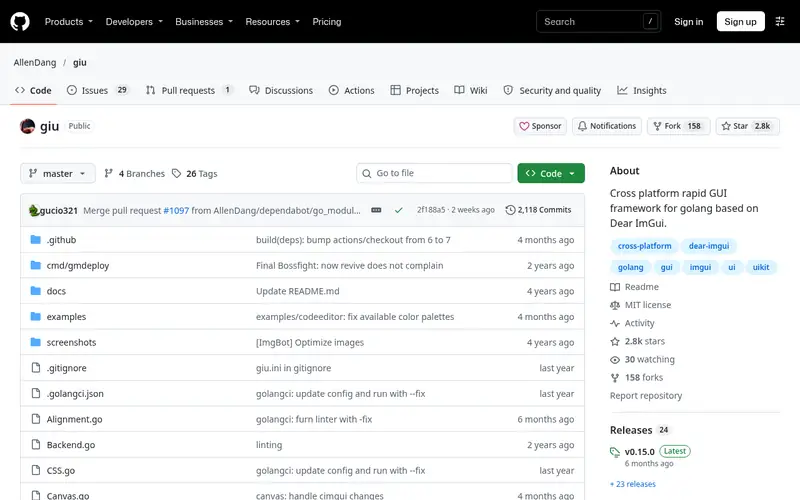
giu provides Go bindings for Dear ImGui, a C++ immediate-mode GUI library. It is well suited to internal tools, editors and debug panels where dense controls matter more than native styling. It runs on Windows, macOS and Linux and is open source on GitHub.
Pick giu when you want a quick control panel or inspector and are comfortable with an ImGui look. Skip it for customer-facing apps that should match platform conventions, and note that it relies on cgo and a C++ toolchain at build time. Mobile targets are not part of its scope.
Standout: Fast to build dense control panels
Free (open source), as listed by the vendor (giu website). Confirm the current plan price before you buy.
Free plan. Plans change, so confirm on the vendor's pricing page before you buy.
Benefits
- Fast to build dense control panels
- wraps the widely used Dear ImGui library
Drawbacks
- ImGui styling is not native
- not aimed at consumer desktop apps
Skip it if this limit matters to you: imGui styling is not native.
Verdict. A sensible pick for tool-style and debug interfaces built on Dear ImGui.
Who should use what
If you want a pure-Go UI for desktop and mobile, start with Fyne. If your team already writes HTML and JavaScript, Wails keeps Go on the backend and reuses those skills. If you need custom drawing or a small dependency footprint, try Gio UI. If you need native GTK4 widgets on Linux, use gotk4, and if you need dense tool panels, giu is the quickest route.
Questions to settle before you buy
What to check before you buy
- Confirm the framework builds on every OS you plan to ship, including any C library or webview requirements.
- Check the licence and whether it fits your distribution model, including static linking and bundling.
- Read the last commit date and open issues to judge maintenance activity.
- Test packaging and installer size, especially for webview and GTK-based options.
- Verify that the widget set covers your core screens before writing custom components.
FAQ
Do I need cgo for Go GUI frameworks?
It depends on the framework. Fyne and Gio UI are written in Go and do not require cgo for typical desktop builds. Wails uses the system webview. gotk4, Cogent Core and giu rely on C libraries, so they need cgo and a working C toolchain at build time.
Can these frameworks build mobile apps?
Fyne and Gio UI both list Android and iOS among their targets. Wails, gotk4, Cogent Core and giu focus on desktop, with Cogent Core also targeting the web. Mobile support in Go GUI toolkits is less mature than desktop, so test early on real devices.
Are Go GUI apps large?
Binary size varies. Pure-Go toolkits include their rendering code in the binary. Wails uses the system webview, which can keep installers smaller, while GTK-based apps depend on system libraries or bundled ones. Measure your own build rather than relying on general claims.
Which framework has the largest community?
Fyne and Wails have the largest and most active communities among the options here, with frequent releases and broad third-party material. Gio UI and giu have smaller but focused followings, while gotk4 and Cogent Core are more niche. Check repository activity and issue response times before committing.
Do any of these frameworks cost money?
All six listed here are free and open source. Costs come from development time, platform setup and packaging work. If you need commercial support, check each project's site, since support arrangements are separate from the open-source licence.
Sources we checked
Method: how we score · editorial policy.
Change log. First published 27 Nov 2026.