Stage 01 · Write · Researched comparison
Best Go Configuration Libraries in 2026
Viper is the first pick for most teams that want one library to read flags, env vars and config files across many formats. It suits larger applications that accept its dependency footprint. For a smaller core with pluggable parsers, koanf is the common alternative. If you only need environment variables, caarlos0/env or kelseyhightower/envconfig keep things minimal.

By Shihab Mia
Published 27 Nov 2026 · 7 tools compared
We run no ads and no affiliate links at launch. The order of a list follows our published method. See how we score.
Prices are the starting prices vendors list publicly. Plans change, so confirm the current price on the vendor page before you buy.
Key takeaways
- Viper handles files, env vars, flags and remote stores, but pulls in more dependencies than the others.
- koanf keeps a small core and adds file formats through separate parser modules.
- caarlos0/env and kelseyhightower/envconfig focus on struct tags for environment variables and nothing else.
- All seven libraries here are free and open source, so cost is not a deciding factor.
Who each pick is for
- Teams wanting one library for files, env vars and flagsViper
- Developers who want a small core with pluggable parserskoanf
- Services configured only through environment variablesenvconfig (kelseyhightower)
- Minimal struct-tag parsing of environment variablescaarlos0/env
- Apps that combine env vars with YAML, JSON or TOML filescleanenv
- CLIs that need rich command-line flag parsinggo-flags
- Composing config from multiple backends behind one loaderconfita
Comparison
| Tool | Best for | Standout feature | Listed starting price | Free plan or trial |
|---|---|---|---|---|
| 1Viper | Teams wanting one library for files, env vars and flags | Reads JSON, TOML, YAML, HCL and other formats | Free (open source) | Free plan |
| 2koanf | Developers who want a small core with pluggable parsers | Small core with file formats added as separate modules | Free (open source) | Free plan |
| 3envconfig (kelseyhightower) | Services configured only through environment variables | Struct tags map env vars with almost no code | Free (open source) | Free plan |
| 4caarlos0/env | Minimal struct-tag parsing of environment variables | Small API with struct tags, defaults and required fields | Free (open source) | Free plan |
| 5cleanenv | Apps that combine env vars with YAML, JSON or TOML files | Reads env vars and config files with one struct | Free (open source) | Free plan |
| 6go-flags | CLIs that need rich command-line flag parsing | Struct-tag flag definitions with subcommands and help generation | Free (open source) | Free plan |
| 7confita | Composing config from multiple backends behind one loader | Backend model for env, files, flags and remote stores | Free (open source) | Free plan |
How we picked
We compared libraries on fit for common configuration jobs (env vars, files, flags, remote stores), supported platforms, licence, dependency weight, maintenance activity and documented limits. Sources are vendor and project documentation, repository READMEs and public licence files. Prices and maintenance status can change, so confirm details on each project page before you commit.
The tools, one by one
Viper
Best for teams wanting one library for files, env vars and flags
What it is and where it fits
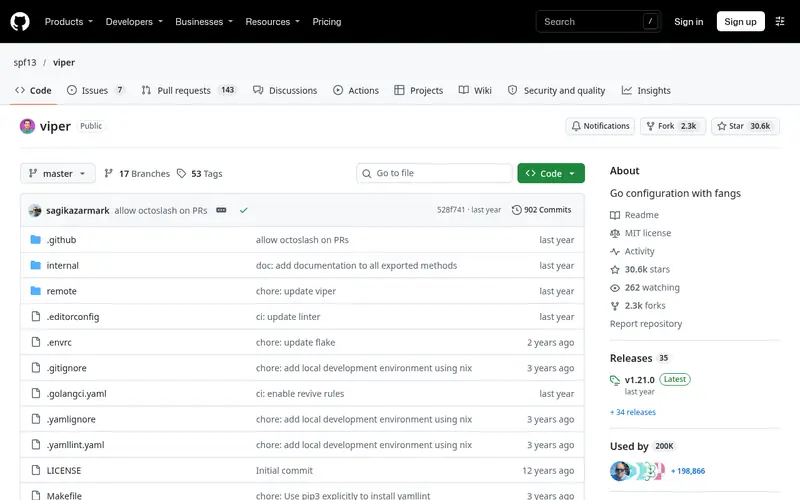
Viper is the most widely used general-purpose configuration library in the Go ecosystem. It reads config files in JSON, TOML, YAML, HCL and other formats, binds environment variables, integrates with pflag for command-line flags, and can read from remote key-value stores. Values are resolved in a defined precedence order, with explicit settings beating flags, env vars, config files and defaults.
It runs anywhere Go runs, including servers, containers and CLIs. The licence is MIT. The main cost is weight: Viper brings in a sizeable set of dependencies, which matters for small binaries. Its package-level functions and precedence rules also take time to learn. Teams building a tiny CLI or a library should consider a narrower option first.
Standout: Reads JSON, TOML, YAML, HCL and other formats
Free (open source), as listed by the vendor (Viper website). Confirm the current plan price before you buy.
Free plan. Plans change, so confirm on the vendor's pricing page before you buy.
Benefits
- Reads JSON, TOML, YAML, HCL and other formats
- watches files and merges sources with clear precedence
Drawbacks
- Large dependency tree
- global state and precedence can be hard to reason about
Skip it if this limit matters to you: large dependency tree.
Verdict. A sensible pick for teams wanting one library for files, env vars and flags.
Alternatives in this guide: koanf, envconfig (kelseyhightower), caarlos0/env
koanf
Best for developers who want a small core with pluggable parsers
What it is and where it fits
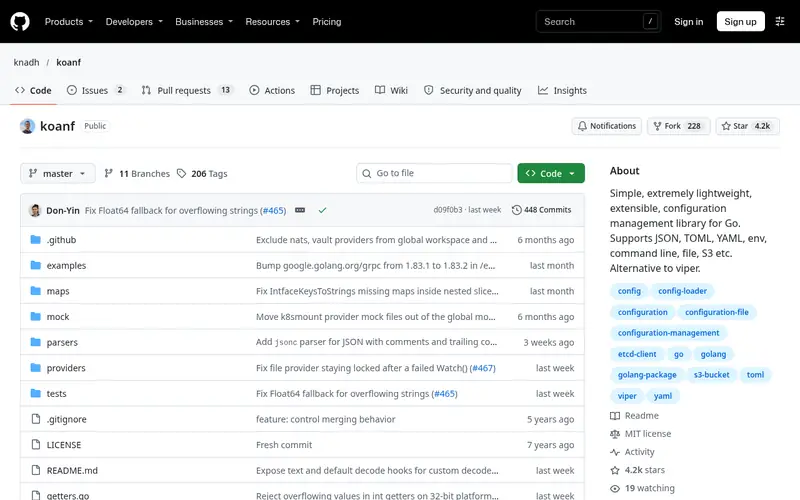
koanf (pronounced "conf") is a configuration library built around a small core. You add providers for files, environment variables, flags or remote stores, and parsers for YAML, JSON, TOML and others as separate modules. This keeps the dependency footprint close to what you actually use.
It supports merging multiple sources in the order you define, watching files for changes, and unmarshalling into structs. It runs on any Go platform. The licence is MIT. The trade-off is setup effort: a simple file-plus-env configuration takes more lines than Viper. Teams that want a batteries-included library may find it too manual, while teams that care about binary size and explicit behavior often prefer it.
Standout: Small core with file formats added as separate modules
Free (open source), as listed by the vendor (koanf website). Confirm the current plan price before you buy.
Free plan. Plans change, so confirm on the vendor's pricing page before you buy.
Benefits
- Small core with file formats added as separate modules
- explicit merge order and providers
Drawbacks
- More wiring than Viper for a basic setup
- smaller ecosystem of examples
Skip it if this limit matters to you: more wiring than Viper for a basic setup.
Verdict. A sensible pick for developers who want a small core with pluggable parsers.
Alternatives in this guide: Viper, envconfig (kelseyhightower), caarlos0/env
envconfig (kelseyhightower)
Best for services configured only through environment variables
What it is and where it fits
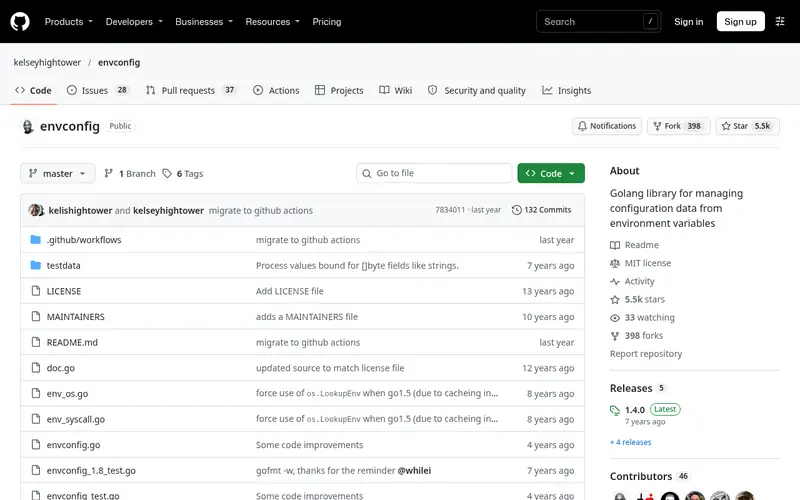
envconfig reads environment variables into a Go struct using tags. You define a struct, tag fields with `envconfig`, and call `Process`. It supports required fields, default values, custom decoders and nested structs. For twelve-factor services that take all configuration from the environment, it covers the job with little code.
It runs on any Go platform and is MIT licensed. The limitation is scope: there is no file parsing, no flag binding and no watching. The repository has seen little active development in recent years, so treat it as stable rather than evolving. Teams that need files or flags should look at Viper, koanf or cleanenv instead.
Standout: Struct tags map env vars with almost no code
Free (open source), as listed by the vendor (envconfig (kelseyhightower) website). Confirm the current plan price before you buy.
Free plan. Plans change, so confirm on the vendor's pricing page before you buy.
Benefits
- Struct tags map env vars with almost no code
- handles required fields and defaults
Drawbacks
- No file or flag support
- project is in maintenance mode with limited new work
Skip it if this limit matters to you: no file or flag support.
Verdict. A sensible pick for services configured only through environment variables.
Alternatives in this guide: Viper, koanf, caarlos0/env
caarlos0/env
Best for minimal struct-tag parsing of environment variables
What it is and where it fits
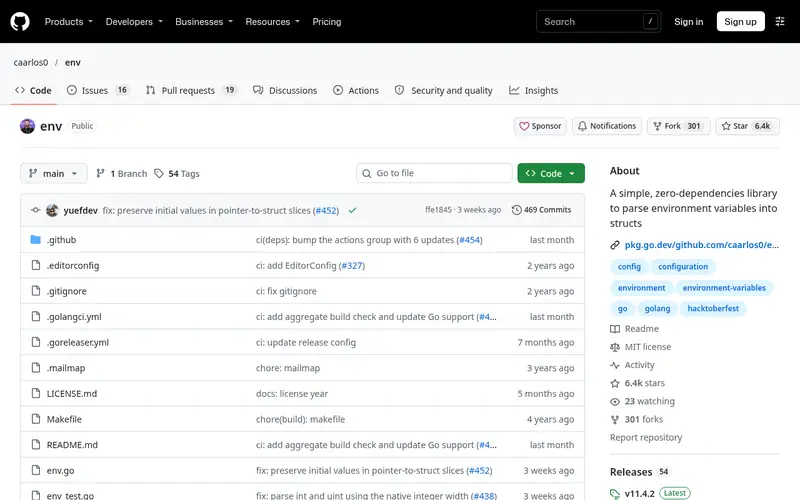
caarlos0/env parses environment variables into structs using tags. It supports default values, required fields, custom parsers and slices, and it keeps the API small. The library is actively maintained and MIT licensed, and it runs on any Go platform.
It is a good fit for small services, CLIs and containerized apps where the environment is the only configuration source. It does not read files, bind flags or watch for changes, so it is not a replacement for Viper or koanf in applications that need those inputs. If your config is env-only, this is one of the leanest options available.
Standout: Small API with struct tags, defaults and required fields
Free (open source), as listed by the vendor (caarlos0/env website). Confirm the current plan price before you buy.
Free plan. Plans change, so confirm on the vendor's pricing page before you buy.
Benefits
- Small API with struct tags, defaults and required fields
- actively maintained
Drawbacks
- Environment variables only
- no file or flag sources
Skip it if this limit matters to you: environment variables only.
Verdict. A sensible pick for minimal struct-tag parsing of environment variables.
Alternatives in this guide: Viper, koanf, envconfig (kelseyhightower)
cleanenv
Best for apps that combine env vars with YAML, JSON or TOML files
What it is and where it fits
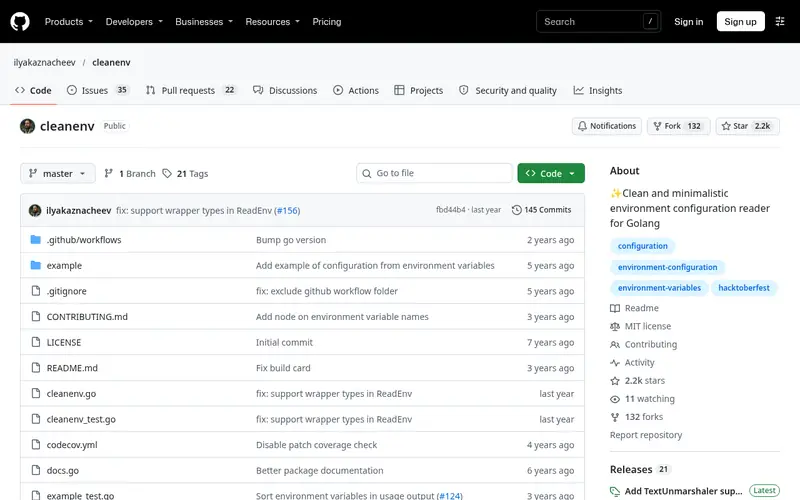
cleanenv reads configuration from environment variables and from YAML, JSON, TOML and .env files into a single struct. It supports required fields, default values, environment variable descriptions, and can print a usage summary. That makes it useful for services that want a file for local development and env vars in production.
It runs on any Go platform and is MIT licensed. The project has a smaller community than Viper, so examples and third-party integrations are fewer. It does not aim to replace a full flag framework. Teams that need heavy flag binding or remote stores should compare Viper and koanf before choosing it.
Standout: Reads env vars and config files with one struct
Free (open source), as listed by the vendor (cleanenv website). Confirm the current plan price before you buy.
Free plan. Plans change, so confirm on the vendor's pricing page before you buy.
Benefits
- Reads env vars and config files with one struct
- supports env descriptions and usage output
Drawbacks
- Smaller community than Viper
- fewer integrations with flag libraries
Skip it if this limit matters to you: smaller community than Viper.
Verdict. A sensible pick for apps that combine env vars with YAML, JSON or TOML files.
Alternatives in this guide: Viper, koanf, envconfig (kelseyhightower)
go-flags
Best for cLIs that need rich command-line flag parsing
What it is and where it fits
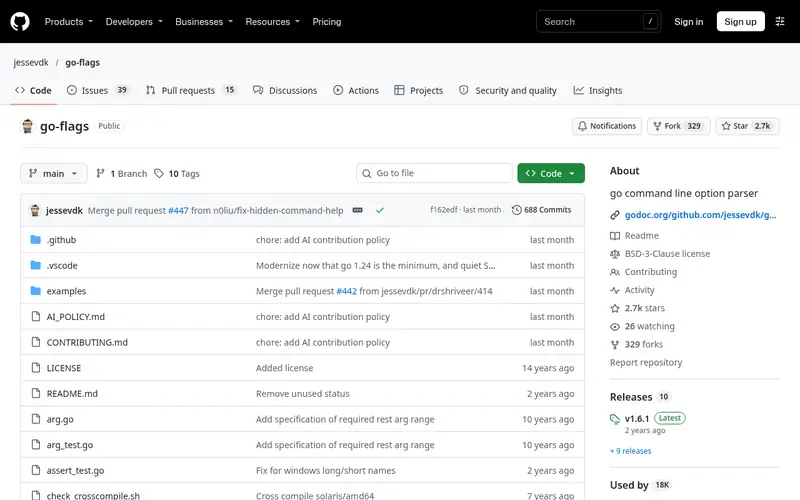
go-flags is a command-line option parser built on struct tags. It supports short and long options, subcommands, groups, required options and automatic help output. Many Go CLIs use it as their flag layer, and it can be combined with an env or file library for the rest of the configuration.
It runs on any Go platform and is BSD licensed. It is not a configuration merger: it does not read YAML or TOML files, and environment variable support is limited to what you wire yourself. Teams that need a single library for files, env and flags should use Viper or koanf, and teams that only need flags will find go-flags sufficient.
Standout: Struct-tag flag definitions with subcommands and help generation
Free (open source), as listed by the vendor (go-flags website). Confirm the current plan price before you buy.
Free plan. Plans change, so confirm on the vendor's pricing page before you buy.
Benefits
- Struct-tag flag definitions with subcommands and help generation
- mature and widely used
Drawbacks
- Focused on flags, not config files or env vars
- not a full config merger
Skip it if this limit matters to you: focused on flags, not config files or env vars.
Verdict. A sensible pick for CLIs that need rich command-line flag parsing.
Alternatives in this guide: Viper, koanf, envconfig (kelseyhightower)
confita
Best for composing config from multiple backends behind one loader
What it is and where it fits
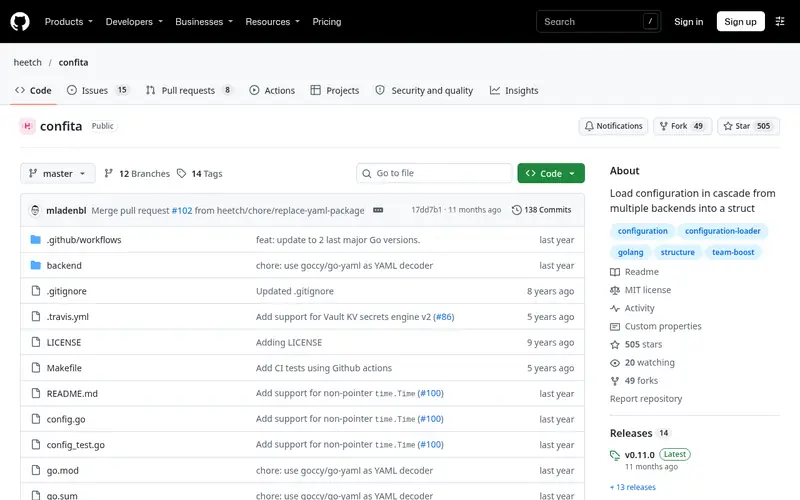
confita loads configuration into a struct from a set of backends. You register backends for environment variables, JSON files, YAML files, command-line flags, Consul and others, and the loader applies them in order. This makes it easy to swap sources between environments without changing the struct.
It runs on any Go platform and is MIT licensed. The project is less active than Viper or koanf, and its user base is smaller, so long-term maintenance is worth checking before adoption. It suits teams that like the backend composition model and do not need the largest ecosystem.
Standout: Backend model for env, files, flags and remote stores
Free (open source), as listed by the vendor (confita website). Confirm the current plan price before you buy.
Free plan. Plans change, so confirm on the vendor's pricing page before you buy.
Benefits
- Backend model for env, files, flags and remote stores
- struct-based loading
Drawbacks
- Less active development
- smaller user base than Viper
Skip it if this limit matters to you: less active development.
Verdict. A sensible pick for composing config from multiple backends behind one loader.
Alternatives in this guide: Viper, koanf, envconfig (kelseyhightower)
Who should use what
A large service that reads YAML in development and env vars in production should start with Viper. A team that cares about binary size and wants explicit merge order should try koanf. A twelve-factor container that only reads environment variables should use caarlos0/env or kelseyhightower/envconfig. A CLI that needs subcommands and help output should pair go-flags with an env or file library. Teams that like backend composition can evaluate confita.
Questions to settle before you buy
What to check before you buy
- List every configuration source you need: env vars, files, flags, remote stores.
- Check the dependency tree, since some libraries add many transitive modules.
- Confirm the licence matches your project's requirements.
- Read the precedence rules so merged values behave as expected in production.
- Check recent commit activity and open issues before adopting a smaller project.
FAQ
Which Go configuration library should I start with?
Viper is the usual starting point because it covers files, env vars and flags in one package. If you only read environment variables, caarlos0/env or kelseyhightower/envconfig is simpler. If binary size matters, koanf gives you a smaller core with optional parsers.
Is Viper too heavy for small projects?
It can be. Viper pulls in a broad dependency tree, which is noticeable in small CLIs and libraries. For those cases, an env-only library or koanf with one parser module keeps the build lean.
Can these libraries read YAML and TOML?
Viper reads YAML, TOML, JSON, HCL and other formats directly. koanf and cleanenv support YAML, JSON and TOML through parsers or built-in readers. Env-only libraries such as caarlos0/env and envconfig do not read files at all.
Do any of these libraries cost money?
No. All seven libraries listed here are free and open source under permissive licences such as MIT, BSD or Apache 2.0. Cost is not a factor; choose based on scope, dependencies and maintenance.
How do I keep secrets out of config files?
Keep secrets in environment variables or a secrets manager, not in committed YAML or TOML files. Most libraries here can read env vars, so production secrets can stay outside the repository. Never paste real tokens or production config into third-party web tools.
Sources we checked
Method: how we score · editorial policy.
Change log. First published 27 Nov 2026.