Stage 03 · Host · Researched comparison
Best Python ORMs for Database Work in 2026
Django ORM is the first pick if you already build on Django and want models, migrations and queries without extra setup. SQLAlchemy suits teams that need fine control over SQL, transactions and multiple database backends. Peewee is a lighter option for small projects and scripts. All three are open source and free, so the choice comes down to framework fit, async support and how much SQL control you want.

By Shihab Mia
Published 22 Nov 2026 · 8 tools compared
We run no ads and no affiliate links at launch. The order of a list follows our published method. See how we score.
Prices are the starting prices vendors list publicly. Plans change, so confirm the current price on the vendor page before you buy.
Key takeaways
- Django ORM, SQLAlchemy, Peewee, Tortoise ORM, Pony ORM, SQLModel, Piccolo and MongoEngine are all free and open source.
- Django ORM only makes sense inside a Django project; SQLAlchemy and the others work in any Python application.
- Async support varies: Tortoise ORM, SQLModel and Piccolo target async code, while Django ORM async support is partial.
- ORMs generate SQL locally, so no query data leaves your machine; the privacy risk is in your database credentials and logs, not the library.
Who each pick is for
- Teams already building on the Django web frameworkDjango ORM
- Applications that need fine control over SQL and multiple backendsSQLAlchemy
- Small projects, scripts and simple applicationsPeewee
- Async applications that want a Django-like model APITortoise ORM
- Developers who prefer writing queries as Python expressionsPony ORM
- FastAPI projects that want Pydantic models and database models combinedSQLModel
- Async projects that want a query builder and admin interfacePiccolo
- Applications that map Python classes to MongoDB documentsMongoEngine
Comparison
| Tool | Best for | Standout feature | Listed starting price | Free plan or trial |
|---|---|---|---|---|
| 1Django ORM | Teams already building on the Django web framework | Tight integration with Django models, admin and migrations | Free (open source) | Free plan |
| 2SQLAlchemy | Applications that need fine control over SQL and multiple backends | Core and ORM layers in one library | Free (open source) | Free plan |
| 3Peewee | Small projects, scripts and simple applications | Small API that is quick to learn | Free (open source) | Free plan |
| 4Tortoise ORM | Async applications that want a Django-like model API | Async-first design | Free (open source) | Free plan |
| 5Pony ORM | Developers who prefer writing queries as Python expressions | Generator-based query syntax that reads like Python | Free (open source) | Free plan |
| 6SQLModel | FastAPI projects that want Pydantic models and database models combined | Built on SQLAlchemy and Pydantic | Free (open source) | Free plan |
| 7Piccolo | Async projects that want a query builder and admin interface | Async query builder with a built-in admin UI | Free (open source) | Free plan |
| 8MongoEngine | Applications that map Python classes to MongoDB documents | Document-style models for MongoDB | Free (open source) | Free plan |
How we picked
We compared these libraries on fit for common Python database work, supported databases and Python versions, licence and price, async support, migration tooling and the size of the community around each project. Sources are vendor documentation, project repositories and public pricing pages. All eight are open source with no paid tier, so price was not a differentiator. Prices and features change, so confirm details on the vendor site before you commit.
The tools, one by one
Django ORM
Best for teams already building on the Django web framework
What it is and where it fits
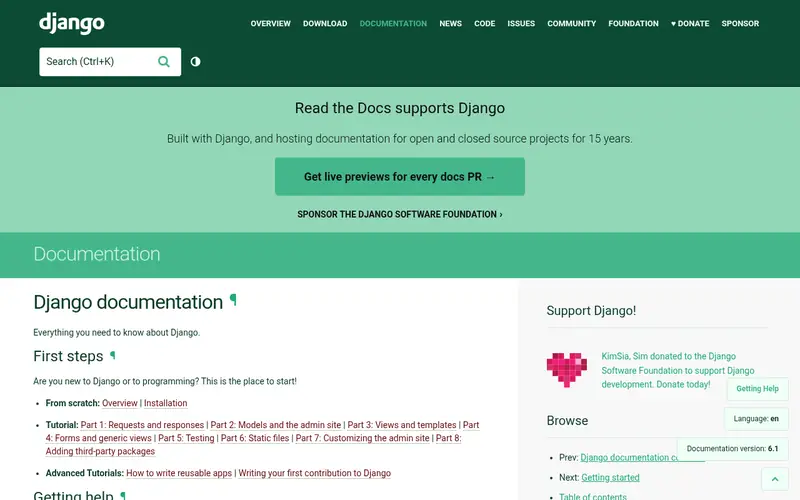
Django ORM ships with Django and needs no separate install. You define models as Python classes, and Django generates migrations, the admin interface and the query layer from them. It supports PostgreSQL, MySQL, SQLite and Oracle through official backends, and third-party packages cover others. The query API covers filters, joins, aggregation and prefetching, and the migration system is mature.
The main limit is scope. Django ORM is not a general-purpose library you drop into a Flask or FastAPI app; it expects the Django settings and app registry. Async views exist, but the ORM's async query support is partial and many operations still run synchronously. Skip it if you are not using Django, or if you need full async database access today.
Standout: Tight integration with Django models, admin and migrations
Free (open source), as listed by the vendor (Django ORM website). Confirm the current plan price before you buy.
Free plan. Plans change, so confirm on the vendor's pricing page before you buy.
Benefits
- Tight integration with Django models, admin and migrations
- large documented query API
Drawbacks
- Tied to Django
- async database support is still limited
Skip it if this limit matters to you: tied to Django.
Verdict. A sensible pick for teams already building on the Django web framework.
Alternatives in this guide: SQLAlchemy, Peewee, Tortoise ORM
SQLAlchemy
Best for applications that need fine control over SQL and multiple backends
What it is and where it fits
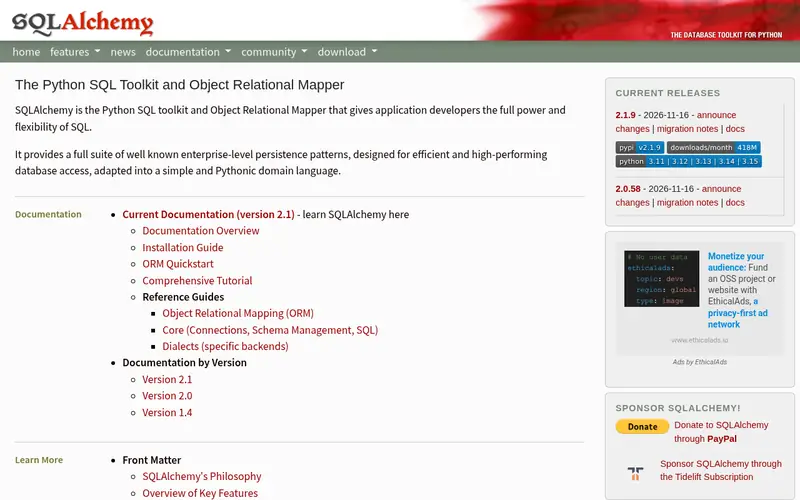
SQLAlchemy is the most widely used standalone Python SQL toolkit and ORM. It has two layers: Core, for building SQL expressions and managing connections, and the ORM, for mapping classes to tables. You can mix them, which helps when part of a query is easier to write in raw SQL. It supports PostgreSQL, MySQL, SQLite, Oracle, Microsoft SQL Server and others through dialects.
SQLAlchemy 2.0 changed the query style and added better async support through drivers such as asyncpg. Alembic, a companion project, handles schema migrations. The tradeoff is complexity: session management, relationship loading and migration setup take more work than Django ORM. Choose it when you want control and portability across frameworks, and skip it for small scripts where a lighter library is enough.
Standout: Core and ORM layers in one library
Free (open source), as listed by the vendor (SQLAlchemy website). Confirm the current plan price before you buy.
Free plan. Plans change, so confirm on the vendor's pricing page before you buy.
Benefits
- Core and ORM layers in one library
- strong support for complex queries and transactions
Drawbacks
- Steeper learning curve
- more setup than framework-bundled ORMs
Skip it if this limit matters to you: steeper learning curve.
Verdict. A sensible pick for applications that need fine control over SQL and multiple backends.
Alternatives in this guide: Django ORM, Peewee, Tortoise ORM
Peewee
Best for small projects, scripts and simple applications
What it is and where it fits
Peewee is a small ORM with a concise API. You define models, connect to a database and query, with support for PostgreSQL, MySQL, SQLite and CockroachDB. It includes a query builder, transactions and a migration helper called playhouse.migrate. The project is maintained and documented, and it works well for command-line tools, small web apps and data scripts where a full framework is overkill.
Peewee does not aim to match SQLAlchemy's depth. Complex relationship loading, async support and large-team migration workflows are weaker. If your schema is growing and you expect heavy concurrency, plan to move to SQLAlchemy or a framework ORM later. For a quick internal tool or a one-off script, it is a reasonable fit.
Standout: Small API that is quick to learn
Free (open source), as listed by the vendor (Peewee website). Confirm the current plan price before you buy.
Free plan. Plans change, so confirm on the vendor's pricing page before you buy.
Benefits
- Small API that is quick to learn
- single-file style setup for small apps
Drawbacks
- Smaller ecosystem than SQLAlchemy
- fewer advanced features
Skip it if this limit matters to you: smaller ecosystem than SQLAlchemy.
Verdict. A sensible pick for small projects, scripts and simple applications.
Alternatives in this guide: Django ORM, SQLAlchemy, Tortoise ORM
Tortoise ORM
Best for async applications that want a Django-like model API
What it is and where it fits
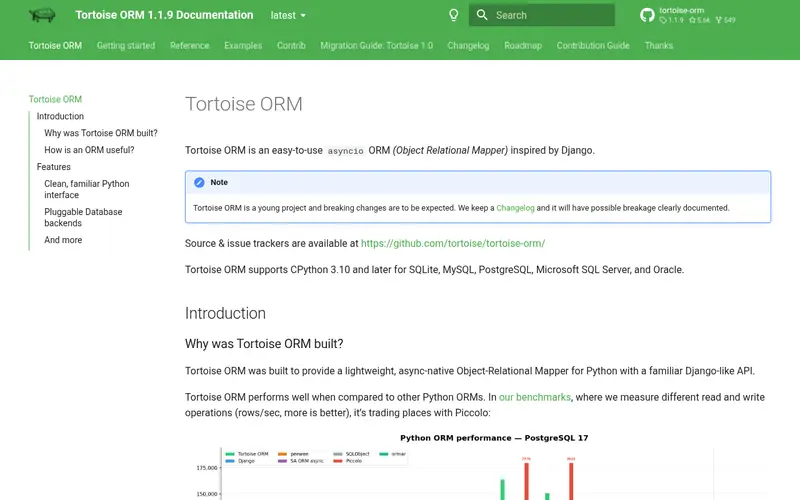
Tortoise ORM is built for asyncio. Models look similar to Django's, and queries return awaitable results, which fits FastAPI, Starlette and other async frameworks. It supports PostgreSQL, MySQL, SQLite and Oracle through drivers such as asyncpg and aiomysql. Aerich, a separate package, handles migrations.
The library is actively maintained but has a smaller community than the major ORMs, so fewer tutorials and third-party packages exist. Some advanced features, such as complex prefetching, are less complete. Choose it when your app is async from the start and you want a model API that feels familiar. Skip it for synchronous codebases or projects that depend on a large plugin ecosystem.
Standout: Async-first design
Free (open source), as listed by the vendor (Tortoise ORM website). Confirm the current plan price before you buy.
Free plan. Plans change, so confirm on the vendor's pricing page before you buy.
Benefits
- Async-first design
- familiar model and queryset style for Django users
Drawbacks
- Smaller community than Django ORM or SQLAlchemy
- fewer third-party integrations
Skip it if this limit matters to you: smaller community than Django ORM or SQLAlchemy.
Verdict. A sensible pick for async applications that want a Django-like model API.
Alternatives in this guide: Django ORM, SQLAlchemy, Peewee
Pony ORM
Best for developers who prefer writing queries as Python expressions
What it is and where it fits
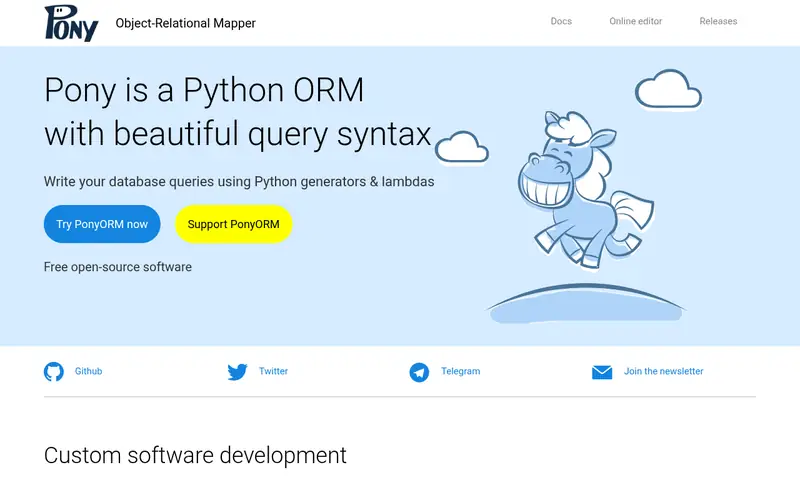
Pony ORM maps classes to tables and lets you write queries with Python generator expressions, which it translates into SQL. It supports SQLite, PostgreSQL, MySQL, Oracle and CockroachDB. The library includes an online editor for trying queries, and it handles identity mapping and caching automatically.
The generator syntax is distinctive. Some developers find it readable; others prefer explicit query builders. Pony ORM has a smaller community than SQLAlchemy or Django ORM, so answers to edge-case questions are harder to find. It is a reasonable choice for smaller projects where the syntax appeals, but check that your database and driver combination is supported before committing.
Standout: Generator-based query syntax that reads like Python
Free (open source), as listed by the vendor (Pony ORM website). Confirm the current plan price before you buy.
Free plan. Plans change, so confirm on the vendor's pricing page before you buy.
Benefits
- Generator-based query syntax that reads like Python
- automatic query optimization
Drawbacks
- Unusual query style
- smaller user base than mainstream ORMs
Skip it if this limit matters to you: unusual query style.
Verdict. A sensible pick for developers who prefer writing queries as Python expressions.
Alternatives in this guide: Django ORM, SQLAlchemy, Peewee
SQLModel
Best for fastAPI projects that want Pydantic models and database models combined
What it is and where it fits
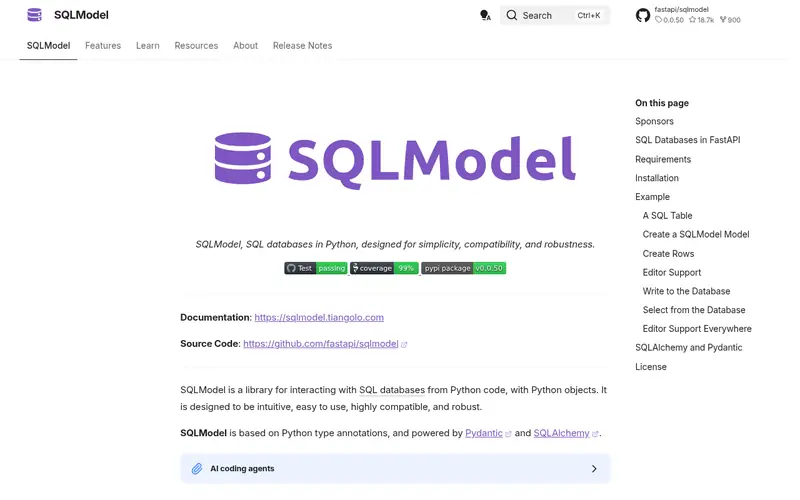
SQLModel combines SQLAlchemy and Pydantic so a single class can serve as a database model and a request or response schema. It is designed by the author of FastAPI and fits that framework closely. Because SQLAlchemy does the database work, it inherits support for PostgreSQL, MySQL, SQLite and other backends.
The project is newer and intentionally smaller in scope than SQLAlchemy. Some advanced ORM features require dropping down to SQLAlchemy directly. Migration tooling is not bundled; teams typically use Alembic. Choose SQLModel if you are building a FastAPI service and want less duplication between schemas and tables. Skip it if you need the full SQLAlchemy feature set or a long track record.
Standout: Built on SQLAlchemy and Pydantic
Free (open source), as listed by the vendor (SQLModel website). Confirm the current plan price before you buy.
Free plan. Plans change, so confirm on the vendor's pricing page before you buy.
Benefits
- Built on SQLAlchemy and Pydantic
- one model class for validation and storage
Drawbacks
- Younger project with a narrower feature set
- depends on SQLAlchemy underneath
Skip it if this limit matters to you: younger project with a narrower feature set.
Verdict. A sensible pick for fastAPI projects that want Pydantic models and database models combined.
Alternatives in this guide: Django ORM, SQLAlchemy, Peewee
Piccolo
Best for async projects that want a query builder and admin interface
What it is and where it fits
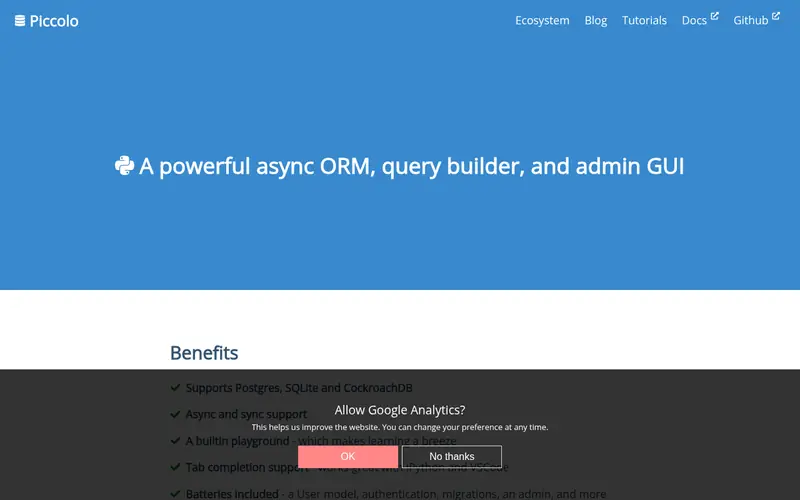
Piccolo is an async query builder and ORM. It supports PostgreSQL, SQLite and CockroachDB, and ships with Piccolo Admin, a web interface for viewing and editing data. Migrations are handled by its own tooling, and the query syntax uses awaitable methods.
The project is maintained but has a smaller user base than the major ORMs. Documentation is good but third-party examples are fewer. It suits async applications that want an admin panel without adding Django. If your team already knows SQLAlchemy or Django ORM, the switch may not pay off unless the admin interface is a specific requirement.
Standout: Async query builder with a built-in admin UI
Free (open source), as listed by the vendor (Piccolo website). Confirm the current plan price before you buy.
Free plan. Plans change, so confirm on the vendor's pricing page before you buy.
Benefits
- Async query builder with a built-in admin UI
- includes migration tooling
Drawbacks
- Smaller ecosystem
- less familiar to developers coming from Django or SQLAlchemy
Skip it if this limit matters to you: smaller ecosystem.
Verdict. A sensible pick for async projects that want a query builder and admin interface.
Alternatives in this guide: Django ORM, SQLAlchemy, Peewee
MongoEngine
Best for applications that map Python classes to MongoDB documents
What it is and where it fits
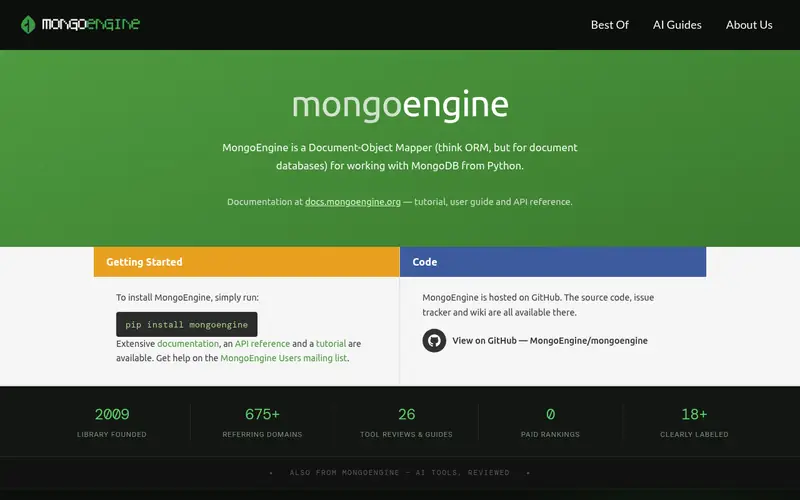
MongoEngine is an object-document mapper for MongoDB. It lets you define document schemas as Python classes, with fields, validation and queries that look similar to a relational ORM. It is not a relational ORM and does not support SQL databases, so it only belongs on this list if your data store is MongoDB.
The project is maintained and documented, but activity is slower than in the larger ORMs. It works with PyMongo underneath. Choose it when you want structure on top of MongoDB collections and prefer class-based models to raw dictionaries. Skip it for relational databases, and check the current release notes before starting a new project.
Standout: Document-style models for MongoDB
Free (open source), as listed by the vendor (MongoEngine website). Confirm the current plan price before you buy.
Free plan. Plans change, so confirm on the vendor's pricing page before you buy.
Benefits
- Document-style models for MongoDB
- schema validation on top of a schemaless store
Drawbacks
- MongoDB only
- not a relational ORM
Skip it if this limit matters to you: mongoDB only.
Verdict. A sensible pick for applications that map Python classes to MongoDB documents.
Alternatives in this guide: Django ORM, SQLAlchemy, Peewee
Who should use what
If you are building a Django site, use Django ORM and avoid adding a second ORM. If you need portability across frameworks and fine SQL control, use SQLAlchemy with Alembic. If you are writing a small script or internal tool, Peewee gets you moving with little setup. If your application is async and you want a Django-like model API, look at Tortoise ORM, SQLModel or Piccolo. If your data lives in MongoDB, MongoEngine is the document mapper to evaluate.
Questions to settle before you buy
What to check before you buy
- Confirm the ORM supports your database and driver version, including async drivers if you need them.
- Check how migrations are handled and whether the tooling fits your deployment process.
- Test relationship loading and query performance on a schema close to your real one.
- Review the licence and the project's recent release activity before adopting it.
- Make sure your team can read the query API; a steeper learning curve costs time.
FAQ
Are these Python ORMs free?
Yes. Django ORM, SQLAlchemy, Peewee, Tortoise ORM, Pony ORM, SQLModel, Piccolo and MongoEngine are all open source and free to use. You pay for hosting, database services and support separately if you need them.
Which Python ORM is best for async code?
Tortoise ORM, SQLModel and Piccolo are built with async in mind. SQLAlchemy 2.0 also supports async through compatible drivers. Django ORM's async database support is partial, so check the current documentation if your app is async throughout.
Do I need SQLAlchemy if I use Django?
No. Django ORM covers models, queries and migrations inside a Django project. SQLAlchemy is a separate toolkit for applications that are not built on Django or that need finer SQL control. Running both in one project adds complexity.
Can these ORMs connect to MongoDB?
MongoEngine is the option here for MongoDB, since it maps Python classes to documents. The relational ORMs on this list target SQL databases such as PostgreSQL, MySQL and SQLite. Check driver support before assuming a backend works.
Does using an ORM send my data anywhere?
No. These libraries run locally and generate SQL or MongoDB queries on your machine. Your data goes only to the database you connect to. Keep credentials out of source control and review what your application logs.
Sources we checked
Method: how we score · editorial policy.
Change log. First published 22 Nov 2026.