Stage 03 · Host · Researched comparison
Best Node.js ORMs in 2026
Prisma is the first pick for most teams that want a typed schema, generated client and clear migration workflow, and it suits TypeScript projects that value tooling over raw SQL control. Sequelize remains a practical choice for established projects that need broad database support and a long track record. Drizzle ORM is the pick for developers who want SQL-like syntax with TypeScript types and a thin runtime.

By Shihab Mia
Published 22 Nov 2026 · 7 tools compared
We run no ads and no affiliate links at launch. The order of a list follows our published method. See how we score.
Prices are the starting prices vendors list publicly. Plans change, so confirm the current price on the vendor page before you buy.
Key takeaways
- Prisma, Sequelize, TypeORM, Drizzle, Knex, MikroORM and Objection are all free and open source, so the decision rests on fit, not licence cost.
- Prisma and Drizzle ship TypeScript-first tooling; Sequelize and TypeORM have wider legacy adoption and more database dialects.
- Knex is a query builder rather than a full ORM, so pick it when you want SQL control and migrations without entity mapping.
- MikroORM and Objection suit teams that want a data mapper or unit-of-work pattern closer to Doctrine or Hibernate.
Who each pick is for
- TypeScript teams that want a typed schema and generated clientPrisma
- Established projects that need broad database supportSequelize
- Teams that want decorator-based entities and multiple patternsTypeORM
- Developers who want SQL-like syntax with TypeScript typesDrizzle ORM
- Developers who want a query builder with migrations, not entity mappingKnex
- Teams that want a data mapper and unit of work patternMikroORM
- Teams that want an ORM on top of KnexObjection
Comparison
| Tool | Best for | Standout feature | Listed starting price | Free plan or trial |
|---|---|---|---|---|
| 1Prisma | TypeScript teams that want a typed schema and generated client | Generated client with strong TypeScript types | Free (open source) | Free plan |
| 2Sequelize | Established projects that need broad database support | Long track record and wide dialect support | Free (open source) | Free plan |
| 3TypeORM | Teams that want decorator-based entities and multiple patterns | Supports active record and data mapper patterns | Free (open source) | Free plan |
| 4Drizzle ORM | Developers who want SQL-like syntax with TypeScript types | Thin runtime with types inferred from schema | Free (open source) | Free plan |
| 5Knex | Developers who want a query builder with migrations, not entity mapping | SQL-like query builder with a small API | Free (open source) | Free plan |
| 6MikroORM | Teams that want a data mapper and unit of work pattern | Data mapper and unit of work similar to Doctrine | Free (open source) | Free plan |
| 7Objection | Teams that want an ORM on top of Knex | Builds on Knex, so SQL control stays available | Free (open source) | Free plan |
How we picked
We compared projects on fit for common Node.js data access jobs, supported databases and runtimes, licence and pricing, and the main limits documented by each project. Sources are vendor pages, official documentation and project repositories. All listed projects are free and open source, so price is not a differentiator here. We did not run benchmarks or surveys. Prices and licences can change, so confirm details on the vendor site before you commit.
The tools, one by one
Prisma
Best for typeScript teams that want a typed schema and generated client
What it is and where it fits
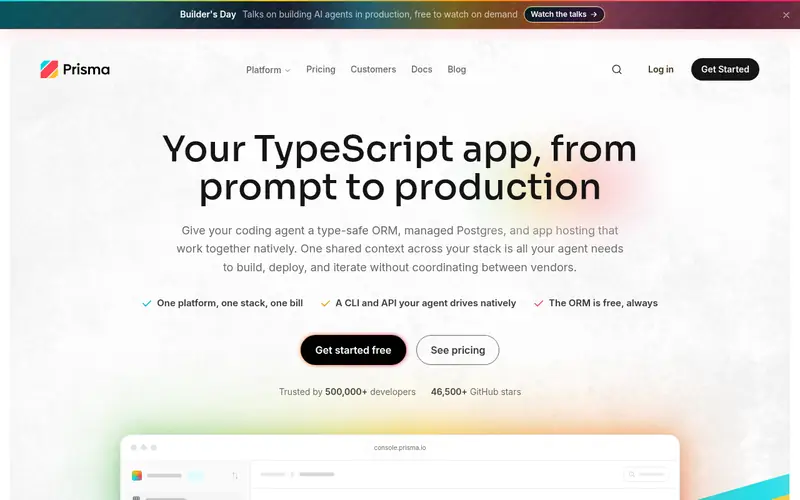
Prisma uses a schema file to define models, then generates a type-safe client for Node.js and TypeScript. It supports PostgreSQL, MySQL, SQLite, SQL Server, MongoDB and CockroachDB. Migrations are managed through the Prisma CLI, and introspection can generate a schema from an existing database.
The project is open source under the Apache 2.0 licence. Prisma also sells a commercial platform for hosted database and team features, but the ORM itself is free. The generated client is a real dependency, so CI and deploy steps must run generation. Teams that prefer hand-written SQL or minimal runtime overhead may find it heavy. See the vendor pricing page for the commercial platform.
Standout: Generated client with strong TypeScript types
Free (open source), as listed by the vendor (Prisma website). Confirm the current plan price before you buy.
Free plan. Plans change, so confirm on the vendor's pricing page before you buy.
Benefits
- Generated client with strong TypeScript types
- schema file drives migrations and introspection
Drawbacks
- Generated client adds a build step
- complex SQL can need raw queries
Skip it if this limit matters to you: generated client adds a build step.
Verdict. A sensible pick for typeScript teams that want a typed schema and generated client.
Alternatives in this guide: Sequelize, TypeORM, Drizzle ORM
Sequelize
Best for established projects that need broad database support
What it is and where it fits
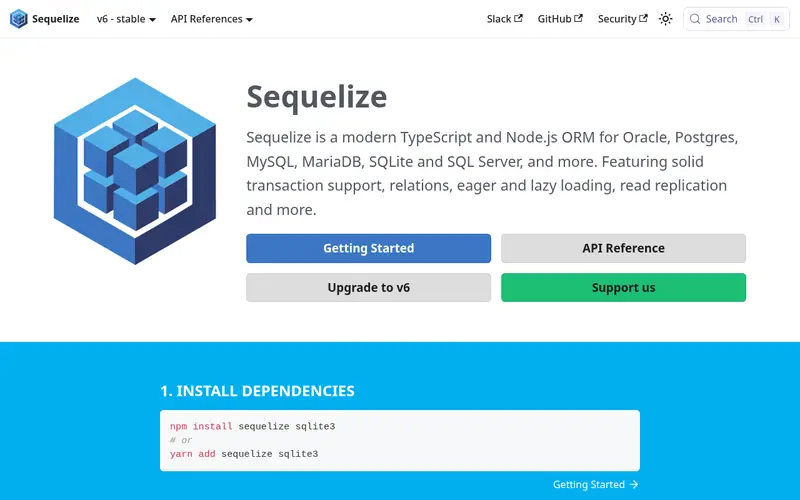
Sequelize is one of the oldest Node.js ORMs and still widely used. It supports PostgreSQL, MySQL, MariaDB, SQLite, SQL Server and other dialects through adapters. Models are defined in JavaScript or TypeScript, and migrations are handled with the Sequelize CLI.
The project is open source under the MIT licence and maintained on GitHub. It works with callback, promise and async/await styles, though newer code should use async/await. TypeScript support exists but is less strict than Prisma or Drizzle. It suits teams maintaining existing Sequelize code or needing a dialect that newer tools do not cover. New greenfield TypeScript projects may prefer a more type-focused option.
Standout: Long track record and wide dialect support
Free (open source), as listed by the vendor (Sequelize website). Confirm the current plan price before you buy.
Free plan. Plans change, so confirm on the vendor's pricing page before you buy.
Benefits
- Long track record and wide dialect support
- Large community and documentation
Drawbacks
- TypeScript types are weaker than newer ORMs
- Older API patterns can feel dated
Skip it if this limit matters to you: typeScript types are weaker than newer ORMs.
Verdict. A sensible pick for established projects that need broad database support.
Alternatives in this guide: Prisma, TypeORM, Drizzle ORM
TypeORM
Best for teams that want decorator-based entities and multiple patterns
What it is and where it fits
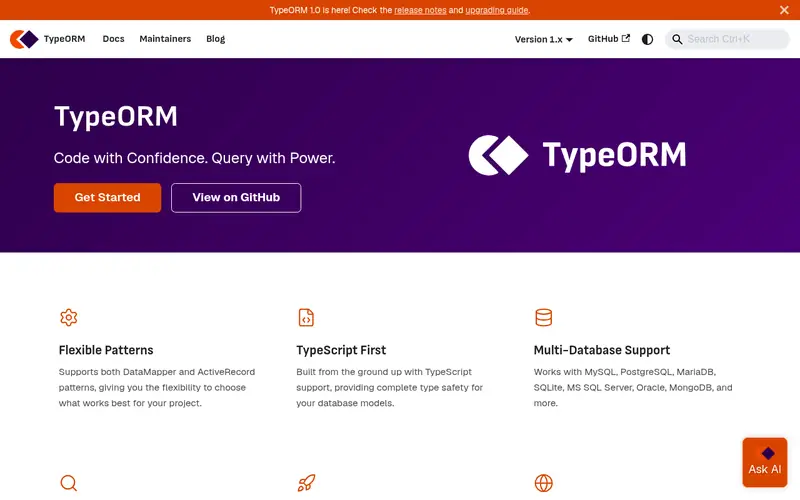
TypeORM is a TypeScript-friendly ORM that supports entities defined with decorators. It works with PostgreSQL, MySQL, MariaDB, SQLite, SQL Server, Oracle, MongoDB and others. It offers both active record and data mapper patterns, and it integrates with NestJS and other frameworks.
The project is open source under the MIT licence. It relies on decorators and reflect-metadata, which means TypeScript configuration changes. Migration generation works but has documented limitations, so many teams write migrations by hand. It is a reasonable fit for NestJS projects and teams comfortable with decorators. Teams that want minimal configuration may prefer Prisma or Drizzle.
Standout: Supports active record and data mapper patterns
Free (open source), as listed by the vendor (TypeORM website). Confirm the current plan price before you buy.
Free plan. Plans change, so confirm on the vendor's pricing page before you buy.
Benefits
- Supports active record and data mapper patterns
- Works across many SQL and NoSQL databases
Drawbacks
- Decorator-heavy API needs TypeScript config
- Migration workflow has known rough edges
Skip it if this limit matters to you: decorator-heavy API needs TypeScript config.
Verdict. A sensible pick for teams that want decorator-based entities and multiple patterns.
Alternatives in this guide: Prisma, Sequelize, Drizzle ORM
Drizzle ORM
Best for developers who want SQL-like syntax with TypeScript types
What it is and where it fits
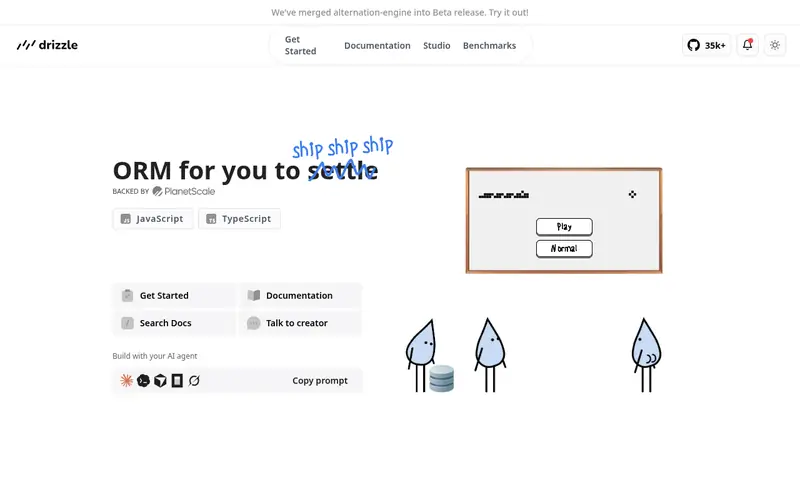
Drizzle ORM is a TypeScript ORM that defines schemas in TypeScript and generates SQL-like queries. It supports PostgreSQL, MySQL, SQLite and related dialects, and it works with serverless drivers and edge runtimes. Migrations are generated with Drizzle Kit.
The project is open source under the Apache 2.0 licence. Its design keeps the runtime small and the query API close to SQL, which suits developers who want control. It has less built-in abstraction for complex relations than older ORMs, and the ecosystem is younger. It is a good fit for TypeScript projects that want types without a heavy client. Teams needing mature tooling for large legacy schemas may prefer Prisma.
Standout: Thin runtime with types inferred from schema
Free (open source), as listed by the vendor (Drizzle ORM website). Confirm the current plan price before you buy.
Free plan. Plans change, so confirm on the vendor's pricing page before you buy.
Benefits
- Thin runtime with types inferred from schema
- SQL-like query API stays close to the database
Drawbacks
- Smaller ecosystem than Prisma or Sequelize
- Fewer built-in abstractions for complex relations
Skip it if this limit matters to you: smaller ecosystem than Prisma or Sequelize.
Verdict. A sensible pick for developers who want SQL-like syntax with TypeScript types.
Knex
Best for developers who want a query builder with migrations, not entity mapping
What it is and where it fits
Knex is a SQL query builder for Node.js, not a full ORM. It supports PostgreSQL, MySQL, SQLite, SQL Server and others, and it includes migration and seed tooling. Queries are built with a chainable API that maps closely to SQL.
The project is open source under the MIT licence. Because it does not map entities, developers write more of the data layer themselves, which can be an advantage for teams that want control. It is often used as the query layer under Objection. Teams that want automatic relation loading and entity mapping should pick an ORM instead. It suits projects where SQL clarity matters more than abstraction.
Standout: SQL-like query builder with a small API
Free (open source), as listed by the vendor (Knex website). Confirm the current plan price before you buy.
Free plan. Plans change, so confirm on the vendor's pricing page before you buy.
Benefits
- SQL-like query builder with a small API
- Built-in migration and seed tooling
Drawbacks
- Not a full ORM, so no entity mapping
- Relations must be handled manually
Skip it if this limit matters to you: not a full ORM, so no entity mapping.
Verdict. A sensible pick for developers who want a query builder with migrations, not entity mapping.
MikroORM
Best for teams that want a data mapper and unit of work pattern
What it is and where it fits
MikroORM is a TypeScript ORM that follows the data mapper and unit of work patterns. It supports PostgreSQL, MySQL, MariaDB, SQLite, MongoDB and others. Entities are plain classes, and the identity map tracks loaded objects during a request.
The project is open source under the MIT licence. It offers strong TypeScript typing and a clear separation between entities and persistence. The patterns are familiar to developers coming from Doctrine or Hibernate, but they add concepts that newer developers may find heavy. It suits larger applications that want explicit persistence control. Small scripts and simple CRUD apps may be better served by a lighter tool.
Standout: Data mapper and unit of work similar to Doctrine
Free (open source), as listed by the vendor (MikroORM website). Confirm the current plan price before you buy.
Free plan. Plans change, so confirm on the vendor's pricing page before you buy.
Benefits
- Data mapper and unit of work similar to Doctrine
- Strong TypeScript support and identity map
Drawbacks
- Steeper learning curve than active record ORMs
- Smaller community than Prisma or Sequelize
Skip it if this limit matters to you: steeper learning curve than active record ORMs.
Verdict. A sensible pick for teams that want a data mapper and unit of work pattern.
Objection
Best for teams that want an ORM on top of Knex
What it is and where it fits
Objection is an ORM built on top of Knex. It adds model classes, relation mapping and eager loading while keeping Knex queries available. It supports the databases Knex supports, including PostgreSQL, MySQL and SQLite.
The project is open source under the MIT licence. Because it depends on Knex, teams already using Knex can add model mapping without switching query layers. It has a smaller community than Prisma or Sequelize, and documentation assumes familiarity with Knex. It suits projects that want an ORM without hiding SQL. Teams starting fresh with TypeScript may prefer Prisma or Drizzle for stronger type tooling.
Standout: Builds on Knex, so SQL control stays available
Free (open source), as listed by the vendor (Objection website). Confirm the current plan price before you buy.
Free plan. Plans change, so confirm on the vendor's pricing page before you buy.
Benefits
- Builds on Knex, so SQL control stays available
- Supports relation mapping and eager loading
Drawbacks
- Requires Knex as a dependency
- Smaller community than the largest ORMs
Skip it if this limit matters to you: requires Knex as a dependency.
Verdict. A sensible pick for teams that want an ORM on top of Knex.
Who should use what
A TypeScript team starting a new API with PostgreSQL should look at Prisma for its generated client and migration workflow. A developer who wants SQL-like queries and a thin runtime should try Drizzle ORM. A team maintaining an existing Sequelize or TypeORM codebase should stay with that ORM unless a migration is justified. A project that wants a query builder with migrations but no entity mapping should use Knex, and teams that want a data mapper pattern should consider MikroORM or Objection.
Questions to settle before you buy
What to check before you buy
- Confirm the ORM supports your database dialect and driver, including serverless or edge runtimes if you use them.
- Check the licence and whether the project is actively maintained on its repository.
- Review the migration workflow and test it against a copy of your schema.
- Check TypeScript support if your codebase is typed, including decorator or build-step requirements.
- Read the docs for relation loading, transactions and raw query escape hatches before adopting.
FAQ
Is Prisma free to use?
Yes. The Prisma ORM is open source under the Apache 2.0 licence. Prisma also sells a commercial platform with hosted and team features, which is separate from the free ORM. Check the vendor pricing page for current commercial plan details.
Which Node.js ORM is best for TypeScript?
Prisma and Drizzle ORM are built around TypeScript types. Prisma generates a client from a schema, while Drizzle infers types from TypeScript schema definitions. MikroORM and TypeORM also support TypeScript but rely more on decorators and configuration.
Can I use an ORM with SQLite?
Yes. Prisma, Sequelize, TypeORM, Drizzle, Knex, MikroORM and Objection all support SQLite among other databases. Check the current docs for driver details and any limits on features such as migrations in your runtime.
Is Knex an ORM?
No. Knex is a SQL query builder with migration and seed tooling. It does not map entities or load relations automatically. Objection is an ORM built on top of Knex if you want model mapping.
Do these ORMs work with MongoDB?
Some do. Prisma, TypeORM and MikroORM list MongoDB support, though feature coverage differs from their SQL support. Sequelize, Drizzle, Knex and Objection focus on SQL databases. Check the docs for your version before relying on MongoDB features.
Sources we checked
Method: how we score · editorial policy.
Change log. First published 22 Nov 2026.