Stage 02 · Test · Researched comparison
Best Python JWT Libraries in 2026
PyJWT is the first pick for most projects. It is a small, focused library for encoding and decoding JSON Web Tokens, and it fits Django, Flask, FastAPI and plain scripts. If you need a broader auth toolkit with OAuth and OpenID Connect support, Authlib is a strong alternative. If you want JOSE support for JWS, JWE and JWK beyond plain JWT, jwcrypto covers that ground.

By Shihab Mia
Published 27 Nov 2026 · 5 tools compared
We run no ads and no affiliate links at launch. The order of a list follows our published method. See how we score.
Prices are the starting prices vendors list publicly. Plans change, so confirm the current price on the vendor page before you buy.
Key takeaways
- PyJWT is the most widely used standalone JWT library for Python and stays close to the RFC 7519 spec.
- Authlib bundles JWT with OAuth 1 and 2, OpenID Connect and client and server flows in one package.
- python-jose handles JWS, JWE and JWK, but check its release activity before adopting it for new work.
- All five libraries here are open source and free to use, so cost is not the deciding factor.
Who each pick is for
- Teams that need a small, focused JWT encoder and decoderPyJWT
- Projects that need JWT plus OAuth and OpenID ConnectAuthlib
- Applications that need JWS, JWE and JWK in one librarypython-jose
- Teams that need a full JOSE implementation with JWK managementjwcrypto
- Minimal JWT encode and decode with a strict, small APIpython-jwt
Comparison
| Tool | Best for | Standout feature | Listed starting price | Free plan or trial |
|---|---|---|---|---|
| 1PyJWT | Teams that need a small, focused JWT encoder and decoder | Simple API for encode and decode | Free (open source) | Free plan |
| 2Authlib | Projects that need JWT plus OAuth and OpenID Connect | Covers JWT, JWS, JWE, JWK, OAuth and OpenID Connect | Free (open source) | Free plan |
| 3python-jose | Applications that need JWS, JWE and JWK in one library | Implements JWS, JWE and JWK alongside JWT | Free (open source) | Free plan |
| 4jwcrypto | Teams that need a full JOSE implementation with JWK management | Complete JWS and JWE support | Free (open source) | Free plan |
| 5python-jwt | Minimal JWT encode and decode with a strict, small API | Very small codebase that is easy to audit | Free (open source) | Free plan |
How we picked
We compared libraries on fit for JWT work, supported token types (JWS, JWE, JWK), platform and framework support, license terms, maintenance activity visible in public repositories, and how much key and claim handling the library leaves to you. Sources are vendor pages, official documentation and project repositories. We did not run benchmarks. Prices and licenses can change, so confirm details on the project site before you commit.
The tools, one by one
PyJWT
Best for teams that need a small, focused JWT encoder and decoder
What it is and where it fits
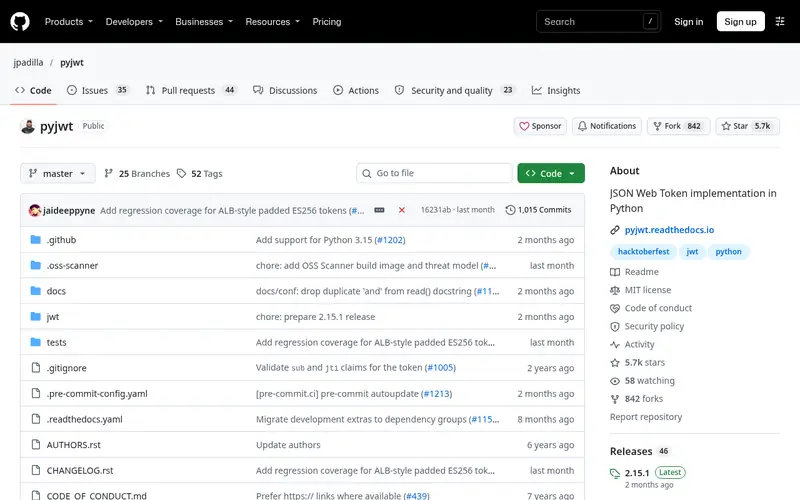
PyJWT is a pure-Python library for encoding and decoding JSON Web Tokens. It supports HMAC, RSA, ECDSA and EdDSA algorithms through optional crypto dependencies. The API is small: you call encode with a payload and key, and decode with the token and key plus an allowed algorithm list. It runs anywhere Python runs, including serverless environments.
The project is open source under the MIT license. It does not handle encrypted tokens (JWE) or OAuth flows, so it is a building block rather than a full auth system. You are responsible for key storage, rotation and claim validation policy. Teams that want a minimal dependency and a clear spec-aligned tool should start here. Skip it if you need JWE or a full identity provider toolkit.
Standout: Simple API for encode and decode
Free (open source), as listed by the vendor (PyJWT website). Confirm the current plan price before you buy.
Free plan. Plans change, so confirm on the vendor's pricing page before you buy.
Benefits
- Simple API for encode and decode
- supports many signing algorithms and key types
Drawbacks
- JWT only, no JWE or OAuth flows
- you handle key management yourself
Skip it if this limit matters to you: JWT only, no JWE or OAuth flows.
Verdict. A sensible pick for teams that need a small, focused JWT encoder and decoder.
Alternatives in this guide: Authlib, python-jose, jwcrypto
Authlib
Best for projects that need JWT plus OAuth and OpenID Connect
What it is and where it fits
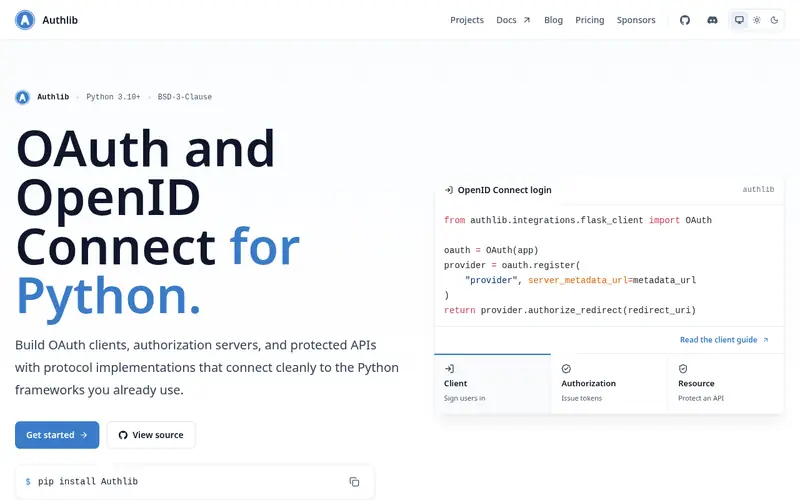
Authlib is a comprehensive library for building OAuth and OpenID Connect clients and servers, and it includes JWT support through its JOSE module. You can sign and verify tokens, manage JSON Web Keys, and plug into framework integrations for Flask, Django and Starlette. It is the choice when your JWT work sits inside a larger auth flow.
The project is open source under the BSD license. Its scope is wider than PyJWT, so the learning curve is steeper, but you avoid pulling in several libraries for OAuth, OIDC and JWT together. Documentation covers client and server setups in detail. Teams that only need to sign a token and check a signature may find it heavier than necessary.
Standout: Covers JWT, JWS, JWE, JWK, OAuth and OpenID Connect
Free (open source), as listed by the vendor (Authlib website). Confirm the current plan price before you buy.
Free plan. Plans change, so confirm on the vendor's pricing page before you buy.
Benefits
- Covers JWT, JWS, JWE, JWK, OAuth and OpenID Connect
- integrates with Flask, Django and FastAPI
Drawbacks
- Larger surface area than a JWT-only library
- more configuration to learn
Skip it if this limit matters to you: larger surface area than a JWT-only library.
Verdict. A sensible pick for projects that need JWT plus OAuth and OpenID Connect.
Alternatives in this guide: PyJWT, python-jose, jwcrypto
python-jose
Best for applications that need JWS, JWE and JWK in one library
What it is and where it fits
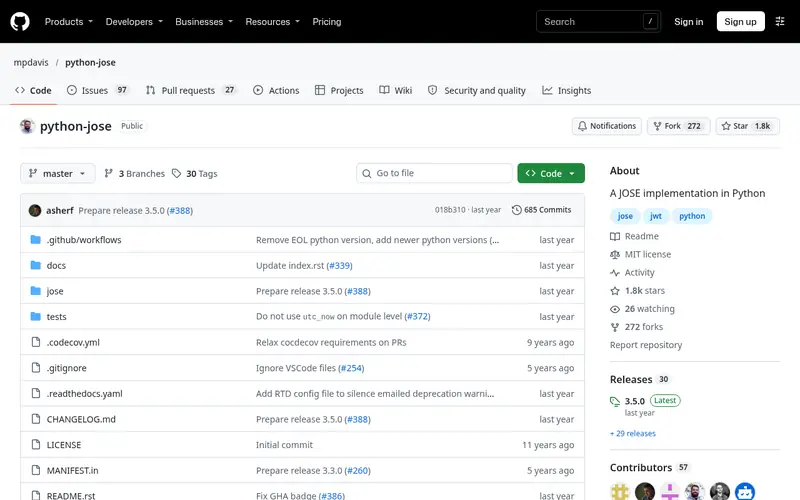
python-jose implements the JavaScript Object Signing and Encryption family: JWS, JWE, JWK and JWT. It lets you sign, verify, encrypt and decrypt tokens, and manage keys as JWK sets. It supports several cryptographic backends, including pyca/cryptography and pycryptodome, chosen at install time.
The library is open source under the MIT license. It is often used in projects that need encrypted tokens, not just signed ones. The main caution is maintenance: check the repository's recent commits and open issues before you commit to it for new production work. If you only need signed JWTs, PyJWT is simpler. If you need the full JOSE stack and want active development, compare it against jwcrypto and Authlib.
Standout: Implements JWS, JWE and JWK alongside JWT
Free (open source), as listed by the vendor (python-jose website). Confirm the current plan price before you buy.
Free plan. Plans change, so confirm on the vendor's pricing page before you buy.
Benefits
- Implements JWS, JWE and JWK alongside JWT
- supports multiple crypto backends
Drawbacks
- Release cadence has been slow
- confirm maintenance status before adopting
Skip it if this limit matters to you: release cadence has been slow.
Verdict. A sensible pick for applications that need JWS, JWE and JWK in one library.
jwcrypto
Best for teams that need a full JOSE implementation with JWK management
What it is and where it fits
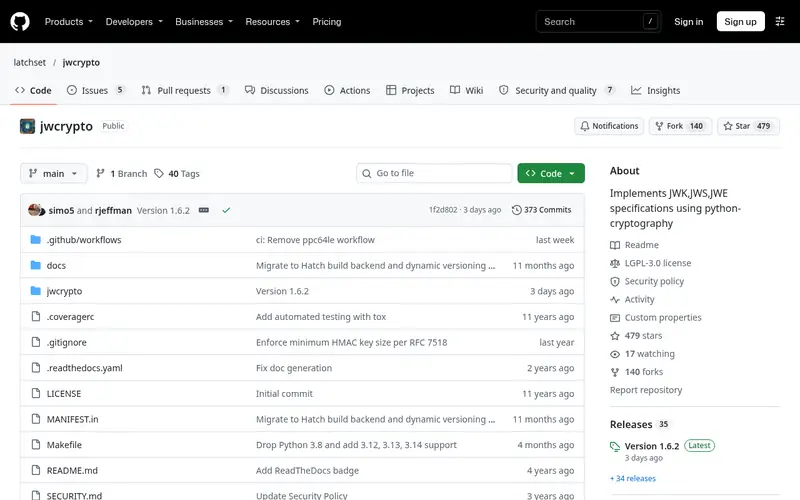
jwcrypto is a JOSE implementation for Python covering JWS, JWE, JWK and JWT. It focuses on the key and crypto layer: you build JWK objects, sign or encrypt with them, and verify or decrypt on the other side. That makes it a good fit when key management and encrypted tokens matter more than a one-line encode call.
The project is open source under the LGPL license. Check that the license fits your distribution model, since LGPL has terms that differ from MIT. The API is more verbose than PyJWT, and you will write more code to get a token signed and checked. It suits backend services and tools that need precise control over algorithms and keys. Skip it if you want the shortest path to a signed JWT.
Standout: Complete JWS and JWE support
Free (open source), as listed by the vendor (jwcrypto website). Confirm the current plan price before you buy.
Free plan. Plans change, so confirm on the vendor's pricing page before you buy.
Benefits
- Complete JWS and JWE support
- strong JWK and key-set handling
Drawbacks
- API is lower level than PyJWT
- fewer framework integrations
Skip it if this limit matters to you: API is lower level than PyJWT.
Verdict. A sensible pick for teams that need a full JOSE implementation with JWK management.
Alternatives in this guide: PyJWT, Authlib, python-jose
python-jwt
Best for minimal JWT encode and decode with a strict, small API
What it is and where it fits
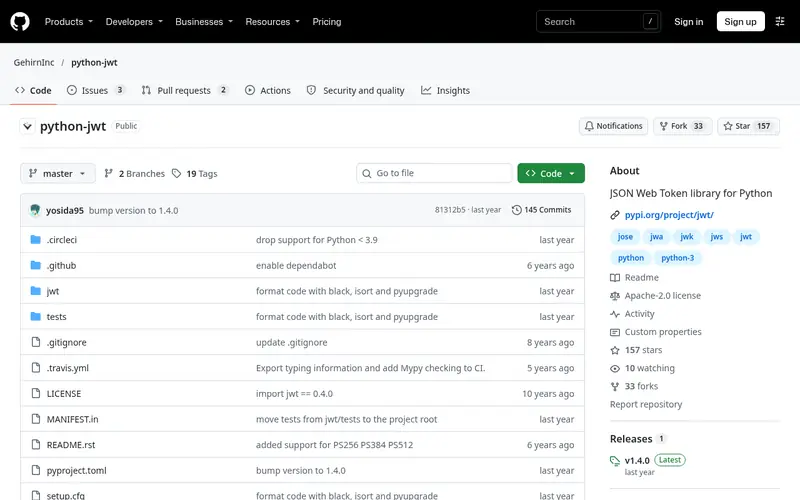
python-jwt is a compact library for encoding and decoding JSON Web Tokens. It exposes a small set of functions and keeps the implementation short, which makes it easy to read and audit. It supports the common HMAC and RSA algorithms.
The project is open source. Because the codebase is small, it has fewer features than PyJWT: expect less built-in help for claim validation and algorithm policy. That also means fewer moving parts. It suits developers who want to read the whole library before trusting it, or who work in constrained environments. For broad algorithm support and active maintenance, PyJWT remains the safer default.
Standout: Very small codebase that is easy to audit
Free (open source), as listed by the vendor (python-jwt website). Confirm the current plan price before you buy.
Free plan. Plans change, so confirm on the vendor's pricing page before you buy.
Benefits
- Very small codebase that is easy to audit
- clear encode and decode functions
Drawbacks
- Limited algorithm coverage compared with PyJWT
- small community
Skip it if this limit matters to you: limited algorithm coverage compared with PyJWT.
Verdict. A sensible pick for minimal JWT encode and decode with a strict, small API.
Alternatives in this guide: PyJWT, Authlib, python-jose
Who should use what
A FastAPI or Django service that only signs and verifies access tokens should use PyJWT. A team building an OAuth or OpenID Connect provider, or integrating with one, should use Authlib. A service that must encrypt token payloads, not just sign them, should compare jwcrypto and python-jose on maintenance and license. A developer who wants to audit every line of the crypto code should look at python-jwt. In all cases, pin the version and review the algorithm allowlist in your decode calls.
Questions to settle before you buy
What to check before you buy
- Confirm the library supports the exact algorithms you plan to use, and pass an explicit allowlist to decode.
- Check the license (MIT, BSD, LGPL) against how you distribute your software.
- Review recent commits, releases and open security issues in the repository.
- Decide whether you need JWE encryption or only JWS signing before picking a library.
- Plan key storage and rotation, since most of these libraries leave that to you.
FAQ
Is PyJWT enough for production JWT handling?
PyJWT is widely used in production and follows RFC 7519. It handles signing and verification well. You still need to manage keys, set token expiry, and pass an explicit algorithm allowlist to decode. It does not encrypt tokens, so use a JOSE library if you need JWE.
What is the difference between JWT, JWS and JWE?
JWT is the token format. JWS is a signed token, which proves integrity but leaves the payload readable. JWE is an encrypted token, which hides the payload. PyJWT and python-jwt focus on signed tokens. jwcrypto, python-jose and Authlib cover both signing and encryption.
Are these Python JWT libraries free?
Yes. All the libraries listed here are open source and free to use. They differ in license: PyJWT, python-jose and python-jwt use permissive licenses, while jwcrypto uses LGPL. Check the license terms if you redistribute code.
Which library should I use for OAuth and OpenID Connect?
Authlib is built for OAuth and OpenID Connect and includes JWT support. It provides client and server flows plus framework integrations. If you only need to verify tokens issued by an identity provider, PyJWT with the provider's public keys is often enough.
How do I avoid common JWT security mistakes?
Always pass an explicit algorithm allowlist to decode, and never accept the "none" algorithm. Verify issuer and audience claims. Keep token lifetimes short. Store signing keys securely and rotate them. Do not paste real tokens or secrets into third-party web debuggers; decode locally instead.
Sources we checked
Method: how we score · editorial policy.
Change log. First published 27 Nov 2026.