Stage 02 · Test · Researched comparison
Best Java WebSocket Libraries in 2026
Spring WebSocket is the first pick for most teams already on Spring, because it adds STOMP messaging, SockJS fallback and a simple handler model on top of the standard Jakarta WebSocket API. If you want a plain, standards-only server, use Jakarta WebSocket (with Tyrus as the reference implementation). If you need raw performance and full control over the network layer, Netty is the better fit.

By Shihab Mia
Published 27 Nov 2026 · 8 tools compared
We run no ads and no affiliate links at launch. The order of a list follows our published method. See how we score.
Prices are the starting prices vendors list publicly. Plans change, so confirm the current price on the vendor page before you buy.
Key takeaways
- Spring WebSocket suits Spring applications that need STOMP, SockJS fallback and message broker integration.
- Jakarta WebSocket and Tyrus are free, open source and follow the Jakarta EE standard for server and client endpoints.
- Netty and Vert.x are free, open source and give low-level control, but you write more wiring yourself.
- All libraries listed here are free or open source; confirm current terms and versions on each project page.
Who each pick is for
- Spring teams needing STOMP and SockJS supportSpring WebSocket
- Standards-based server and client endpoints on Jakarta EEJakarta WebSocket
- Reference implementation and standalone WebSocket clientTyrus
- High-throughput custom WebSocket serversNetty
- Reactive JVM services needing WebSocket and HTTP togetherVert.x
- Embedded servers and clients on the Jetty stackJetty WebSocket
- Lightweight embedded WebSocket serversUndertow
- Portable WebSocket and fallback across containersAtmosphere
Comparison
| Tool | Best for | Standout feature | Listed starting price | Free plan or trial |
|---|---|---|---|---|
| 1Spring WebSocket | Spring teams needing STOMP and SockJS support | Integrates with Spring Boot and Spring Security | Free (open source) | Free plan |
| 2Jakarta WebSocket | Standards-based server and client endpoints on Jakarta EE | Official Jakarta EE specification with broad container support | Free (open source) | Free plan |
| 3Tyrus | Reference implementation and standalone WebSocket client | Reference implementation of Jakarta WebSocket | Free (open source) | Free plan |
| 4Netty | High-throughput custom WebSocket servers | Mature asynchronous network framework with a WebSocket codec | Free (open source) | Free plan |
| 5Vert.x | Reactive JVM services needing WebSocket and HTTP together | Reactive, non-blocking toolkit with a WebSocket API | Free (open source) | Free plan |
| 6Jetty WebSocket | Embedded servers and clients on the Jetty stack | WebSocket support built into a widely used embedded server | Free (open source) | Free plan |
| 7Undertow | Lightweight embedded WebSocket servers | Small, embeddable server with WebSocket handlers | Free (open source) | Free plan |
| 8Atmosphere | Portable WebSocket and fallback across containers | Abstracts WebSocket and fallback transports across containers | Free (open source) | Free plan |
How we picked
We picked libraries that genuinely implement WebSocket servers or clients for Java, then compared fit for the job, supported platforms and containers, licence and price, and the main limits such as ecosystem coupling or missing messaging features. Sources are vendor pages, official documentation and project repositories. Prices and licences can change, so confirm current terms on each project site before you commit.
The tools, one by one
Spring WebSocket
Best for spring teams needing STOMP and SockJS support
What it is and where it fits
Spring WebSocket is part of the Spring Framework and builds on the Jakarta WebSocket API. It adds a handler model, STOMP messaging over WebSocket, SockJS fallback for clients that cannot use WebSocket, and integration with message brokers through the Spring messaging stack. It runs on any JVM that supports the Spring version you choose.
The project is open source under the Apache License 2.0. Most teams use it through the spring-boot-starter-websocket dependency, which pulls in the needed modules. You configure endpoints and message brokers in Java or in Spring configuration. The main limit is coupling: it assumes a Spring application, so it is a poor fit for teams not using Spring or those wanting only the raw standard API.
Standout: Integrates with Spring Boot and Spring Security
Free (open source), as listed by the vendor (Spring WebSocket website). Confirm the current plan price before you buy.
Free plan. Plans change, so confirm on the vendor's pricing page before you buy.
Benefits
- Integrates with Spring Boot and Spring Security
- supports STOMP messaging and SockJS fallback
Drawbacks
- Tied to the Spring ecosystem
- more configuration than a plain endpoint
Skip it if this limit matters to you: tied to the Spring ecosystem.
Verdict. A sensible pick for spring teams needing STOMP and SockJS support.
Alternatives in this guide: Jakarta WebSocket, Tyrus, Netty
Jakarta WebSocket
Best for standards-based server and client endpoints on Jakarta EE
What it is and where it fits
Jakarta WebSocket is the standard API for WebSocket in Jakarta EE. It defines server and client endpoints, annotated and programmatic styles, encoders and decoders for message conversion, and lifecycle callbacks. Because it is a specification, you run it on a compatible container such as GlassFish, WildFly, Tomcat or Payara.
The API is free and open source, and implementations ship with the containers. You get portability across vendors and a stable programming model. The trade-off is that the spec covers the protocol and endpoint model, not higher-level messaging patterns like STOMP or broker integration. Teams that want those features add a library such as Spring WebSocket or build them on top.
Standout: Official Jakarta EE specification with broad container support
Free (open source), as listed by the vendor (Jakarta WebSocket website). Confirm the current plan price before you buy.
Free plan. Plans change, so confirm on the vendor's pricing page before you buy.
Benefits
- Official Jakarta EE specification with broad container support
- covers annotated and programmatic endpoints
Drawbacks
- Specification only, so you need a compatible runtime
- fewer built-in messaging features
Skip it if this limit matters to you: specification only, so you need a compatible runtime.
Verdict. A sensible pick for standards-based server and client endpoints on Jakarta EE.
Alternatives in this guide: Spring WebSocket, Tyrus, Netty
Tyrus
Best for reference implementation and standalone WebSocket client
What it is and where it fits
Tyrus is the Eclipse project that provides the reference implementation of the Jakarta WebSocket API. You can use it inside a compatible container or as a standalone library for client and server endpoints. It supports the standard annotations, encoders and decoders, and the client API, which makes it useful for testing and for applications that need a WebSocket client without a full application server.
Tyrus is open source under the Eclipse Public License 2.0 and the GNU General Public License 2.0 with the Classpath Exception. It is a good choice when you want standards compliance without pulling in Spring. The main drawback is a smaller community and less tutorial material than the larger frameworks, so expect to read the specification and Javadoc.
Standout: Reference implementation of Jakarta WebSocket
Free (open source), as listed by the vendor (Tyrus website). Confirm the current plan price before you buy.
Free plan. Plans change, so confirm on the vendor's pricing page before you buy.
Benefits
- Reference implementation of Jakarta WebSocket
- usable as a standalone client and server
Drawbacks
- Smaller community than Spring or Netty
- documentation is thinner
Skip it if this limit matters to you: smaller community than Spring or Netty.
Verdict. A sensible pick for reference implementation and standalone WebSocket client.
Alternatives in this guide: Spring WebSocket, Jakarta WebSocket, Netty
Netty
Best for high-throughput custom WebSocket servers
What it is and where it fits
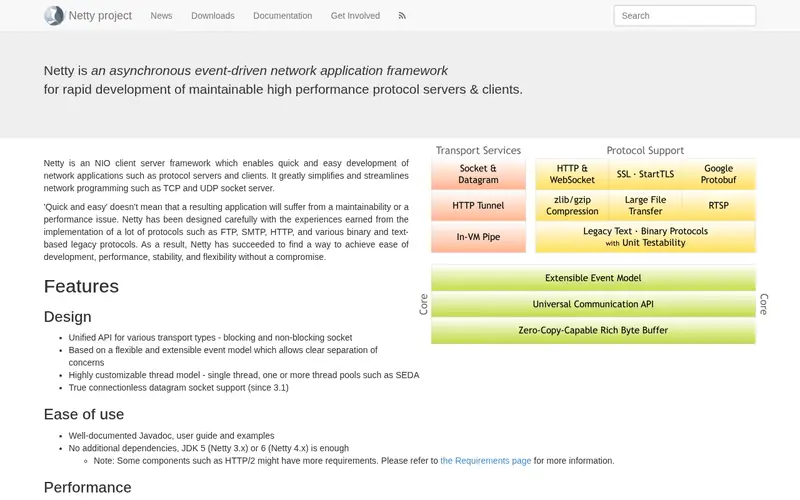
Netty is an asynchronous event-driven network framework. Its HTTP and WebSocket codecs let you build WebSocket servers and clients with control over framing, handshakes, compression and threading. It is the transport layer under many Java frameworks, so it is well tested in production settings.
Netty is open source under the Apache License 2.0. It runs on the JVM and does not require an application server. The cost is complexity: you manage channel pipelines, event loops and buffer lifetimes, and you implement higher-level messaging yourself. Choose Netty when throughput and control matter more than convenience, and skip it for small apps where a standard container is enough.
Standout: Mature asynchronous network framework with a WebSocket codec
Free (open source), as listed by the vendor (Netty website). Confirm the current plan price before you buy.
Free plan. Plans change, so confirm on the vendor's pricing page before you buy.
Benefits
- Mature asynchronous network framework with a WebSocket codec
- fine control over threads and buffers
Drawbacks
- Low-level API with a steep learning curve
- you handle more protocol details
Skip it if this limit matters to you: low-level API with a steep learning curve.
Verdict. A sensible pick for high-throughput custom WebSocket servers.
Alternatives in this guide: Spring WebSocket, Jakarta WebSocket, Tyrus
Vert.x
Best for reactive JVM services needing WebSocket and HTTP together
What it is and where it fits
Vert.x is a reactive toolkit for the JVM. Its HTTP server and client support WebSocket upgrades, and the event bus lets you route messages between components. It works with Java, Kotlin and other JVM languages, and it can run embedded or as part of a larger Vert.x application.
Vert.x is open source under the Apache License 2.0 and the Eclipse Public License 2.0. It suits services that already use reactive patterns or need many concurrent connections with few threads. The main limit is the learning curve: the callback and future style differs from blocking servlet code, and teams outside the Vert.x ecosystem may prefer Spring or the standard API.
Standout: Reactive, non-blocking toolkit with a WebSocket API
Free (open source), as listed by the vendor (Vert.x website). Confirm the current plan price before you buy.
Free plan. Plans change, so confirm on the vendor's pricing page before you buy.
Benefits
- Reactive, non-blocking toolkit with a WebSocket API
- integrates HTTP, event bus and other protocols
Drawbacks
- Different programming model from servlet stacks
- ecosystem is smaller than Spring
Skip it if this limit matters to you: different programming model from servlet stacks.
Verdict. A sensible pick for reactive JVM services needing WebSocket and HTTP together.
Alternatives in this guide: Spring WebSocket, Jakarta WebSocket, Tyrus
Jetty WebSocket
Best for embedded servers and clients on the Jetty stack
What it is and where it fits
Jetty is a Java HTTP server and servlet container with WebSocket support in its own API and through Jakarta WebSocket. You can embed it in an application, run it standalone, and use it as a WebSocket client. It supports the standard endpoint model plus Jetty-specific APIs for more control.
Jetty is open source under the Apache License 2.0 and the Eclipse Public License 2.0. It is a practical choice for embedded servers, testing and applications that already depend on Jetty. The main limit is scope: it gives you the server and WebSocket layer, not a messaging protocol or broker integration, so larger messaging features are your responsibility.
Standout: WebSocket support built into a widely used embedded server
Free (open source), as listed by the vendor (Jetty WebSocket website). Confirm the current plan price before you buy.
Free plan. Plans change, so confirm on the vendor's pricing page before you buy.
Benefits
- WebSocket support built into a widely used embedded server
- works as client and server
Drawbacks
- Best value when you already use Jetty
- not a standalone messaging framework
Skip it if this limit matters to you: best value when you already use Jetty.
Verdict. A sensible pick for embedded servers and clients on the Jetty stack.
Alternatives in this guide: Spring WebSocket, Jakarta WebSocket, Tyrus
Undertow
Best for lightweight embedded WebSocket servers
What it is and where it fits
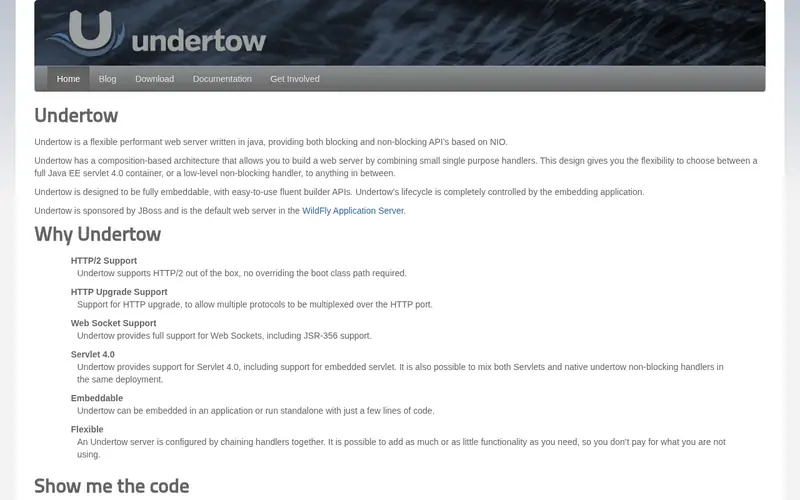
Undertow is a flexible, embeddable web server from the WildFly project. It provides WebSocket handlers for server endpoints and works with the Jakarta WebSocket API in compatible setups. It is designed for low overhead and can be embedded directly in a Java application.
Undertow is open source under the Apache License 2.0. It is a good fit when you want a small server with WebSocket support and do not need a full application server. The trade-off is a smaller standalone community and fewer high-level features than Spring, so you build messaging and fallback behavior yourself. It is less suitable for teams that want batteries-included messaging.
Standout: Small, embeddable server with WebSocket handlers
Free (open source), as listed by the vendor (Undertow website). Confirm the current plan price before you buy.
Free plan. Plans change, so confirm on the vendor's pricing page before you buy.
Benefits
- Small, embeddable server with WebSocket handlers
- used inside WildFly
Drawbacks
- Smaller standalone community
- fewer high-level messaging features
Skip it if this limit matters to you: smaller standalone community.
Verdict. A sensible pick for lightweight embedded WebSocket servers.
Alternatives in this guide: Spring WebSocket, Jakarta WebSocket, Tyrus
Atmosphere
Best for portable WebSocket and fallback across containers
What it is and where it fits
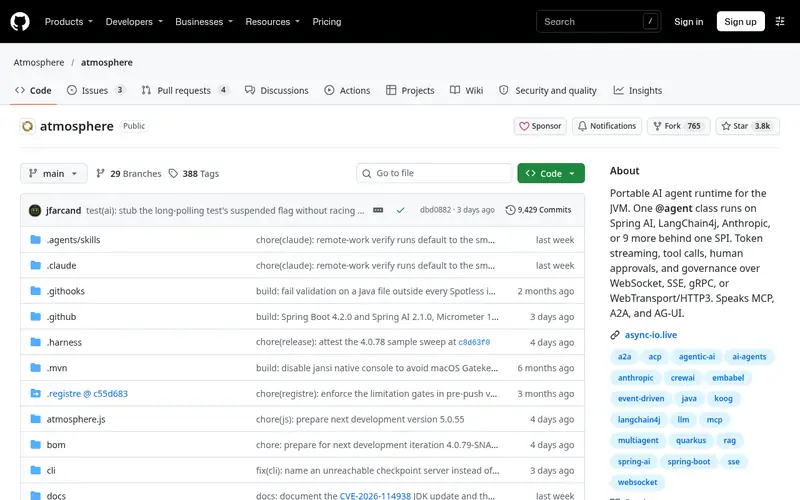
Atmosphere is a framework for asynchronous messaging that supports WebSocket and fallback transports such as long polling. It runs on multiple containers and integrates with frameworks including Spring and Jersey. It is useful when you need the same messaging code to work across environments that do not all support WebSocket.
Atmosphere is open source under the Apache License 2.0 and the Eclipse Public License 2.0. It handles transport negotiation and connection tracking, which saves work when fallback matters. The main limits are an extra abstraction layer and a smaller community than the largest frameworks. Teams that control both client and server and can rely on WebSocket may not need it.
Standout: Abstracts WebSocket and fallback transports across containers
Free (open source), as listed by the vendor (Atmosphere website). Confirm the current plan price before you buy.
Free plan. Plans change, so confirm on the vendor's pricing page before you buy.
Benefits
- Abstracts WebSocket and fallback transports across containers
- works with several frameworks
Drawbacks
- Smaller community than Spring or Netty
- adds an abstraction layer to learn
Skip it if this limit matters to you: smaller community than Spring or Netty.
Verdict. A sensible pick for portable WebSocket and fallback across containers.
Alternatives in this guide: Spring WebSocket, Jakarta WebSocket, Tyrus
Who should use what
If you are building a Spring Boot application and want STOMP messaging with SockJS fallback, start with Spring WebSocket. If you need a standards-only endpoint that runs on any Jakarta EE container, use Jakarta WebSocket with Tyrus as the reference implementation. If you are writing a high-throughput custom server and want control over the network layer, choose Netty. If you want a small embedded server with WebSocket support and already use Jetty or Undertow, stay with that stack. Teams needing transport fallback across containers should look at Atmosphere.
Questions to settle before you buy
What to check before you buy
- Confirm the library supports your container or runtime, and check the Jakarta EE version it targets.
- Decide whether you need only the WebSocket protocol or higher-level messaging such as STOMP and broker integration.
- Check the licence and confirm it fits your distribution model.
- Plan authentication and authorization for the handshake and for messages.
- Test reconnect, heartbeat and backpressure behavior under real network conditions.
FAQ
Do I need Spring to use WebSocket in Java?
No. Jakarta WebSocket is the standard API and runs on compatible containers without Spring. Spring WebSocket adds convenience features such as STOMP and SockJS, but it is optional. Many applications use the standard API directly or through a reference implementation like Tyrus.
What is the difference between Jakarta WebSocket and Tyrus?
Jakarta WebSocket is the specification that defines the API. Tyrus is the Eclipse project that provides the reference implementation of that specification. You can use Tyrus inside a compatible container or as a standalone client and server library.
Can these libraries act as WebSocket clients?
Yes. Jakarta WebSocket, Tyrus, Jetty, Netty and Vert.x all provide client APIs as well as server support. Check the documentation for the client container and threading model, since they differ between libraries.
Is Netty faster than Spring WebSocket?
Netty gives you lower-level control over threads, buffers and framing, which can help with high connection counts. Spring WebSocket runs on top of a container and adds messaging features. We do not publish benchmarks, so measure your own workload before choosing.
Are these libraries free to use?
All libraries listed here are free or open source. Spring, Netty, Vert.x, Jetty, Undertow and Atmosphere use the Apache License 2.0, and some also offer the Eclipse Public License 2.0. Tyrus uses the Eclipse Public License 2.0 and GPL 2.0 with the Classpath Exception. Confirm terms on each project page.
Sources we checked
Method: how we score · editorial policy.
Change log. First published 27 Nov 2026.