Stage 02 · Test · Researched comparison
Best Java JWT Libraries in 2026
JJWT is the first pick for most Java teams. It has a fluent API, handles signing and verification, and supports both symmetric and asymmetric keys. Nimbus JOSE+JWT suits projects that need full JOSE coverage, including JWE encryption and JWK key sets. Auth0 java-jwt is a lighter option for teams that want a small API focused on signing and verifying tokens.

By Shihab Mia
Published 27 Nov 2026 · 7 tools compared
We run no ads and no affiliate links at launch. The order of a list follows our published method. See how we score.
Prices are the starting prices vendors list publicly. Plans change, so confirm the current price on the vendor page before you buy.
Key takeaways
- JJWT, Nimbus JOSE+JWT, Auth0 java-jwt, FusionAuth java-jwt and jose4j are all free and open source.
- Nimbus JOSE+JWT and jose4j cover JWS, JWE and JWK, which matters when you need encryption or key rotation.
- All five libraries run in plain Java and do not send token data to a third party.
- Some libraries have optional paid support or commercial editions, so confirm terms on the vendor page.
Who each pick is for
- Teams that want a simple, fluent signing and verification APIJJWT
- Projects that need full JOSE support, including JWE and JWKNimbus JOSE+JWT
- Developers who want a small API for signing and verifying tokensAuth0 java-jwt
- Teams that need JOSE features plus fine-grained validation controlsjose4j
- Teams already using FusionAuth or wanting a maintained fork of java-jwtFusionAuth java-jwt
- Spring applications that need JWT support built into the security stackSpring Security OAuth2 JOSE
- Vert.x applications that need JWT authentication in the frameworkvertx-auth-jwt
Comparison
| Tool | Best for | Standout feature | Listed starting price | Free plan or trial |
|---|---|---|---|---|
| 1JJWT | Teams that want a simple, fluent signing and verification API | Fluent builder API for claims and keys | Free (open source) | Free plan |
| 2Nimbus JOSE+JWT | Projects that need full JOSE support, including JWE and JWK | Broad coverage of JWS, JWE and JWK | Free (open source) | Free plan |
| 3Auth0 java-jwt | Developers who want a small API for signing and verifying tokens | Compact API with clear algorithm classes | Free (open source) | Free plan |
| 4jose4j | Teams that need JOSE features plus fine-grained validation controls | Covers JWS, JWE and JWK | Free (open source) | Free plan |
| 5FusionAuth java-jwt | Teams already using FusionAuth or wanting a maintained fork of java-jwt | Actively maintained fork with the familiar java-jwt API | Free (open source) | Free plan |
| 6Spring Security OAuth2 JOSE | Spring applications that need JWT support built into the security stack | Integrates with Spring Security filter chains | Free (open source) | Free plan |
| 7vertx-auth-jwt | Vert.x applications that need JWT authentication in the framework | Fits the Vert.x auth model | Free (open source) | Free plan |
How we picked
We compared libraries on fit for creating and verifying JWTs in Java, platform support, licence and price, algorithm coverage, and documented limits. We also looked at whether each library keeps token handling local, which all of these do since they run in your own JVM. Sources are vendor pages, official documentation and project repositories. Prices and licence terms can change, so confirm them on the vendor site before you commit.
The tools, one by one
JJWT
Best for teams that want a simple, fluent signing and verification API
What it is and where it fits
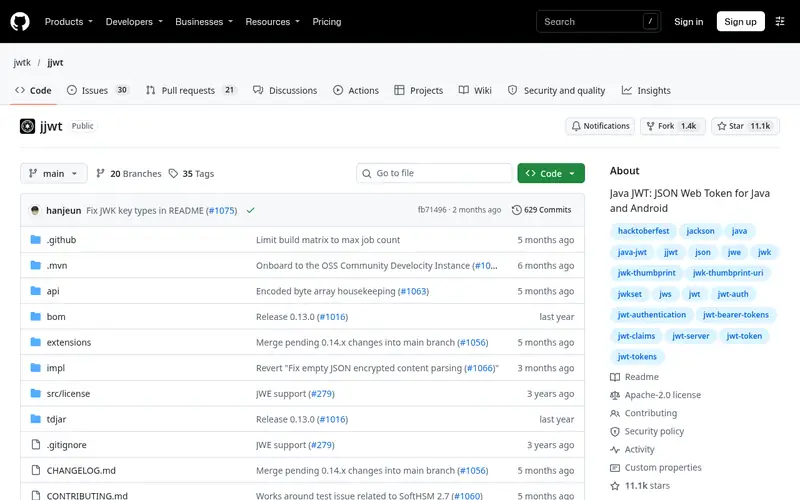
JJWT is a Java library for building and parsing JWTs. You create a token with a builder, set claims and a signing key, then compact it to a string. Parsing uses a matching builder that verifies the signature and checks claims such as expiration. It supports HMAC, RSA, ECDSA and EdDSA signing through pluggable algorithms.
The library targets standard Java and works on the JVM, including Android with some configuration. It is distributed under the Apache 2.0 license. JJWT focuses on JWS, so teams that need JWE encryption or JWK set handling should look at Nimbus or jose4j. The main limit is that the API has changed between major versions, so pin your version and read the migration notes.
Standout: Fluent builder API for claims and keys
Free (open source), as listed by the vendor (JJWT website). Confirm the current plan price before you buy.
Free plan. Plans change, so confirm on the vendor's pricing page before you buy.
Benefits
- Fluent builder API for claims and keys
- supports JWS signing and verification with many algorithms
Drawbacks
- Encryption support is limited compared with full JOSE libraries
- API changed across major versions
Skip it if this limit matters to you: encryption support is limited compared with full JOSE libraries.
Verdict. A sensible pick for teams that want a simple, fluent signing and verification API.
Alternatives in this guide: Nimbus JOSE+JWT, Auth0 java-jwt, jose4j
Nimbus JOSE+JWT
Best for projects that need full JOSE support, including JWE and JWK
What it is and where it fits
Nimbus JOSE+JWT is a Java library that implements JSON Object Signing and Encryption. It covers signed tokens (JWS), encrypted tokens (JWE) and JSON Web Keys (JWK), including key sets and key generation. That makes it a fit for systems that rotate keys or need encrypted tokens, not just signed ones.
It runs on standard Java and is published under the Apache 2.0 license. The API is more explicit than JJWT, so a basic sign-and-verify flow takes a few more lines. In return you get coverage of the wider JOSE spec and helpers for JWK parsing and selection. Teams with simple HMAC signing may find it heavier than needed.
Standout: Broad coverage of JWS, JWE and JWK
Free (open source), as listed by the vendor (Nimbus JOSE+JWT website). Confirm the current plan price before you buy.
Free plan. Plans change, so confirm on the vendor's pricing page before you buy.
Benefits
- Broad coverage of JWS, JWE and JWK
- well documented with many examples
Drawbacks
- Larger API surface to learn
- more configuration for simple signing tasks
Skip it if this limit matters to you: larger API surface to learn.
Verdict. A sensible pick for projects that need full JOSE support, including JWE and JWK.
Alternatives in this guide: JJWT, Auth0 java-jwt, jose4j
Auth0 java-jwt
Best for developers who want a small API for signing and verifying tokens
What it is and where it fits
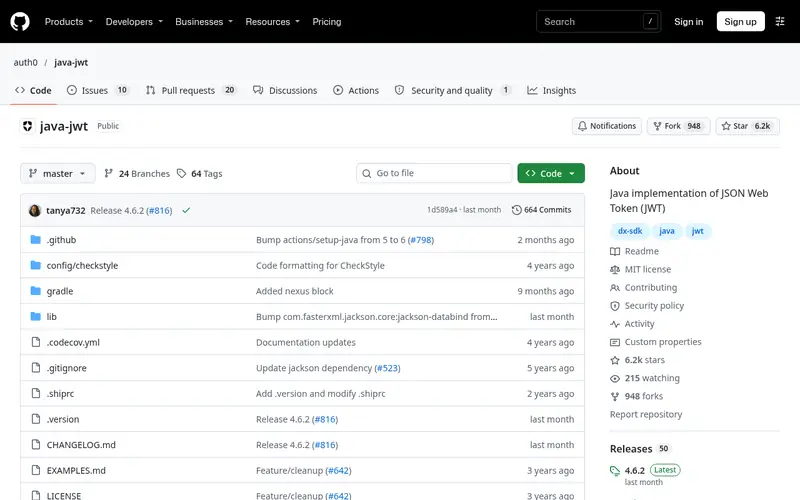
Auth0 java-jwt is a Java library for creating and verifying JWTs. You pick an algorithm such as HMAC256 or RSA256, build a token with claims and a verifier, and decode incoming tokens with a verifier that checks the signature and claims. The API is small and easy to read.
It runs on the JVM and is released under the MIT license. The library focuses on JWS signing and verification. It does not provide JWE encryption or a full JWK set implementation, so it suits services that only need signed access tokens. Teams that need encryption or complex key handling should choose Nimbus or jose4j instead.
Standout: Compact API with clear algorithm classes
Free (open source), as listed by the vendor (Auth0 java-jwt website). Confirm the current plan price before you buy.
Free plan. Plans change, so confirm on the vendor's pricing page before you buy.
Benefits
- Compact API with clear algorithm classes
- MIT license
Drawbacks
- No JWE encryption support
- fewer JWK helpers than Nimbus
Skip it if this limit matters to you: no JWE encryption support.
Verdict. A sensible pick for developers who want a small API for signing and verifying tokens.
Alternatives in this guide: JJWT, Nimbus JOSE+JWT, jose4j
jose4j
Best for teams that need JOSE features plus fine-grained validation controls
What it is and where it fits
jose4j is a Java library that implements JOSE standards, including JWS, JWE and JWK. It provides builders for producing tokens and consumers for validating them, with options to check issuer, audience, expiration and other claims. It also supports key management for encrypted tokens.
The library runs on standard Java and is distributed under the Apache 2.0 license. It is a good fit when you need strict validation rules or encrypted tokens and want explicit control over each check. The trade-off is a more verbose API and documentation that lives mostly in a project wiki, so simple signing tasks take more code than with JJWT.
Standout: Covers JWS, JWE and JWK
Free (open source), as listed by the vendor (jose4j website). Confirm the current plan price before you buy.
Free plan. Plans change, so confirm on the vendor's pricing page before you buy.
Benefits
- Covers JWS, JWE and JWK
- detailed control over claim and header validation
Drawbacks
- Documentation is spread across a wiki
- API is verbose for simple cases
Skip it if this limit matters to you: documentation is spread across a wiki.
Verdict. A sensible pick for teams that need JOSE features plus fine-grained validation controls.
Alternatives in this guide: JJWT, Nimbus JOSE+JWT, Auth0 java-jwt
FusionAuth java-jwt
Best for teams already using FusionAuth or wanting a maintained fork of java-jwt
What it is and where it fits
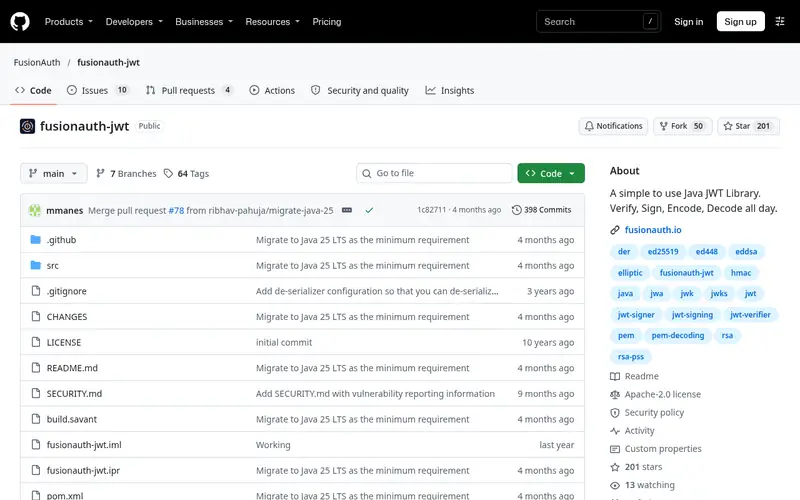
FusionAuth java-jwt is a fork of the Auth0 java-jwt library maintained by FusionAuth. It keeps the same style of API for signing and verifying tokens, so code written against java-jwt is close to compatible. It adds maintenance and fixes from the FusionAuth team.
It runs on the JVM and is released under the Apache 2.0 license. Like the original, it focuses on JWS signing and verification and does not provide JWE encryption or full JWK set handling. It suits teams that want a maintained version of the java-jwt API or that already use FusionAuth products. Check the changelog for differences from the upstream library before switching.
Standout: Actively maintained fork with the familiar java-jwt API
Free (open source), as listed by the vendor (FusionAuth java-jwt website). Confirm the current plan price before you buy.
Free plan. Plans change, so confirm on the vendor's pricing page before you buy.
Benefits
- Actively maintained fork with the familiar java-jwt API
- Apache 2.0 license
Drawbacks
- Smaller community than the original
- no JWE encryption support
Skip it if this limit matters to you: smaller community than the original.
Verdict. A sensible pick for teams already using FusionAuth or wanting a maintained fork of java-jwt.
Alternatives in this guide: JJWT, Nimbus JOSE+JWT, Auth0 java-jwt
Spring Security OAuth2 JOSE
Best for spring applications that need JWT support built into the security stack
What it is and where it fits
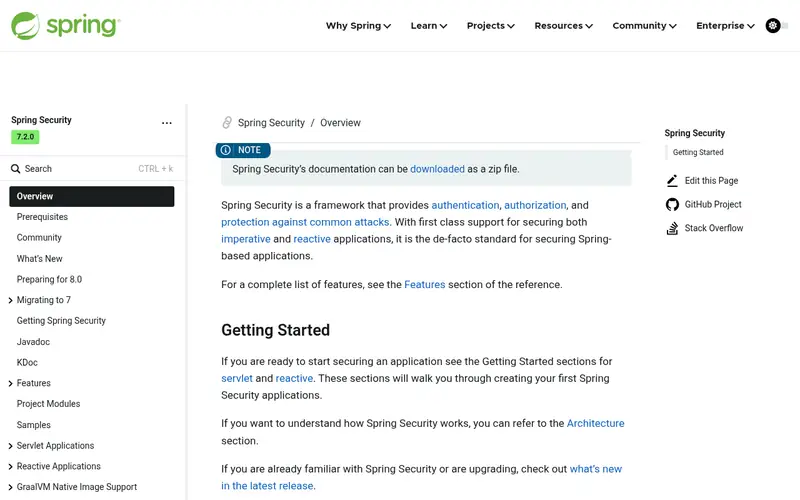
Spring Security provides JOSE support through its OAuth2 JOSE module. It includes JWT encoders and decoders, Nimbus-based JWK handling and integration with Spring Security's resource server configuration. If your application already uses Spring Security, this keeps token validation inside the same filter chain.
It runs on the JVM and is released under the Apache 2.0 license. The JOSE classes wrap the Nimbus library, so you get similar algorithm coverage with Spring-style configuration. The main limit is that it is designed for Spring applications. A plain Java service or a non-Spring framework is better served by JJWT, Nimbus or jose4j directly.
Standout: Integrates with Spring Security filter chains
Free (open source), as listed by the vendor (Spring Security OAuth2 JOSE website). Confirm the current plan price before you buy.
Free plan. Plans change, so confirm on the vendor's pricing page before you buy.
Benefits
- Integrates with Spring Security filter chains
- includes JWT decoder and encoder support
Drawbacks
- Tied to the Spring ecosystem
- more setup than a standalone library
Skip it if this limit matters to you: tied to the Spring ecosystem.
Verdict. A sensible pick for spring applications that need JWT support built into the security stack.
Alternatives in this guide: JJWT, Nimbus JOSE+JWT, Auth0 java-jwt
vertx-auth-jwt
Best for vert.x applications that need JWT authentication in the framework
What it is and where it fits
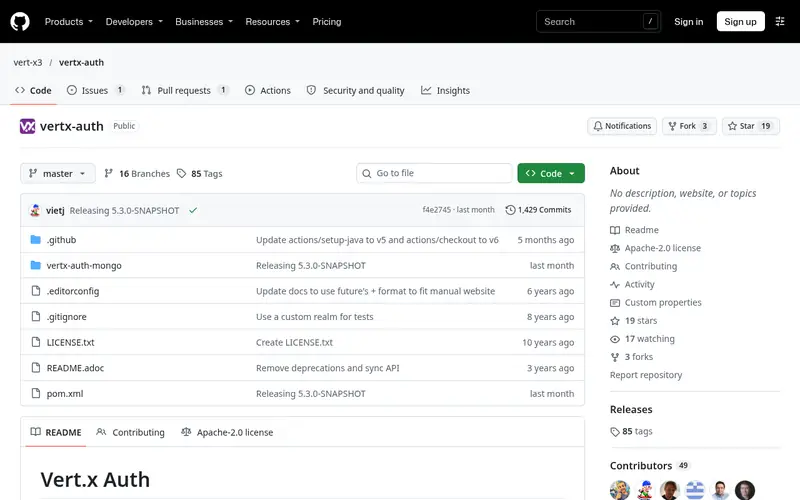
vertx-auth-jwt is the JWT authentication module for the Vert.x toolkit. It provides a JWT auth provider that validates tokens and exposes claims to handlers, plus support for JWK and key rotation. It plugs into Vert.x routing and auth handlers.
It runs on the JVM and is released under the Apache 2.0 license. The module is built for Vert.x applications, so it is not a good choice for a plain Java service or a Spring application. If you use Vert.x and want token validation inside the framework's auth model, it removes the need to wire a separate library by hand.
Standout: Fits the Vert.x auth model
Free (open source), as listed by the vendor (vertx-auth-jwt website). Confirm the current plan price before you buy.
Free plan. Plans change, so confirm on the vendor's pricing page before you buy.
Benefits
- Fits the Vert.x auth model
- supports JWK and key rotation
Drawbacks
- Only useful inside Vert.x
- not a general-purpose standalone library
Skip it if this limit matters to you: only useful inside Vert.x.
Verdict. A sensible pick for vert.x applications that need JWT authentication in the framework.
Alternatives in this guide: JJWT, Nimbus JOSE+JWT, Auth0 java-jwt
Who should use what
If you need a quick sign-and-verify flow with a fluent API, start with JJWT. If you need encrypted tokens, JWK sets or key rotation, choose Nimbus JOSE+JWT or jose4j. If you are already on Spring Security, use its JOSE module so validation stays in the security filter chain. If you use Vert.x, vertx-auth-jwt fits the framework's auth model. Teams that want the java-jwt API can pick the original project or the FusionAuth fork, depending on maintenance activity.
Questions to settle before you buy
What to check before you buy
- Confirm the library supports the algorithms you plan to use, including key sizes and curves.
- Check how it validates claims such as issuer, audience and expiration, and whether those checks are on by default.
- Verify the licence fits your project and that the version you pin is still maintained.
- Decide whether you need JWE encryption or JWK set handling, since not every library covers them.
- Review the migration notes for major version changes before upgrading in production.
FAQ
Which Java JWT library is best for most projects?
JJWT is a good default for signing and verifying tokens because of its fluent API and broad algorithm support. Choose Nimbus JOSE+JWT or jose4j if you need JWE encryption or JWK set handling. Spring and Vert.x applications can use the JWT support built into those frameworks.
Do these libraries send my tokens to a third party?
No. All the libraries listed run inside your own JVM and handle tokens locally. They do not call an external service to sign or verify tokens. Your keys and token data stay in your application and infrastructure.
Can I use these libraries for encrypted tokens?
Nimbus JOSE+JWT and jose4j support JWE encryption. JJWT, Auth0 java-jwt and FusionAuth java-jwt focus on JWS signing and verification. Check the documentation for the specific algorithms and key types you need before choosing.
Are these libraries free?
Yes. All the libraries listed are open source and free to use under licences such as Apache 2.0 or MIT. Some vendors offer optional paid support or commercial products, so check the vendor page if you need support terms.
How do I handle key rotation?
Nimbus JOSE+JWT and jose4j provide JWK set support, which helps with key rotation. You load the key set, select the key by key ID, and verify tokens against it. Simpler libraries require you to manage keys and key IDs yourself.
Sources we checked
Method: how we score · editorial policy.
Change log. First published 27 Nov 2026.