Stage 02 · Test · Researched comparison
Best Go WebSocket Libraries in 2026
Gorilla WebSocket is the first pick for most teams. It is a small, stable library that gives you direct control over the connection, and it suits projects that want a plain RFC 6455 implementation without extra abstractions. If you want a maintained library with a context-aware API and no dependencies, look at coder/websocket (formerly nhooyr.io/websocket). If you need a full pub/sub server with scaling, Centrifugo is the alternative.

By Shihab Mia
Published 27 Nov 2026 · 6 tools compared
We run no ads and no affiliate links at launch. The order of a list follows our published method. See how we score.
Prices are the starting prices vendors list publicly. Plans change, so confirm the current price on the vendor page before you buy.
Key takeaways
- Gorilla WebSocket, coder/websocket and gobwas/ws are all free and open source, so cost is not a deciding factor between them.
- Gorilla WebSocket and gobwas/ws sit close to the wire protocol; Melody and Centrifugo add higher-level abstractions.
- coder/websocket has no third-party dependencies, which simplifies vendoring and security review.
- Centrifugo is a standalone server rather than a Go library, so pick it only when you need a separate messaging tier.
Who each pick is for
- Teams that want a stable, low-level RFC 6455 implementationGorilla WebSocket
- Developers who want a minimal, dependency-free library with context supportcoder/websocket
- Performance-sensitive services that want control over buffers and allocationgobwas/ws
- Small apps that want sessions, broadcast and rooms without a frameworkMelody
- Teams that want a standalone real-time messaging server with scalingCentrifugo
- Services already built on the fasthttp serverFasthttp WebSocket
Comparison
| Tool | Best for | Standout feature | Listed starting price | Free plan or trial |
|---|---|---|---|---|
| 1Gorilla WebSocket | Teams that want a stable, low-level RFC 6455 implementation | Widely used and well documented | Free (open source) | Free plan |
| 2coder/websocket | Developers who want a minimal, dependency-free library with context support | No third-party dependencies | Free (open source) | Free plan |
| 3gobwas/ws | Performance-sensitive services that want control over buffers and allocation | Low-level API with fine control over framing and buffers | Free (open source) | Free plan |
| 4Melody | Small apps that want sessions, broadcast and rooms without a framework | Built-in session and broadcast helpers | Free (open source) | Free plan |
| 5Centrifugo | Teams that want a standalone real-time messaging server with scaling | Separate server with pub/sub channels, presence and history | Free (open source) | Free plan |
| 6Fasthttp WebSocket | Services already built on the fasthttp server | Works with fasthttp handlers and its request context | Free (open source) | Free plan |
How we picked
We picked libraries that implement WebSocket functionality for Go and are currently maintained, with a public repository or vendor documentation. Criteria were fit for common server-side jobs, supported platforms (all are pure Go and run where Go runs), license and price, and the main limits such as missing scaling or extra operational services. We did not run benchmarks. Sources are vendor pages, project repositories and public documentation. Prices and maintenance status change, so confirm details on the vendor or repository page before you commit.
The tools, one by one
Gorilla WebSocket
Best for teams that want a stable, low-level RFC 6455 implementation
What it is and where it fits
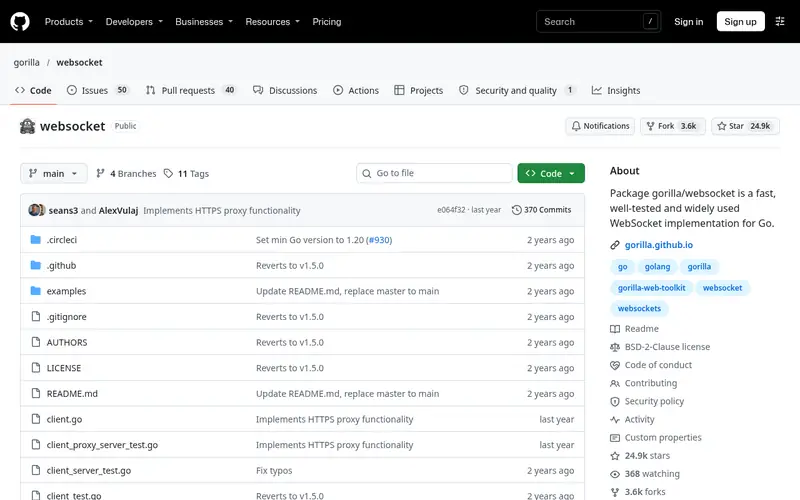
Gorilla WebSocket is a pure Go implementation of the WebSocket protocol. It gives you a Conn type with read and write methods, plus helpers for the upgrade handshake, ping/pong and close frames. It runs anywhere Go runs. The project is released under the BSD 3-Clause license. It was archived for a period and then returned to active maintenance under the Gorilla organization, so check the repository for the current commit activity before you depend on it. It does not handle message routing, broadcast or horizontal scaling. Skip it if you want a framework that manages rooms and presence for you.
Standout: Widely used and well documented
Free (open source), as listed by the vendor (Gorilla WebSocket website). Confirm the current plan price before you buy.
Free plan. Plans change, so confirm on the vendor's pricing page before you buy.
Benefits
- Widely used and well documented
- simple API that maps closely to the WebSocket protocol
Drawbacks
- No built-in rooms, pub/sub or scaling
- you write reconnection and hub logic yourself
Skip it if this limit matters to you: no built-in rooms, pub/sub or scaling.
Verdict. A sensible pick for teams that want a stable, low-level RFC 6455 implementation.
Alternatives in this guide: coder/websocket, gobwas/ws, Melody
coder/websocket
Best for developers who want a minimal, dependency-free library with context support
What it is and where it fits
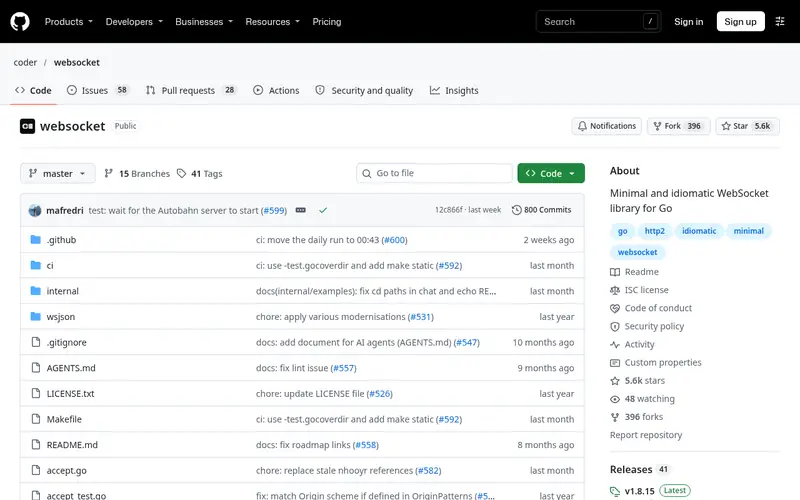
coder/websocket was formerly published as nhooyr.io/websocket and is now maintained under the Coder organization. It implements RFC 6455 and passes the Autobahn test suite according to its documentation. The API is small: Dial, Accept and a Conn with Read and Write methods that take a context. That makes cancellation and deadlines straightforward. It is MIT licensed and has no external module dependencies, which helps with vendoring and supply-chain review. It does not provide a hub, rooms or scaling. It suits services that want a thin layer over the protocol and are comfortable writing their own connection management.
Standout: No third-party dependencies
Free (open source), as listed by the vendor (coder/websocket website). Confirm the current plan price before you buy.
Free plan. Plans change, so confirm on the vendor's pricing page before you buy.
Benefits
- No third-party dependencies
- API uses context.Context for reads and writes
Drawbacks
- Low-level like Gorilla, so you build routing yourself
- smaller ecosystem of examples
Skip it if this limit matters to you: low-level like Gorilla, so you build routing yourself.
Verdict. A sensible pick for developers who want a minimal, dependency-free library with context support.
Alternatives in this guide: Gorilla WebSocket, gobwas/ws, Melody
gobwas/ws
Best for performance-sensitive services that want control over buffers and allocation
What it is and where it fits
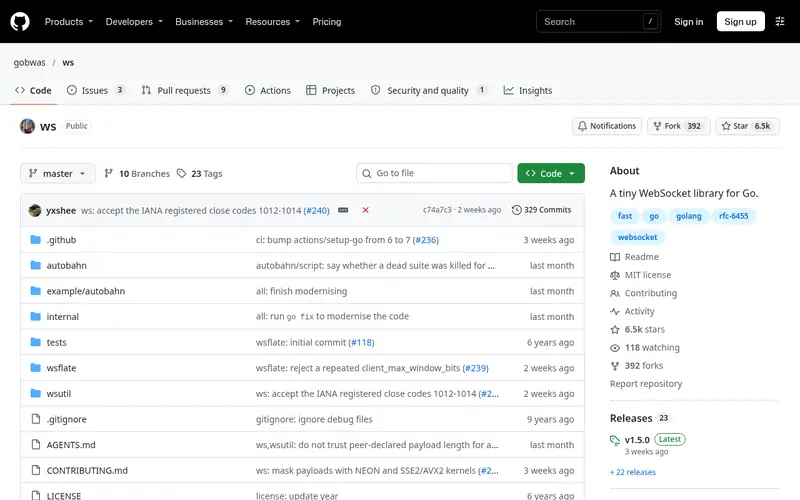
gobwas/ws is a WebSocket library focused on control over the protocol layer. It exposes frame reading and writing primitives and lets you manage buffers yourself, which can reduce allocations in high-throughput services. It handles the HTTP upgrade, masking and the frame format. It is MIT licensed and pure Go. Because it is deliberately low-level, you write more glue code for message assembly, ping handling and connection lifecycle. It is a reasonable fit for teams that have already profiled their workload and want to tune the hot path. Most CRUD-style applications will be faster to build on Gorilla or coder/websocket.
Standout: Low-level API with fine control over framing and buffers
Free (open source), as listed by the vendor (gobwas/ws website). Confirm the current plan price before you buy.
Free plan. Plans change, so confirm on the vendor's pricing page before you buy.
Benefits
- Low-level API with fine control over framing and buffers
- includes helpers for upgrade and masking
Drawbacks
- More code to write for common tasks
- fewer high-level examples than Gorilla
Skip it if this limit matters to you: more code to write for common tasks.
Verdict. A sensible pick for performance-sensitive services that want control over buffers and allocation.
Alternatives in this guide: Gorilla WebSocket, coder/websocket, Melody
Melody
Best for small apps that want sessions, broadcast and rooms without a framework
What it is and where it fits
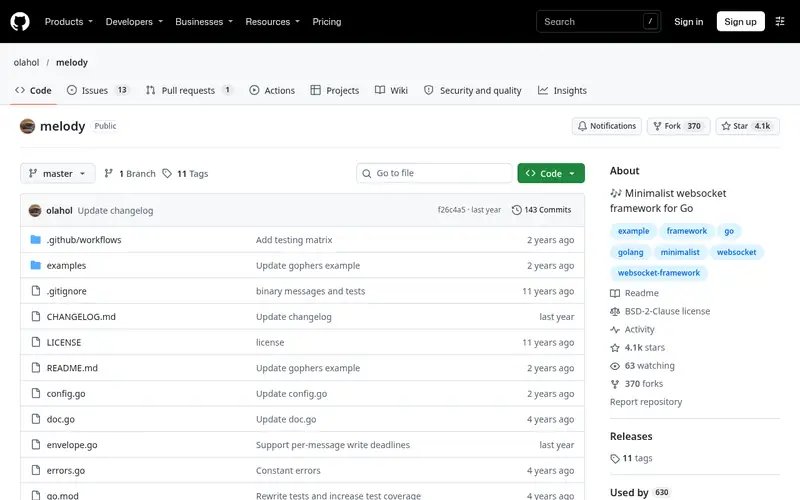
Melody is a small framework layered on top of Gorilla WebSocket. It adds a Session type, broadcast to all or selected sessions, and simple room-like grouping through session filters. You attach it to a standard net/http handler, which keeps it compatible with common Go routers. It is BSD 2-Clause licensed. Melody does not provide persistence, message history or cross-node delivery, so a multi-instance deployment still needs a broker such as Redis pub/sub. It fits prototypes, internal tools and small chat features. Skip it if you need a full messaging platform or strict control over the wire layer.
Standout: Built-in session and broadcast helpers
Free (open source), as listed by the vendor (Melody website). Confirm the current plan price before you buy.
Free plan. Plans change, so confirm on the vendor's pricing page before you buy.
Benefits
- Built-in session and broadcast helpers
- integrates with net/http handlers
Drawbacks
- Built on Gorilla WebSocket, so it inherits that dependency
- limited scaling features
Skip it if this limit matters to you: built on Gorilla WebSocket, so it inherits that dependency.
Verdict. A sensible pick for small apps that want sessions, broadcast and rooms without a framework.
Alternatives in this guide: Gorilla WebSocket, coder/websocket, gobwas/ws
Centrifugo
Best for teams that want a standalone real-time messaging server with scaling
What it is and where it fits
Centrifugo is a standalone real-time messaging server written in Go. Your Go backend publishes messages to it over an HTTP or gRPC API, and browser or mobile clients connect to Centrifugo over WebSocket, SSE or HTTP streaming. It provides channels, presence, message history and horizontal scaling through Redis or NATS. The core server is open source under the Apache 2.0 license, and a commercial edition adds features such as additional scaling options and support. Because it is a separate service, you take on deployment, monitoring and auth token handling. It suits products that need many concurrent connections across several backend instances.
Standout: Separate server with pub/sub channels, presence and history
Free (open source), as listed by the vendor (Centrifugo website). Confirm the current plan price before you buy.
Free plan. Plans change, so confirm on the vendor's pricing page before you buy.
Benefits
- Separate server with pub/sub channels, presence and history
- clients for many languages
Drawbacks
- Not a Go library you import
- adds an operational service to run and monitor
Skip it if this limit matters to you: not a Go library you import.
Verdict. A sensible pick for teams that want a standalone real-time messaging server with scaling.
Alternatives in this guide: Gorilla WebSocket, coder/websocket, gobwas/ws
Fasthttp WebSocket
Best for services already built on the fasthttp server
What it is and where it fits
Fasthttp WebSocket is a WebSocket implementation for the fasthttp HTTP server. Its API follows Gorilla WebSocket closely, so migration between the two is mostly mechanical. It handles the upgrade handshake, framing, ping/pong and close frames within the fasthttp request lifecycle. It is MIT licensed. The main constraint is scope: it is designed for fasthttp, not the standard library net/http. If your service uses net/http or a router built on it, use Gorilla or coder/websocket instead. It suits high-connection-count services that already chose fasthttp for its allocation behavior.
Standout: Works with fasthttp handlers and its request context
Free (open source), as listed by the vendor (Fasthttp WebSocket website). Confirm the current plan price before you buy.
Free plan. Plans change, so confirm on the vendor's pricing page before you buy.
Benefits
- Works with fasthttp handlers and its request context
- API modeled on Gorilla WebSocket
Drawbacks
- Only useful if you use fasthttp
- not compatible with net/http handlers
Skip it if this limit matters to you: only useful if you use fasthttp.
Verdict. A sensible pick for services already built on the fasthttp server.
Alternatives in this guide: Gorilla WebSocket, coder/websocket, gobwas/ws
Who should use what
If you are building a standard Go HTTP service and want a stable, familiar library, start with Gorilla WebSocket. If you want no third-party dependencies and context-aware reads and writes, choose coder/websocket. If you need rooms and broadcast helpers for a small app, Melody saves code. If you run many backend instances and need presence, history and scaling as a service, Centrifugo is the fit. Teams already on fasthttp should use Fasthttp WebSocket.
Questions to settle before you buy
What to check before you buy
- Confirm the repository has recent commits and a release within the last year.
- Check the license (BSD, MIT or Apache 2.0) against your organization's policy.
- Decide whether you need a library or a separate server, since that changes deployment.
- Plan how you will scale across instances: sticky sessions, a broker or a dedicated server.
- Set read and write deadlines and ping/pong handling so dead connections are cleaned up.
- Review how authentication tokens are passed during the upgrade handshake.
FAQ
Is Gorilla WebSocket still maintained?
Yes. After a period archived, the project returned to maintenance under the Gorilla organization. Check the repository commit history and releases for current activity before depending on it, since maintenance status can change.
Do I need a framework like Melody or Centrifugo?
Only if you want features beyond the protocol. Gorilla and coder/websocket give you the connection. Melody adds sessions and broadcast. Centrifugo adds a separate server with channels, presence and scaling. Plain libraries are enough for many services.
Which library has no third-party dependencies?
coder/websocket has no external module dependencies, according to its repository. That simplifies vendoring and dependency review. Gorilla WebSocket and gobwas/ws are also small, but check their go.mod files for the current dependency list.
Can I use these with net/http routers?
Gorilla WebSocket, coder/websocket and Melody work with net/http handlers and common routers. Fasthttp WebSocket requires the fasthttp server. Centrifugo is a separate service, so your router only publishes messages to it over HTTP or gRPC.
Are these libraries free?
Yes. All six options listed here are free and open source under licenses such as BSD, MIT and Apache 2.0. Centrifugo also offers a commercial edition with extra features; check its pricing page for current details.
Sources we checked
Method: how we score · editorial policy.
Change log. First published 27 Nov 2026.