Stage 02 · Test · Researched comparison
Best Go JWT Libraries in 2026
golang-jwt/jwt is the first pick for most teams. It is the maintained community fork of the original dgrijalva library, supports HMAC, RSA, ECDSA and EdDSA signing methods, and fits standard service-to-service and API token work. For a minimal dependency footprint, use lestrrat-go/jwx, which also handles JWK, JWS and JWE. For a higher-level toolkit with token storage and rotation helpers, look at go-jose or the auth-focused go-guardian.

By Shihab Mia
Published 27 Nov 2026 · 5 tools compared
We run no ads and no affiliate links at launch. The order of a list follows our published method. See how we score.
Prices are the starting prices vendors list publicly. Plans change, so confirm the current price on the vendor page before you buy.
Key takeaways
- golang-jwt/jwt is free and open source under the MIT licence and is the most widely used general-purpose choice.
- lestrrat-go/jwx covers JWT plus JWK, JWS and JWE in one module, which helps when you need key sets.
- All libraries listed here are free and open source; none requires a paid plan to sign or verify tokens.
- JWT libraries run in your own process, so secrets and signing keys never leave your infrastructure.
Who each pick is for
- General-purpose JWT signing and parsing in Go servicesgolang-jwt/jwt
- Teams that need JWT plus JWK, JWS and JWElestrrat-go/jwx
- JOSE-focused work including JWS and JWEgo-jose/go-jose
- Authentication strategies built around JWT in Go APIsgo-guardian
- Minimal, low-allocation JWT encoding and decodingcristalhq/jwt
Comparison
| Tool | Best for | Standout feature | Listed starting price | Free plan or trial |
|---|---|---|---|---|
| 1golang-jwt/jwt | General-purpose JWT signing and parsing in Go services | Supports HMAC, RSA, ECDSA and EdDSA | Free (open source) | Free plan |
| 2lestrrat-go/jwx | Teams that need JWT plus JWK, JWS and JWE | Covers JWK, JWS and JWE alongside JWT | Free (open source) | Free plan |
| 3go-jose/go-jose | JOSE-focused work including JWS and JWE | Full JOSE implementation with JWS and JWE | Free (open source) | Free plan |
| 4go-guardian | Authentication strategies built around JWT in Go APIs | Bundles JWT with basic auth, bearer tokens and strategies | Free (open source) | Free plan |
| 5cristalhq/jwt | Minimal, low-allocation JWT encoding and decoding | Small API and low allocations | Free (open source) | Free plan |
How we picked
We picked libraries that genuinely sign, parse or verify JWTs in Go and are currently maintained. Criteria were fit for common token workflows, signing method coverage, whether the module is pure Go and cross-platform, licence (all MIT or Apache-2.0 here), and the main limits such as missing JWK or JWE support. Sources are vendor documentation, project repositories and public licence files. Prices and maintenance status change, so confirm details on each project page before you commit.
The tools, one by one
golang-jwt/jwt
Best for general-purpose JWT signing and parsing in Go services
What it is and where it fits
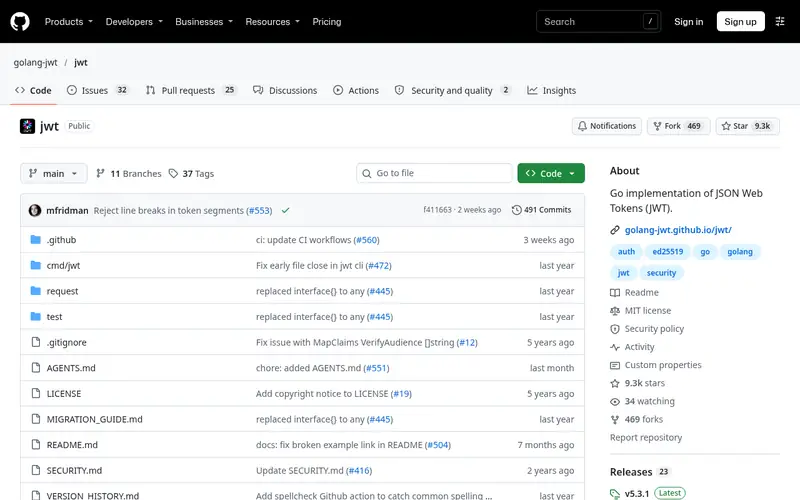
This is the community-maintained fork of the original dgrijalva/jwt-go library and the default choice for most Go projects. It provides a `Token` type, signing method implementations and parser options such as required claims and allowed algorithms. The API is small and stable, so it fits HTTP middleware, gRPC interceptors and CLI tools.
The library covers HMAC (HS256/384/512), RSA (RS and PS families), ECDSA and EdDSA. It does not manage JSON Web Key Sets or key rotation for you, so you load keys yourself. It is pure Go with no cgo, so it builds on Linux, macOS, Windows and most Go targets. The licence is MIT. Teams that need JWK or JWE support should pair it with another module or pick a broader toolkit.
Standout: Supports HMAC, RSA, ECDSA and EdDSA
Free (open source), as listed by the vendor (golang-jwt/jwt website). Confirm the current plan price before you buy.
Free plan. Plans change, so confirm on the vendor's pricing page before you buy.
Benefits
- Supports HMAC, RSA, ECDSA and EdDSA
- active maintenance and broad adoption
Drawbacks
- No built-in JWK set handling
- key rotation is left to you
Skip it if this limit matters to you: no built-in JWK set handling.
Verdict. A sensible pick for general-purpose JWT signing and parsing in Go services.
Alternatives in this guide: lestrrat-go/jwx, go-jose/go-jose, go-guardian
lestrrat-go/jwx
Best for teams that need JWT plus JWK, JWS and JWE
What it is and where it fits
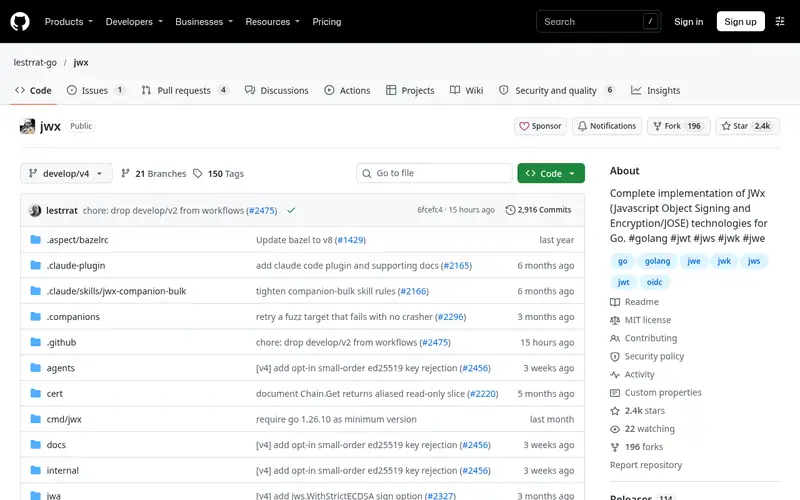
jwx is a family of Go modules for the JOSE standards. The `jwt` package handles token creation and verification, while `jwk`, `jws` and `jwe` cover keys, signatures and encryption. This makes it a good fit when you consume an identity provider's JWKS endpoint or need to encrypt claims.
It supports the common signing algorithms and lets you fetch and cache remote key sets. The trade-off is a bigger API than a single-purpose library, so expect more reading before you are productive. It is MIT licensed and pure Go. If you only sign HS256 tokens and never touch key sets, the extra surface may not be worth it.
Standout: Covers JWK, JWS and JWE alongside JWT
Free (open source), as listed by the vendor (lestrrat-go/jwx website). Confirm the current plan price before you buy.
Free plan. Plans change, so confirm on the vendor's pricing page before you buy.
Benefits
- Covers JWK, JWS and JWE alongside JWT
- strong key set support
Drawbacks
- Larger API surface to learn
- more modules to track
Skip it if this limit matters to you: larger API surface to learn.
Verdict. A sensible pick for teams that need JWT plus JWK, JWS and JWE.
Alternatives in this guide: golang-jwt/jwt, go-jose/go-jose, go-guardian
go-jose/go-jose
Best for jOSE-focused work including JWS and JWE
What it is and where it fits
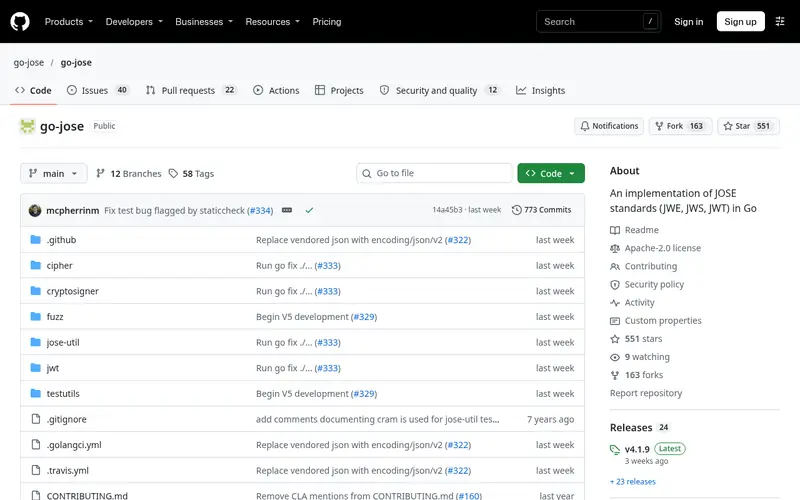
go-jose is the maintained fork of the Square go-jose library and implements JOSE: JSON Web Signature, JSON Web Encryption and JSON Web Key. You can build and verify JWTs on top of it, and it is a common dependency in OpenID Connect and OAuth tooling written in Go.
It supports RSA, ECDSA, EdDSA and HMAC signing, plus encryption with RSA and AES key wrapping. The API is closer to the spec than to a convenience wrapper, so simple token parsing takes a few more lines. It is Apache-2.0 licensed and pure Go. Choose it when you need encryption or full JOSE coverage rather than just signed tokens.
Standout: Full JOSE implementation with JWS and JWE
Free (open source), as listed by the vendor (go-jose/go-jose website). Confirm the current plan price before you buy.
Free plan. Plans change, so confirm on the vendor's pricing page before you buy.
Benefits
- Full JOSE implementation with JWS and JWE
- used widely in OIDC tooling
Drawbacks
- JWT helpers are thinner than dedicated libraries
- API can feel low-level
Skip it if this limit matters to you: JWT helpers are thinner than dedicated libraries.
Verdict. A sensible pick for JOSE-focused work including JWS and JWE.
Alternatives in this guide: golang-jwt/jwt, lestrrat-go/jwx, go-guardian
go-guardian
Best for authentication strategies built around JWT in Go APIs
What it is and where it fits
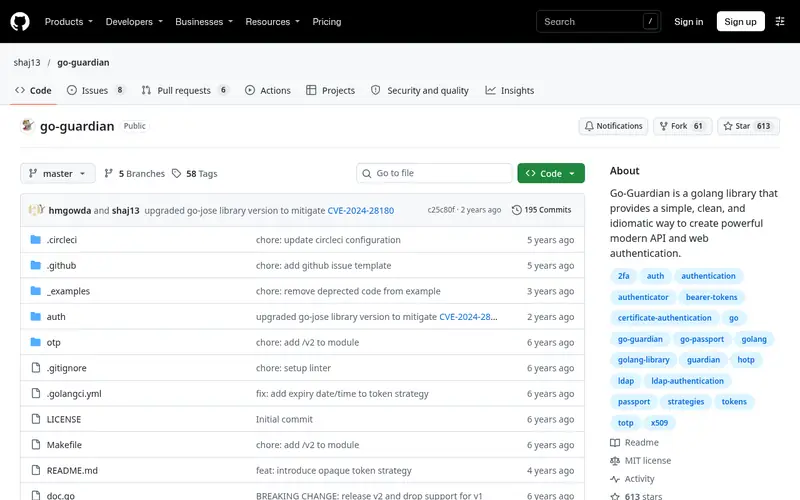
go-guardian is an authentication library that includes JWT support alongside basic auth, bearer token and other strategies. It provides middleware helpers for net/http and popular routers, so you can wire token checks into a request pipeline with less glue code.
It is aimed at teams building an auth layer rather than just parsing a token. The JWT part uses standard signing methods, and the library adds strategy interfaces and token caching options. It is MIT licensed. If you only need to sign and verify a token, a smaller library is simpler; go-guardian pays off when you want a fuller auth structure.
Standout: Bundles JWT with basic auth, bearer tokens and strategies
Free (open source), as listed by the vendor (go-guardian website). Confirm the current plan price before you buy.
Free plan. Plans change, so confirm on the vendor's pricing page before you buy.
Benefits
- Bundles JWT with basic auth, bearer tokens and strategies
- middleware-friendly
Drawbacks
- Opinionated structure
- smaller community than core JWT libraries
Skip it if this limit matters to you: opinionated structure.
Verdict. A sensible pick for authentication strategies built around JWT in Go APIs.
Alternatives in this guide: golang-jwt/jwt, lestrrat-go/jwx, go-jose/go-jose
cristalhq/jwt
Best for minimal, low-allocation JWT encoding and decoding
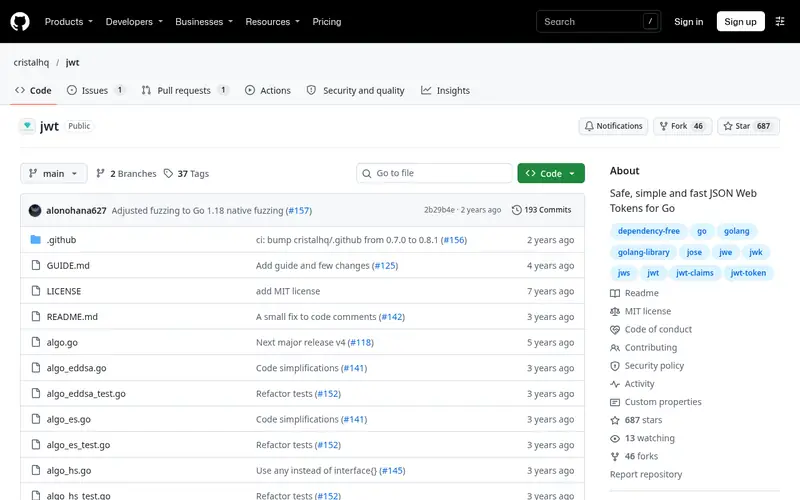
What it is and where it fits
cristalhq/jwt is a lightweight library for building and verifying JWTs. It separates signing from verification with a builder and a verifier, and it focuses on doing that with few allocations. The API is compact, which suits services that want a small dependency.
It supports HMAC, RSA and ECDSA signing methods and lets you register custom algorithms. It does not include JWK sets, JWE or higher-level auth middleware. It is MIT licensed and pure Go. Pick it when token signing is a small part of your service and you want to keep the dependency tree tight.
Standout: Small API and low allocations
Free (open source), as listed by the vendor (cristalhq/jwt website). Confirm the current plan price before you buy.
Free plan. Plans change, so confirm on the vendor's pricing page before you buy.
Benefits
- Small API and low allocations
- straightforward verifier setup
Drawbacks
- Narrow scope
- no JWK or JWE support
Skip it if this limit matters to you: narrow scope.
Verdict. A sensible pick for minimal, low-allocation JWT encoding and decoding.
Alternatives in this guide: golang-jwt/jwt, lestrrat-go/jwx, go-jose/go-jose
Who should use what
If you need standard signed tokens for an API or service-to-service calls, start with golang-jwt/jwt. If you consume a JWKS endpoint or need encrypted claims, use lestrrat-go/jwx or go-jose. If you are building an auth layer with middleware and multiple strategies, go-guardian bundles more. For a tiny dependency footprint, cristalhq/jwt keeps the API small.
Questions to settle before you buy
What to check before you buy
- Confirm the library supports the signing algorithms your identity provider issues.
- Check whether you need JWK set fetching and rotation, and pick a library that covers it.
- Verify the repository has recent commits and responds to security reports.
- Read the parser options so you can enforce required claims and allowed algorithms.
- Confirm the licence fits your project and that the module is pure Go if you cross-compile.
FAQ
Which Go JWT library should I start with?
golang-jwt/jwt is the safest default for most teams. It is maintained, MIT licensed and covers the common signing methods. Move to lestrrat-go/jwx or go-jose when you need JWK sets, JWE or fuller JOSE support.
Are these Go JWT libraries free?
Yes. Every library listed here is free and open source under the MIT or Apache-2.0 licence. There is no paid tier for signing or verifying tokens. You pay only for your own infrastructure.
Can I use these libraries to verify tokens from an identity provider?
Yes, if the library supports the provider's signing algorithm and can load its public keys. For JWKS endpoints, lestrrat-go/jwx and go-jose include key set handling. With golang-jwt you fetch and cache keys yourself.
Do I need JWE support?
Only if you must encrypt claims, not just sign them. Signed JWTs are readable by anyone who has the token. If your data must stay confidential in transit between services, use a library with JWE support such as go-jose or jwx.
Are my keys sent anywhere when I use these libraries?
No. These are Go modules that run inside your own process. Signing keys and tokens stay on your infrastructure. That is different from pasting a token into a third-party web decoder, which you should avoid for production secrets.
Sources we checked
Method: how we score · editorial policy.
Change log. First published 27 Nov 2026.