Stage 01 · Write · Researched comparison
Best Rust Serialization Libraries in 2026
Serde is the first pick for most Rust projects. It gives you one data model and derives Serialize and Deserialize for your types, then works with many formats through separate crates. Choose prost when you are working with Protocol Buffers and need generated types and schema-driven compatibility. Choose Cap'n Proto when you need zero-copy reads in a latency-sensitive system.

By Shihab Mia
Published 27 Nov 2026 · 6 tools compared
We run no ads and no affiliate links at launch. The order of a list follows our published method. See how we score.
Prices are the starting prices vendors list publicly. Plans change, so confirm the current price on the vendor page before you buy.
Key takeaways
- Serde is the default framework; format support comes from separate crates such as serde_json and ron.
- prost targets Protocol Buffers and generates Rust types from .proto files; it does not use Serde derives.
- All libraries listed here are open source and free to use; check each repository for its current licence terms.
Who each pick is for
- General-purpose serialization framework for most Rust typesSerde
- JSON reading and writing in Rust services and toolsserde_json
- Human-readable config and data files with Rust-like syntaxRON
- Protocol Buffers with generated Rust typesprost
- MessagePack encoding of Serde typesrmp-serde
- Zero-copy messages in performance-sensitive systemsCap'n Proto
Comparison
| Tool | Best for | Standout feature | Listed starting price | Free plan or trial |
|---|---|---|---|---|
| 1Serde | General-purpose serialization framework for most Rust types | Works with many formats through separate crates | Free (open source) | Free plan |
| 2serde_json | JSON reading and writing in Rust services and tools | Mature and widely used | Free (open source) | Free plan |
| 3RON | Human-readable config and data files with Rust-like syntax | Syntax maps closely to Rust values | Free (open source) | Free plan |
| 4prost | Protocol Buffers with generated Rust types | Schema-first with generated code | Free (open source) | Free plan |
| 5rmp-serde | MessagePack encoding of Serde types | More compact than JSON | Free (open source) | Free plan |
| 6Cap'n Proto | Zero-copy messages in performance-sensitive systems | Reads without a decode step | Free (open source) | Free plan |
How we picked
We picked libraries that are actively maintained and genuinely handle serialization in Rust. Criteria were fit for common jobs (general framework, JSON, binary, schema-first), platform support including no_std where relevant, licence and price, and the main limits users hit, such as schema coupling or toolchain setup. Sources are vendor sites, crate documentation, and project repositories. Prices and licences can change, so confirm on the vendor or repository page before you commit.
The tools, one by one
Serde
Best for general-purpose serialization framework for most Rust types
What it is and where it fits
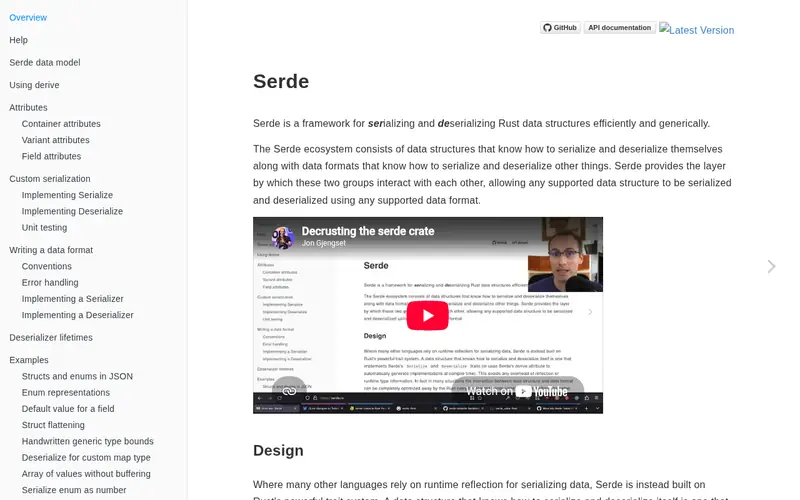
Serde is a framework for serializing and deserializing Rust data structures. You implement or derive the Serialize and Deserialize traits once, then use a format crate to read and write JSON, YAML, TOML, CBOR, and others. It runs anywhere Rust runs, including embedded targets with no_std when configured.
The core serde crate and serde_derive are open source under MIT or Apache-2.0. Format crates are separate projects with their own licences and release cycles. Serde does not define a wire format, so compatibility depends on the format crate you choose. Skip it only if you need a schema-first format with generated code, where prost or Cap'n Proto fit better.
Standout: Works with many formats through separate crates
Free (open source), as listed by the vendor (Serde website). Confirm the current plan price before you buy.
Free plan. Plans change, so confirm on the vendor's pricing page before you buy.
Benefits
- Works with many formats through separate crates
- derive macros cut boilerplate
Drawbacks
- The core crate handles no format by itself
- derive errors can be hard to read
Skip it if this limit matters to you: the core crate handles no format by itself.
Verdict. A sensible pick for general-purpose serialization framework for most Rust types.
Alternatives in this guide: serde_json, RON, prost
serde_json
Best for jSON reading and writing in Rust services and tools
What it is and where it fits
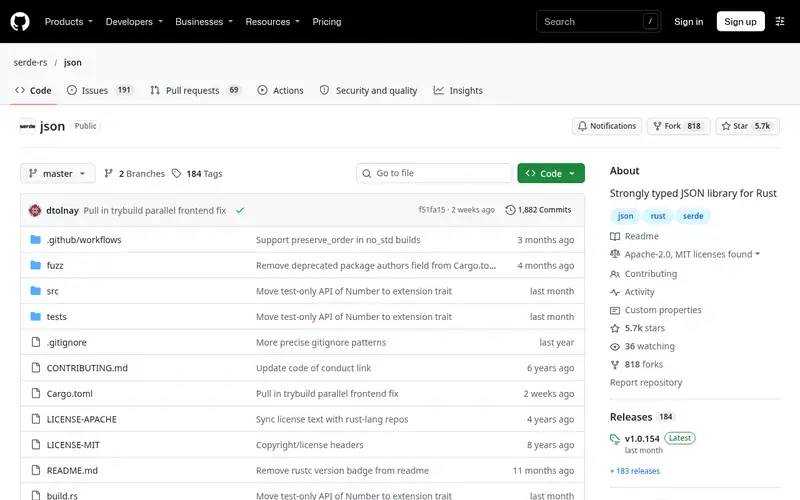
serde_json is the standard JSON crate for Serde. It provides from_str, to_string, and streaming APIs, plus a Value type for data without a fixed schema. It runs on any platform Rust supports and is commonly used in web services, CLIs, and config loaders.
The crate is open source under MIT or Apache-2.0. It does not enforce a schema, so validation is up to your code. JSON has no native distinction between integers and floats beyond what the parser infers, and large integers can lose precision. If payload size matters, a binary format may suit you better.
Standout: Mature and widely used
Free (open source), as listed by the vendor (serde_json website). Confirm the current plan price before you buy.
Free plan. Plans change, so confirm on the vendor's pricing page before you buy.
Benefits
- Mature and widely used
- supports streaming and untyped Value trees
Drawbacks
- JSON is verbose on the wire
- numbers map to limited types
Skip it if this limit matters to you: JSON is verbose on the wire.
Verdict. A sensible pick for JSON reading and writing in Rust services and tools.
RON
Best for human-readable config and data files with Rust-like syntax
What it is and where it fits
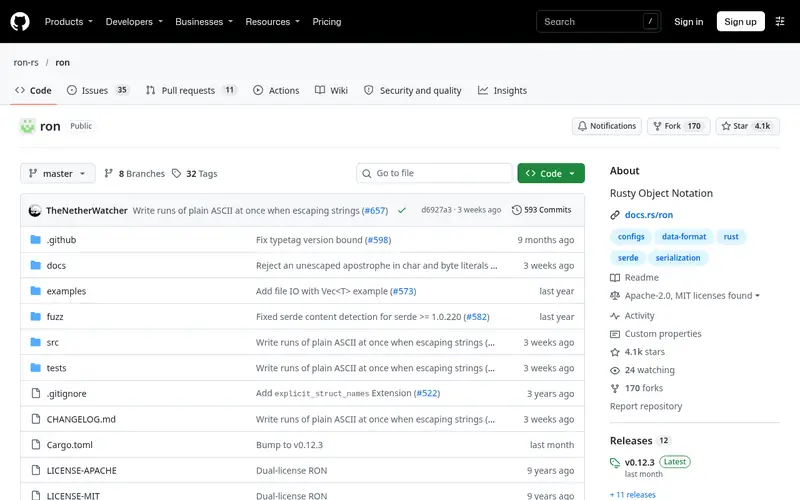
RON (Rusty Object Notation) is a text format designed to look like Rust literals. It supports structs, enums, tuples, and options in a way that mirrors Rust types, which makes it useful for config files and test fixtures. It is built on Serde and runs wherever Rust runs.
The crate is open source under MIT or Apache-2.0. RON is mainly a Rust ecosystem format, so other languages have limited or no support. It is not a good choice for public APIs or data shared with non-Rust services. Parsing is slower than binary formats, which matters for large files.
Standout: Syntax maps closely to Rust values
Free (open source), as listed by the vendor (RON website). Confirm the current plan price before you buy.
Free plan. Plans change, so confirm on the vendor's pricing page before you buy.
Benefits
- Syntax maps closely to Rust values
- readable and diff-friendly
Drawbacks
- Not a general interchange format
- fewer tools than JSON
Skip it if this limit matters to you: not a general interchange format.
Verdict. A sensible pick for human-readable config and data files with Rust-like syntax.
Alternatives in this guide: Serde, serde_json, prost
prost
Best for protocol Buffers with generated Rust types
What it is and where it fits
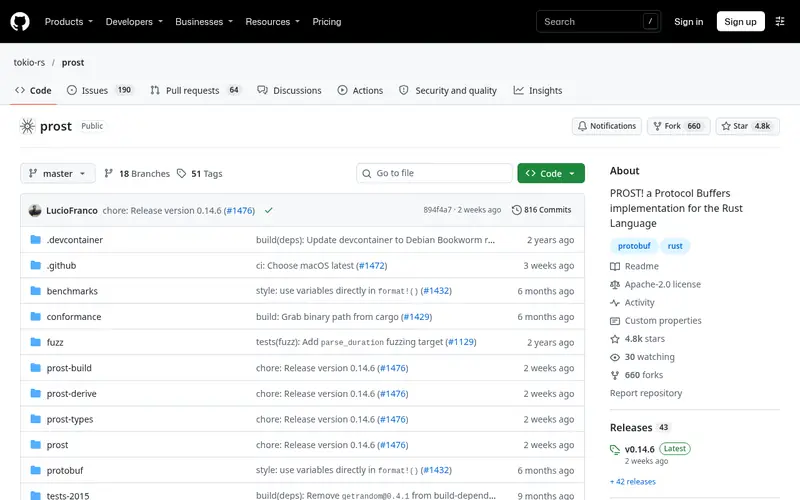
prost is a Protocol Buffers implementation for Rust. You define messages in .proto files, and the build step generates Rust structs with encode and decode methods. Because the schema is shared, services in different languages can exchange the same messages.
The project is open source under Apache-2.0. It needs protoc or a compatible compiler available during the build, which adds setup work. Generated types do not implement Serde traits by default, so mixing with Serde-based code takes extra glue. Choose prost when you already use Protocol Buffers or need strict schema evolution.
Standout: Schema-first with generated code
Free (open source), as listed by the vendor (prost website). Confirm the current plan price before you buy.
Free plan. Plans change, so confirm on the vendor's pricing page before you buy.
Benefits
- Schema-first with generated code
- compact and cross-language
Drawbacks
- Requires a protoc toolchain at build time
- does not use Serde derives
Skip it if this limit matters to you: requires a protoc toolchain at build time.
Verdict. A sensible pick for protocol Buffers with generated Rust types.
Alternatives in this guide: Serde, serde_json, RON
rmp-serde
Best for messagePack encoding of Serde types
What it is and where it fits
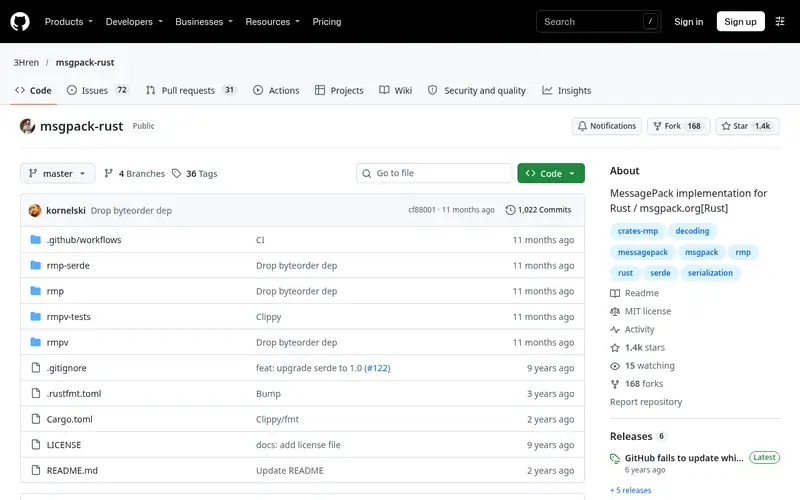
rmp-serde connects Serde types to MessagePack, a binary format that keeps a schema-free model similar to JSON but with smaller output. It suits logging pipelines, message queues, and storage where JSON is too large but a full schema is overkill.
The msgpack-rust project is open source under MIT. MessagePack is self-describing, so readers can decode without your Rust types, though field names and integer widths still need agreement. Tooling is thinner than for JSON, and some consumers map integers or maps differently. Test round trips with the actual readers you plan to use.
Standout: More compact than JSON
Free (open source), as listed by the vendor (rmp-serde website). Confirm the current plan price before you buy.
Free plan. Plans change, so confirm on the vendor's pricing page before you buy.
Benefits
- More compact than JSON
- self-describing enough for many readers
Drawbacks
- Less common than JSON in web tooling
- type mapping needs care
Skip it if this limit matters to you: less common than JSON in web tooling.
Verdict. A sensible pick for messagePack encoding of Serde types.
Alternatives in this guide: Serde, serde_json, RON
Cap'n Proto
Best for zero-copy messages in performance-sensitive systems
What it is and where it fits
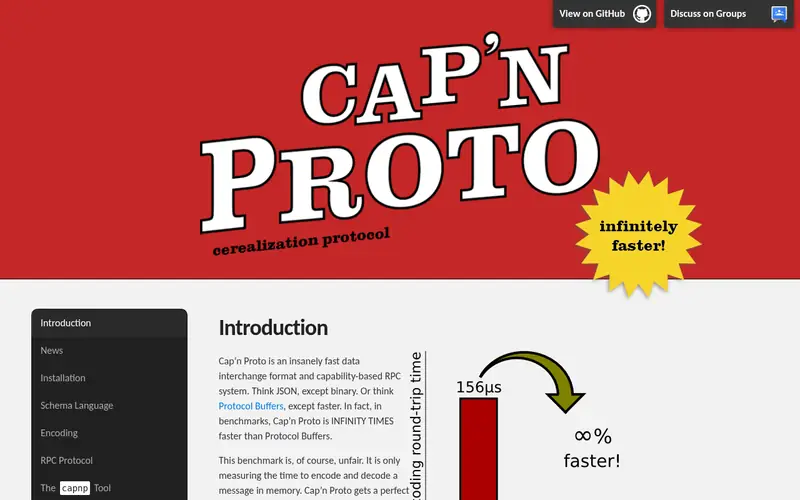
Cap'n Proto is a schema-based serialization system with a Rust implementation. Messages are laid out so they can be read directly from the buffer without a parsing pass, which helps in high-throughput or low-latency systems. You define schemas and generate Rust code from them.
The core project is open source under MIT. The Rust support lives in the capnp crate and related tooling, with its own release cadence. The model differs from Serde: you work with generated readers and builders rather than plain structs. That adds learning cost. Use it when zero-copy access is a real requirement, not for small config files.
Standout: Reads without a decode step
Free (open source), as listed by the vendor (Cap'n Proto website). Confirm the current plan price before you buy.
Free plan. Plans change, so confirm on the vendor's pricing page before you buy.
Benefits
- Reads without a decode step
- schema-based with evolution support
Drawbacks
- More setup and a different programming model
- larger ecosystem cost
Skip it if this limit matters to you: more setup and a different programming model.
Verdict. A sensible pick for zero-copy messages in performance-sensitive systems.
Alternatives in this guide: Serde, serde_json, RON
Who should use what
If you are building a typical Rust service or CLI, start with Serde plus serde_json. If your team already defines APIs in .proto files, use prost. If you need to read messages without a decode step in a latency-sensitive system, evaluate Cap'n Proto. For config files that people edit by hand, RON is a reasonable fit inside Rust-only projects.
Questions to settle before you buy
What to check before you buy
- Confirm the format is readable by every language and service that will consume the data.
- Check how the library handles schema changes, missing fields, and unknown fields.
- Verify the crate supports your targets, including no_std or embedded if needed.
- Review the licence of both the core crate and any format crate you add.
- Test round trips with real payloads, including edge cases like large integers and optional fields.
FAQ
Is Serde a serialization format?
No. Serde is a framework that defines traits for converting Rust types to and from data. Actual formats come from separate crates such as serde_json or ron. You add the format crate you need alongside Serde.
When should I use a binary format instead of JSON?
Use a binary format when both ends are under your control and you want smaller, faster output, such as caches or internal IPC. Use JSON when other languages or tools must read the data, or when you need a self-describing format that tolerates schema drift.
Does prost work with Serde?
Not by default. prost generates types with its own encode and decode methods for Protocol Buffers. Mixing with Serde-based code requires extra conversion code. If you want Serde derives everywhere, a Serde format crate is a simpler path.
Are these libraries free to use?
Yes. All the libraries listed here are open source and free to use. Each has its own licence, commonly MIT or Apache-2.0, so check the repository for the exact terms and any attribution requirements.
Can I use these libraries on embedded targets?
Some of them. Serde supports no_std with the alloc or core features, and several format crates offer no_std modes. Check each crate's documentation for feature flags and memory requirements before relying on it in an embedded build.
Sources we checked
Method: how we score · editorial policy.
Change log. First published 27 Nov 2026.