Stage 01 · Write · Researched comparison
Best React State Management Libraries in 2026
Redux Toolkit is the first pick for teams that want one well-documented pattern, DevTools support and a large hiring pool. Zustand suits developers who want a small, hook-based store with little boilerplate. Jotai fits apps built from many small, independent pieces of state. All three are open source and free, and they run in the browser, so no state data leaves the machine.

By Shihab Mia
Published 27 Nov 2026 · 6 tools compared
We run no ads and no affiliate links at launch. The order of a list follows our published method. See how we score.
Prices are the starting prices vendors list publicly. Plans change, so confirm the current price on the vendor page before you buy.
Key takeaways
- Redux Toolkit, Zustand, Jotai, MobX, Valtio and TanStack Store are all free and open source, so cost is not the deciding factor.
- Redux Toolkit has the most structure and the largest ecosystem; Zustand and Jotai ship far less code and less boilerplate.
- MobX and Valtio use mutable state with automatic tracking, which reads differently from the immutable patterns in Redux.
- TanStack Store is younger than Redux or MobX, so check its community examples before starting a new project on it.
Who each pick is for
- Teams that want one structured, well-documented patternRedux Toolkit
- Developers who want a small store with minimal boilerplateZustand
- Apps built from many small, independent pieces of stateJotai
- Teams that prefer mutable state with automatic trackingMobX
- Developers who want proxy-based mutable state with React hooksValtio
- Teams already using TanStack libraries who want a framework-agnostic storeTanStack Store
Comparison
| Tool | Best for | Standout feature | Listed starting price | Free plan or trial |
|---|---|---|---|---|
| 1Redux Toolkit | Teams that want one structured, well-documented pattern | Official recommended way to write Redux | Free (open source) | Free plan |
| 2Zustand | Developers who want a small store with minimal boilerplate | Tiny API built on hooks | Free (open source) | Free plan |
| 3Jotai | Apps built from many small, independent pieces of state | Atom-based model avoids large store objects | Free (open source) | Free plan |
| 4MobX | Teams that prefer mutable state with automatic tracking | Automatic dependency tracking | Free (open source) | Free plan |
| 5Valtio | Developers who want proxy-based mutable state with React hooks | Very small API | Free (open source) | Free plan |
| 6TanStack Store | Teams already using TanStack libraries who want a framework-agnostic store | Framework-agnostic core | Free (open source) | Free plan |
How we picked
We picked libraries that are real, standalone products and are currently maintained, then compared them on fit for common React state problems, supported platforms, licence and price, and the main limits each one documents. Sources are official documentation, project repositories and public licence pages. We did not run benchmarks or collect user reviews. Prices and maintenance status change, so confirm details on each vendor or repository page before you commit.
The tools, one by one
Redux Toolkit
Best for teams that want one structured, well-documented pattern
What it is and where it fits
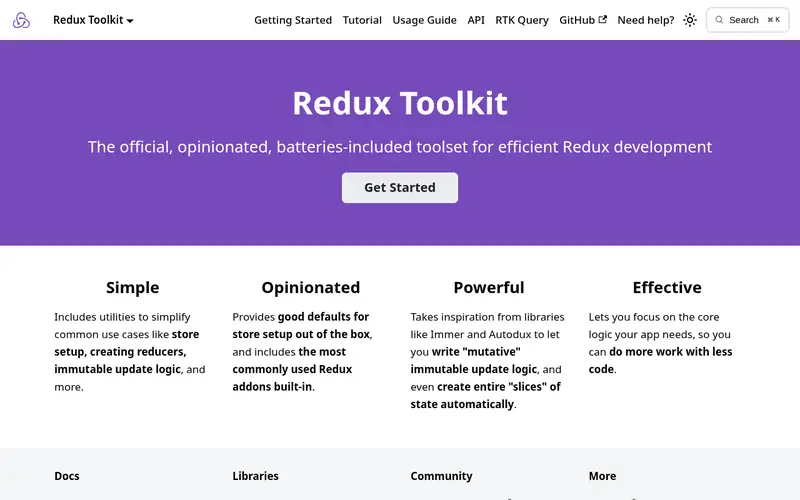
Redux Toolkit is the official, opinionated package for writing Redux logic. It wraps the classic Redux store with helpers such as configureStore and createSlice, which cut the amount of setup code. It also bundles RTK Query for data fetching and caching. The Redux DevTools extension gives time-travel debugging and a full action log, which helps on larger teams.
It runs anywhere React runs, plus React Native, and it is not tied to a single framework. The licence is MIT. The main cost is conceptual: reducers, slices, actions and selectors all have to be learned. Small apps that hold a little UI state will find it heavy. Teams with many contributors, strict review processes or a need for traceable state changes are the best fit.
Standout: Official recommended way to write Redux
Free (open source), as listed by the vendor (Redux Toolkit website). Confirm the current plan price before you buy.
Free plan. Plans change, so confirm on the vendor's pricing page before you buy.
Benefits
- Official recommended way to write Redux
- includes DevTools and RTK Query
Drawbacks
- More concepts to learn than hook-based stores
- more boilerplate than Zustand
Skip it if this limit matters to you: more concepts to learn than hook-based stores.
Verdict. A sensible pick for teams that want one structured, well-documented pattern.
Zustand
Best for developers who want a small store with minimal boilerplate
What it is and where it fits
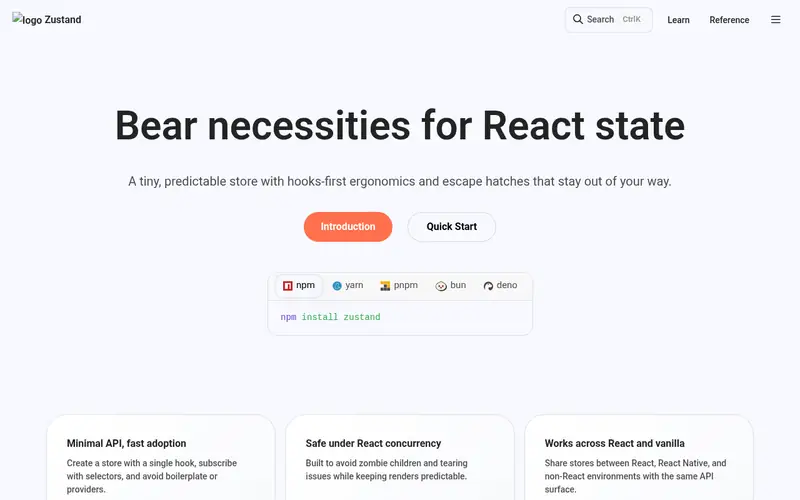
Zustand is a small state library that uses a single store created with a hook. You define state and actions in one place and read them with a selector. Components re-render only when the selected slice changes. The store can be read and written outside React, which helps in utilities, tests and event handlers.
It is MIT licensed and works with React and React Native. There is no provider requirement, so setup is short. The trade-off is that Zustand gives you few rules. On a large codebase you will want your own conventions for store shape, selectors and action naming. It also has no built-in DevTools panel of its own, though it can connect to Redux DevTools. Skip it if your team wants a formal, enforced architecture.
Standout: Tiny API built on hooks
Free (open source), as listed by the vendor (Zustand website). Confirm the current plan price before you buy.
Free plan. Plans change, so confirm on the vendor's pricing page before you buy.
Benefits
- Tiny API built on hooks
- works outside React components too
Drawbacks
- Fewer built-in conventions than Redux
- large apps need team rules
Skip it if this limit matters to you: fewer built-in conventions than Redux.
Verdict. A sensible pick for developers who want a small store with minimal boilerplate.
Alternatives in this guide: Redux Toolkit, Jotai, MobX
Jotai
Best for apps built from many small, independent pieces of state
What it is and where it fits
Jotai models state as atoms. Each atom is a small unit that components subscribe to directly, and derived atoms compute values from others. This bottom-up approach keeps re-renders narrow and avoids the large store object common in Redux. It integrates with React Suspense and works with React and React Native.
The package is MIT licensed and has no paid tier. It pairs well with server-state libraries, since Jotai handles client state only. The main limit is scale of understanding: an app with hundreds of atoms needs naming and file conventions, or the state graph becomes hard to follow. Developers coming from Redux often need time to adjust. It suits component-heavy UIs where state is naturally local.
Standout: Atom-based model avoids large store objects
Free (open source), as listed by the vendor (Jotai website). Confirm the current plan price before you buy.
Free plan. Plans change, so confirm on the vendor's pricing page before you buy.
Benefits
- Atom-based model avoids large store objects
- fine-grained re-renders
Drawbacks
- Many atoms can be hard to trace
- less familiar to Redux-trained teams
Skip it if this limit matters to you: many atoms can be hard to trace.
Verdict. A sensible pick for apps built from many small, independent pieces of state.
Alternatives in this guide: Redux Toolkit, Zustand, MobX
MobX
Best for teams that prefer mutable state with automatic tracking
What it is and where it fits
MobX uses observable state and reactions. You mark state as observable, change it directly, and MobX tracks which components read which values and re-renders them. The companion package mobx-react-lite provides the React bindings. This removes much of the manual selector and memo work that immutable stores require.
It is MIT licensed and works with React, React Native and plain JavaScript. MobX has a long history and stable documentation. The trade-off is a mutable programming model that surprises developers trained on Redux. Automatic tracking can also make it unclear why a component re-rendered. Teams that value explicit, traceable updates may prefer Redux Toolkit. Teams that want less wiring often like MobX.
Standout: Automatic dependency tracking
Free (open source), as listed by the vendor (MobX website). Confirm the current plan price before you buy.
Free plan. Plans change, so confirm on the vendor's pricing page before you buy.
Benefits
- Automatic dependency tracking
- less manual selector code
Drawbacks
- Mutable model differs from Redux
- magic can obscure data flow
Skip it if this limit matters to you: mutable model differs from Redux.
Verdict. A sensible pick for teams that prefer mutable state with automatic tracking.
Alternatives in this guide: Redux Toolkit, Zustand, Jotai
Valtio
Best for developers who want proxy-based mutable state with React hooks
What it is and where it fits
Valtio makes an object reactive through a proxy. You mutate the object as normal JavaScript, and components that read it through useSnapshot re-render. There are no actions, reducers or selectors to define. The API surface is small, which keeps setup short.
It is MIT licensed and built for React, with support for React Native. Because state is a plain mutable object, code reads like ordinary JavaScript. The proxy layer is the catch: stack traces and debugging can be less obvious than with plain objects, and some libraries do not handle proxies well. The community is smaller than Redux or Zustand. It suits small to mid-size apps and developers who dislike immutable update patterns.
Standout: Very small API
Free (open source), as listed by the vendor (Valtio website). Confirm the current plan price before you buy.
Free plan. Plans change, so confirm on the vendor's pricing page before you buy.
Benefits
- Very small API
- mutate state directly and read with useSnapshot
Drawbacks
- Proxy behaviour can confuse debugging
- smaller ecosystem
Skip it if this limit matters to you: proxy behaviour can confuse debugging.
Verdict. A sensible pick for developers who want proxy-based mutable state with React hooks.
Alternatives in this guide: Redux Toolkit, Zustand, Jotai
TanStack Store
Best for teams already using TanStack libraries who want a framework-agnostic store
What it is and where it fits
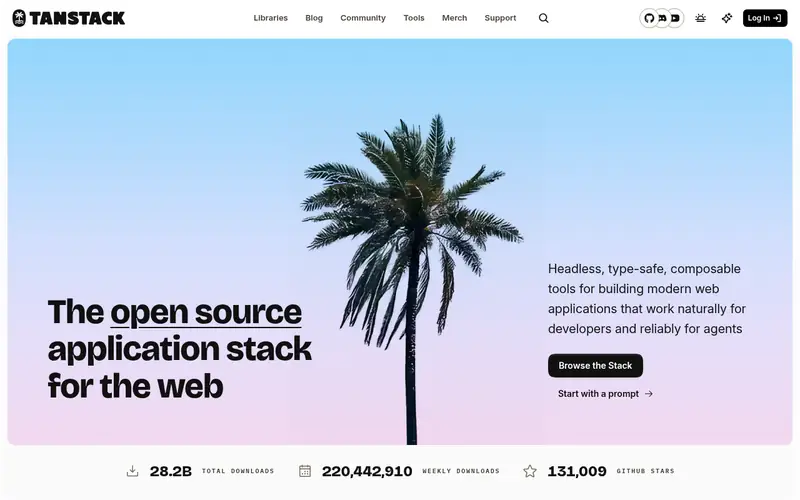
TanStack Store is a framework-agnostic state library from the TanStack project, which also maintains TanStack Query and TanStack Router. The core store works in plain JavaScript, and React bindings are provided through a separate package. Derived state and subscriptions are part of the design.
It is MIT licensed and free. Because the core is not tied to React, the same store logic can be shared with other frameworks. The main limit is maturity: it has fewer tutorials, examples and third-party integrations than Redux or Zustand. Teams already using TanStack Query or Router get consistent patterns across their stack. Teams that want a large hiring pool and years of community answers may prefer Redux Toolkit.
Standout: Framework-agnostic core
Free (open source), as listed by the vendor (TanStack Store website). Confirm the current plan price before you buy.
Free plan. Plans change, so confirm on the vendor's pricing page before you buy.
Benefits
- Framework-agnostic core
- fits the TanStack ecosystem
Drawbacks
- Younger than Redux or MobX
- fewer community examples
Skip it if this limit matters to you: younger than Redux or MobX.
Verdict. A sensible pick for teams already using TanStack libraries who want a framework-agnostic store.
Alternatives in this guide: Redux Toolkit, Zustand, Jotai
Who should use what
Large teams with many contributors and a need for traceable state changes should start with Redux Toolkit. Developers who want a small hook-based store and little setup should look at Zustand. Apps made of many independent pieces of UI state fit Jotai's atom model. Teams that prefer mutable state and automatic tracking should compare MobX and Valtio. Anyone already using TanStack Query or Router should consider TanStack Store for consistent patterns across the stack.
Questions to settle before you buy
What to check before you buy
- Confirm the library is actively maintained by checking recent commits and releases in its repository.
- Check the licence and whether it fits your organisation's policy.
- Test how the library handles server state, or pair it with a data-fetching library such as TanStack Query.
- Review DevTools support, since debugging state changes is harder without it.
- Check React and React Native version support against your current stack.
FAQ
Are these React state management libraries free?
Yes. Every library in this guide is open source and free to use. Redux Toolkit, Zustand, Jotai, MobX, Valtio and TanStack Store are all published under permissive licences, mostly MIT. There is no paid tier for the core libraries. Costs come from hosting, tooling or commercial support if you choose to buy it separately.
Do I need a state management library at all?
Not always. Local component state with useState and useReducer covers many apps. A library helps when state is shared across distant components, needs to persist, or must be traced during debugging. Start simple and add a library when prop drilling or duplicated state becomes a real problem.
What is the difference between client state and server state?
Client state is data the app owns, such as form input, theme or open panels. Server state is data fetched from an API, such as user records. Libraries like Redux Toolkit, Zustand and Jotai focus on client state. For server state, many teams use a data-fetching library such as TanStack Query alongside them.
How does TanStack Store differ from the other options?
TanStack Store is framework-agnostic at its core, so the same store logic can be shared beyond React, with React bindings provided through a separate package. It is younger than Redux or MobX and has fewer tutorials and third-party integrations. Teams already using TanStack Query or Router get consistent patterns across their stack, while teams that want a large hiring pool may prefer Redux Toolkit.
Can I use more than one of these libraries in one app?
Yes, but keep the split clear. A common pattern is one library for global client state and a separate data-fetching library for server state. Running two general-purpose state libraries side by side adds confusion about where state lives. Pick one primary store and document the rule for your team.
Sources we checked
Method: how we score · editorial policy.
Change log. First published 27 Nov 2026.