Stage 01 · Write · Researched comparison
Best Python Dependency Injection Libraries in 2026
Dependency Injector is the first pick for most teams that want a full framework with providers, scopes and wiring. It suits larger applications where configuration and lifecycle control matter. Injector is a lighter alternative that follows Google Guice patterns and stays close to plain Python types. Lagom is a good fit for teams that want automatic injection with minimal boilerplate and type-hint based resolution.

By Shihab Mia
Published 27 Nov 2026 · 6 tools compared
We run no ads and no affiliate links at launch. The order of a list follows our published method. See how we score.
Prices are the starting prices vendors list publicly. Plans change, so confirm the current price on the vendor page before you buy.
Key takeaways
- All six libraries here are open source and free to use, so selection comes down to API style, scope support and framework fit.
- Dependency Injector and Injector support explicit container configuration, while Lagom and svcs lean on type hints and automatic wiring.
- FastAPI Depends is not a standalone library but the built-in injection mechanism of FastAPI, so it only fits projects already on that framework.
- None of these tools send your code anywhere; they run in your process, so there is no data privacy concern beyond your own repository.
Who each pick is for
- Larger apps needing providers, scopes and wiringDependency Injector
- Guice-style explicit binding in plain PythonInjector
- Automatic injection with minimal boilerplateLagom
- Lightweight registry with a clean lifecyclesvcs
- A tiny container for small services and scriptspunq
- Projects already built on FastAPIFastAPI Depends
Comparison
| Tool | Best for | Standout feature | Listed starting price | Free plan or trial |
|---|---|---|---|---|
| 1Dependency Injector | Larger apps needing providers, scopes and wiring | Rich provider types for factories, singletons, configuration and resources | Free (open source) | Free plan |
| 2Injector | Guice-style explicit binding in plain Python | Clear binding API modelled on Google Guice | Free (open source) | Free plan |
| 3Lagom | Automatic injection with minimal boilerplate | Resolves dependencies from type hints with little configuration | Free (open source) | Free plan |
| 4svcs | Lightweight registry with a clean lifecycle | Small, focused API with a registry and per-request containers | Free (open source) | Free plan |
| 5punq | A tiny container for small services and scripts | Very small API surface that is quick to learn | Free (open source) | Free plan |
| 6FastAPI Depends | Projects already built on FastAPI | Built into FastAPI with no extra dependency | Free (open source) | Free plan |
How we picked
We selected libraries that are actively maintained, published on PyPI and documented through official repositories or vendor pages. Criteria were fit for dependency injection in Python, supported platforms, licence and price, whether the tool runs locally with no data sent to third parties, and main limits such as scope handling and framework coupling. We did not run benchmarks or collect user reviews. Prices and licences can change, so confirm details on each project page before you commit.
The tools, one by one
Dependency Injector
Best for larger apps needing providers, scopes and wiring
What it is and where it fits
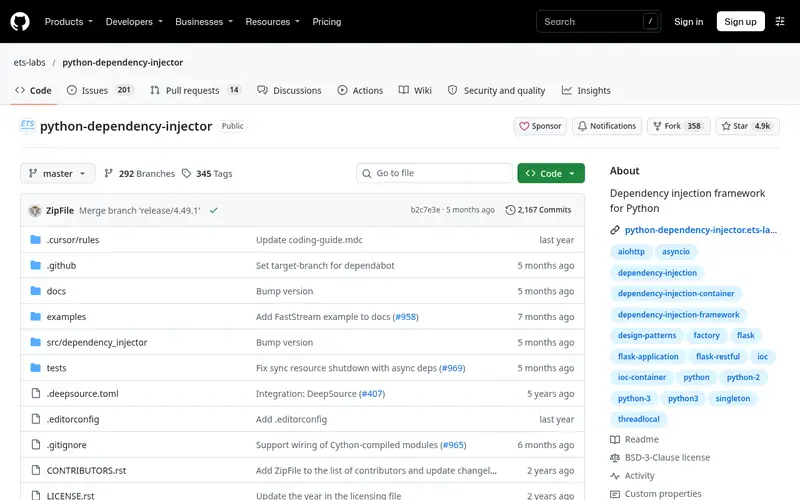
Dependency Injector is a framework for building object graphs in Python. You declare providers for factories, singletons, configuration values and resources, then assemble them into containers. It supports scopes such as singleton and factory, and it can wire containers into modules, classes and functions so call sites receive dependencies without manual passing.
It runs on standard CPython and integrates with common web frameworks, including Flask and FastAPI, through documented examples. The project is open source under the MIT licence and is distributed on PyPI. The main cost is verbosity: small scripts rarely need this much structure. Teams with many services, configuration objects and resource lifecycles get the most value. Skip it if you want injection driven purely by type hints with almost no setup.
Standout: Rich provider types for factories, singletons, configuration and resources
Free (open source), as listed by the vendor (Dependency Injector website). Confirm the current plan price before you buy.
Free plan. Plans change, so confirm on the vendor's pricing page before you buy.
Benefits
- Rich provider types for factories, singletons, configuration and resources
- container wiring connects dependencies to modules and classes
Drawbacks
- More configuration code than type-hint based libraries
- the API surface takes time to learn
Skip it if this limit matters to you: more configuration code than type-hint based libraries.
Verdict. A sensible pick for larger apps needing providers, scopes and wiring.
Injector
Best for guice-style explicit binding in plain Python
What it is and where it fits
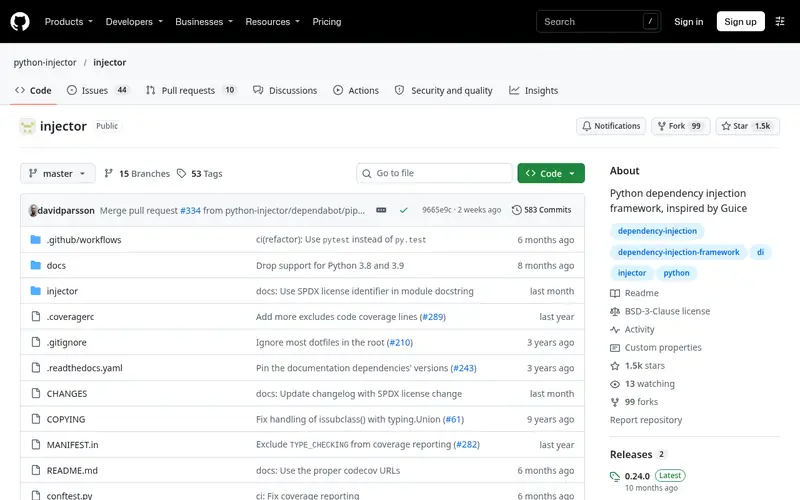
Injector is a dependency injection framework that follows the design of Google Guice. You create an Injector, configure bindings from interfaces or keys to concrete implementations, and request instances by type. Constructor injection works through type annotations, and modules let you group related bindings and reuse them across an application.
It is a standalone library with no framework requirement, so it fits CLI tools, services and libraries alike. The project is open source under the BSD licence and published on PyPI. The trade-off is that abstract types and configuration values need explicit bindings, which adds code compared with auto-wiring libraries. It suits developers who like explicit, readable binding modules and want to avoid magic in resolution.
Standout: Clear binding API modelled on Google Guice
Free (open source), as listed by the vendor (Injector website). Confirm the current plan price before you buy.
Free plan. Plans change, so confirm on the vendor's pricing page before you buy.
Benefits
- Clear binding API modelled on Google Guice
- works with type hints and supports modules for grouping bindings
Drawbacks
- Requires explicit bindings for interfaces and non-trivial types
- smaller ecosystem than the larger frameworks
Skip it if this limit matters to you: requires explicit bindings for interfaces and non-trivial types.
Verdict. A sensible pick for guice-style explicit binding in plain Python.
Alternatives in this guide: Dependency Injector, Lagom, svcs
Lagom
Best for automatic injection with minimal boilerplate
What it is and where it fits
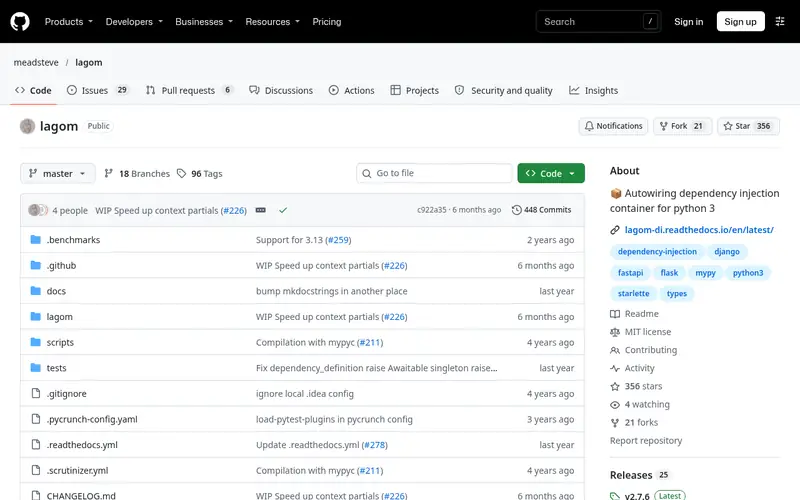
Lagom is a dependency injection container that leans on Python type hints. You define classes with annotated constructor parameters, and the container builds the graph for you. Explicit definitions are available when a type needs a specific factory or a singleton scope. It also offers helpers for wiring into web frameworks and for testing.
The library is open source under the MIT licence and installable from PyPI. It works on standard Python and does not require a framework. The automatic approach keeps setup short, which helps small and medium services. The downside is that implicit resolution can make large graphs harder to trace, so teams with complex lifecycles may prefer explicit providers. It is a good fit for developers who want injection without a container configuration file.
Standout: Resolves dependencies from type hints with little configuration
Free (open source), as listed by the vendor (Lagom website). Confirm the current plan price before you buy.
Free plan. Plans change, so confirm on the vendor's pricing page before you buy.
Benefits
- Resolves dependencies from type hints with little configuration
- supports singletons and explicit definitions when you need them
Drawbacks
- Auto-wiring can hide construction order in large graphs
- fewer built-in integrations than larger frameworks
Skip it if this limit matters to you: auto-wiring can hide construction order in large graphs.
Verdict. A sensible pick for automatic injection with minimal boilerplate.
Alternatives in this guide: Dependency Injector, Injector, svcs
svcs
Best for lightweight registry with a clean lifecycle
What it is and where it fits
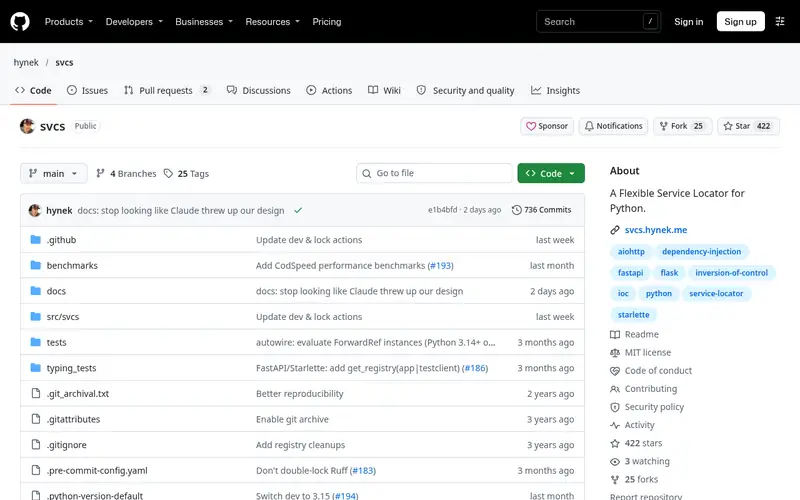
svcs is a dependency injection library built around a registry of factories and a container that resolves them. You register factories by type, then ask a container for instances. It supports different container lifetimes, which helps with per-request scopes in web applications, and it documents integration with frameworks such as Starlette and Flask.
The project is open source under the MIT licence and available on PyPI. It targets developers who want a small, understandable core rather than a large framework. It does not try to cover every injection pattern, so very complex graphs may need manual wiring. It suits teams that want explicit registration with a short learning curve and clean request-scoped lifecycles.
Standout: Small, focused API with a registry and per-request containers
Free (open source), as listed by the vendor (svcs website). Confirm the current plan price before you buy.
Free plan. Plans change, so confirm on the vendor's pricing page before you buy.
Benefits
- Small, focused API with a registry and per-request containers
- documented integration with web frameworks
Drawbacks
- Younger project with a smaller user base
- not a full provider framework
Skip it if this limit matters to you: younger project with a smaller user base.
Verdict. A sensible pick for lightweight registry with a clean lifecycle.
Alternatives in this guide: Dependency Injector, Injector, Lagom
punq
Best for a tiny container for small services and scripts
What it is and where it fits
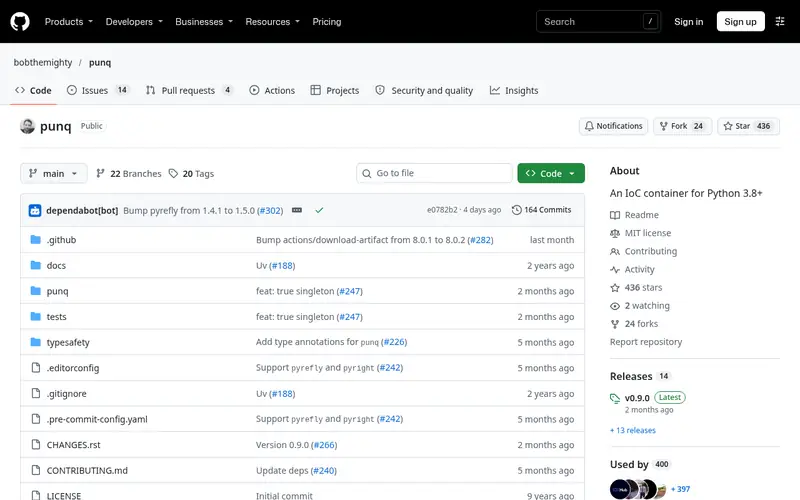
punq is a small dependency injection container for Python. You register services by key, optionally with a factory or a singleton scope, and resolve them from the container. The API is short enough to read in one sitting, which makes it useful for scripts, small services and teaching.
It is open source under the MIT licence and published on PyPI. It runs on standard Python with no framework dependency. Because it is minimal, it does not offer automatic type-hint resolution, wiring helpers or rich lifecycle management. That is fine for small codebases, but larger applications often outgrow it. Choose punq when you want a container you can fully understand and do not need framework integration.
Standout: Very small API surface that is quick to learn
Free (open source), as listed by the vendor (punq website). Confirm the current plan price before you buy.
Free plan. Plans change, so confirm on the vendor's pricing page before you buy.
Benefits
- Very small API surface that is quick to learn
- supports registering instances, factories and singletons
Drawbacks
- Minimal feature set with no framework integrations
- limited scope handling compared with larger libraries
Skip it if this limit matters to you: minimal feature set with no framework integrations.
Verdict. A sensible pick for A tiny container for small services and scripts.
Alternatives in this guide: Dependency Injector, Injector, Lagom
FastAPI Depends
Best for projects already built on FastAPI
What it is and where it fits
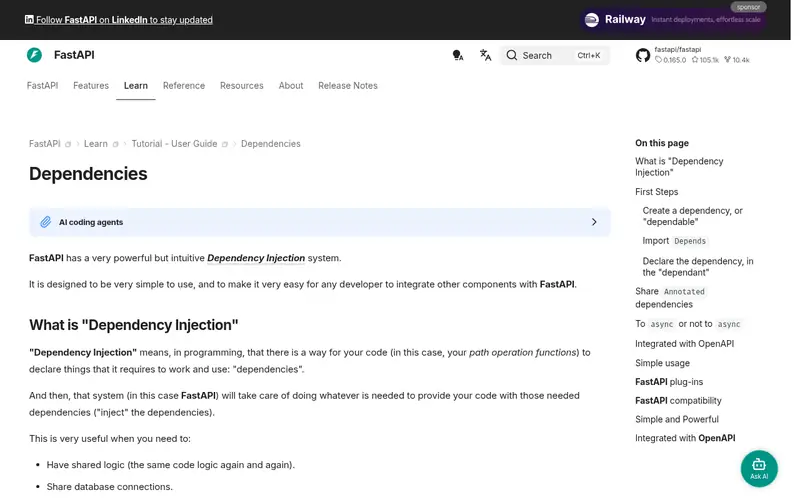
FastAPI Depends is the dependency injection system built into the FastAPI web framework. You declare dependencies as function parameters using Depends, and FastAPI resolves them per request. Sub-dependencies, per-request caching and yield-based teardown cover common needs such as database sessions and authentication.
It is part of FastAPI, which is open source under the MIT licence. There is nothing extra to install beyond the framework. The limit is scope: it works inside FastAPI request handling and is not a general container for CLI tools or background workers. Projects already on FastAPI should start here before adding a separate library. Teams on Flask, Django or plain Python need one of the standalone options instead.
Standout: Built into FastAPI with no extra dependency
Free (open source), as listed by the vendor (FastAPI Depends website). Confirm the current plan price before you buy.
Free plan. Plans change, so confirm on the vendor's pricing page before you buy.
Benefits
- Built into FastAPI with no extra dependency
- supports sub-dependencies, caching per request and yield-based cleanup
Drawbacks
- Only usable inside FastAPI applications
- not a general-purpose container for non-web code
Skip it if this limit matters to you: only usable inside FastAPI applications.
Verdict. A sensible pick for projects already built on FastAPI.
Alternatives in this guide: Dependency Injector, Injector, Lagom
Who should use what
Teams building a large service with configuration objects and resource lifecycles should start with Dependency Injector. Developers who prefer explicit Guice-style bindings will find Injector a natural fit. Small services and scripts that want quick setup can use punq or Lagom, depending on whether they prefer explicit registration or type-hint auto-wiring. Projects already on FastAPI should use the built-in Depends system first and only add a standalone container if they need injection outside request handling.
Questions to settle before you buy
What to check before you buy
- Confirm the library is actively maintained, with recent commits or releases and a current PyPI package.
- Check the licence matches your organisation's policy before adding it to production code.
- Verify the scope model (singleton, factory, per-request) matches how your services hold state.
- Test how the library handles abstract types, configuration values and optional dependencies in your codebase.
- Check framework integration docs if you use FastAPI, Flask, Django or Starlette, and confirm the version you run is supported.
FAQ
Do I need a dependency injection library in Python?
No. Python's default arguments and factory functions cover many cases. A library helps when object graphs grow, when you need consistent scopes, or when you want to swap implementations in tests without editing call sites.
Which of these libraries is easiest to learn?
punq has the smallest API and can be learned quickly. Lagom is also short to set up because it resolves from type hints. Larger frameworks such as Dependency Injector take more time but offer more control over providers and scopes.
Are these libraries free?
Yes. All six options listed are open source and free to use. Check each project's licence, since terms differ between MIT, BSD and other licences, and confirm the current licence on the official repository.
Can I use these with FastAPI?
Dependency Injector, Injector, Lagom and svcs document ways to work alongside web frameworks, including FastAPI. FastAPI also has its own Depends system. For most FastAPI projects, start with Depends and add a container only if you need injection outside request handling.
Do these tools send my code or data anywhere?
No. These are Python libraries that run inside your process. They do not transmit code or data to external servers. Normal care with secrets still applies: keep credentials in environment variables or a secrets manager, not in container configuration committed to source control.
Sources we checked
Method: how we score · editorial policy.
Change log. First published 27 Nov 2026.