Stage 01 · Write · Researched comparison
Best Java Dependency Injection Frameworks in 2026
Spring Framework is the first pick for most teams because it combines dependency injection with a large ecosystem and broad documentation. Guice suits projects that want a lightweight, annotation-driven container without the wider Spring stack. Dagger fits Android and build-time code generation needs where reflection is unwanted. All three are open source, so cost is not the deciding factor.

By Shihab Mia
Published 27 Nov 2026 · 6 tools compared
We run no ads and no affiliate links at launch. The order of a list follows our published method. See how we score.
Prices are the starting prices vendors list publicly. Plans change, so confirm the current price on the vendor page before you buy.
Key takeaways
- Spring Framework, Guice, Dagger, CDI implementations and Micronaut are all free and open source.
- Spring offers the widest ecosystem but has a steeper learning curve than Guice.
- Dagger resolves dependencies at compile time, which suits Android and reflection-free builds.
- Quarkus and Micronaut target fast startup and low memory for cloud and native builds.
Who each pick is for
- Teams that want a mature container with a large ecosystemSpring Framework
- Developers who want a lightweight annotation-driven containerGoogle Guice
- Android and JVM projects that want compile-time injectionDagger
- Jakarta EE applications that need the CDI standardJakarta CDI (Weld)
- Cloud and native builds that need fast startupMicronaut
- Kubernetes and native Java services with fast bootQuarkus
Comparison
| Tool | Best for | Standout feature | Listed starting price | Free plan or trial |
|---|---|---|---|---|
| 1Spring Framework | Teams that want a mature container with a large ecosystem | Very broad ecosystem and documentation | Free (open source) | Free plan |
| 2Google Guice | Developers who want a lightweight annotation-driven container | Small footprint and clear binding model | Free (open source) | Free plan |
| 3Dagger | Android and JVM projects that want compile-time injection | Resolves dependencies at compile time with no reflection | Free (open source) | Free plan |
| 4Jakarta CDI (Weld) | Jakarta EE applications that need the CDI standard | Standard specification with multiple implementations | Free (open source) | Free plan |
| 5Micronaut | Cloud and native builds that need fast startup | Ahead-of-time injection with low memory use | Free (open source) | Free plan |
| 6Quarkus | Kubernetes and native Java services with fast boot | Build-time dependency injection | Free (open source) | Free plan |
How we picked
We selected projects that genuinely provide dependency injection for Java and are currently maintained. Criteria included fit for the job, supported platforms, licence and price, and the main limits documented by each project. Sources are vendor pages, official documentation and project repositories. We did not run benchmarks or collect user reviews. Prices and licences can change, so confirm details on the vendor site before you commit.
The tools, one by one
Spring Framework
Best for teams that want a mature container with a large ecosystem
What it is and where it fits
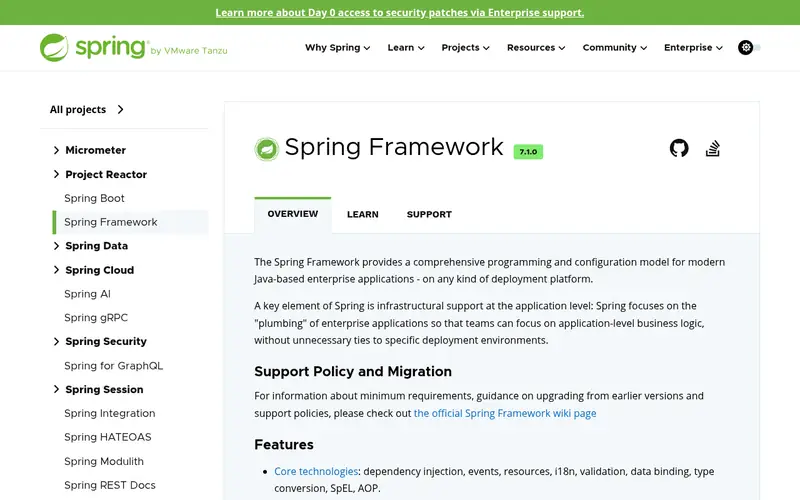
Spring Framework is the reference implementation many Java teams start with. Its core container handles constructor, setter and field injection, and it integrates with Spring Boot, Spring Data and Spring Security. Configuration can be annotation-based or XML-based, and profiles let you swap beans per environment. It runs on the standard JVM and supports Java versions from recent LTS releases upward.
The project is open source under the Apache License 2.0. There is no paid tier for the framework itself; commercial support and hosted services are separate products. The main limits are startup time and memory use compared with compile-time frameworks, plus the amount of configuration a large application can accumulate. Teams that want a minimal container should look at Guice or Dagger instead.
Standout: Very broad ecosystem and documentation
Free (open source), as listed by the vendor (Spring Framework website). Confirm the current plan price before you buy.
Free plan. Plans change, so confirm on the vendor's pricing page before you buy.
Benefits
- Very broad ecosystem and documentation
- supports annotation and XML configuration
Drawbacks
- Steep learning curve
- heavier startup than compile-time frameworks
Skip it if this limit matters to you: steep learning curve.
Verdict. A sensible pick for teams that want a mature container with a large ecosystem.
Alternatives in this guide: Google Guice, Dagger, Jakarta CDI (Weld)
Google Guice
Best for developers who want a lightweight annotation-driven container
What it is and where it fits
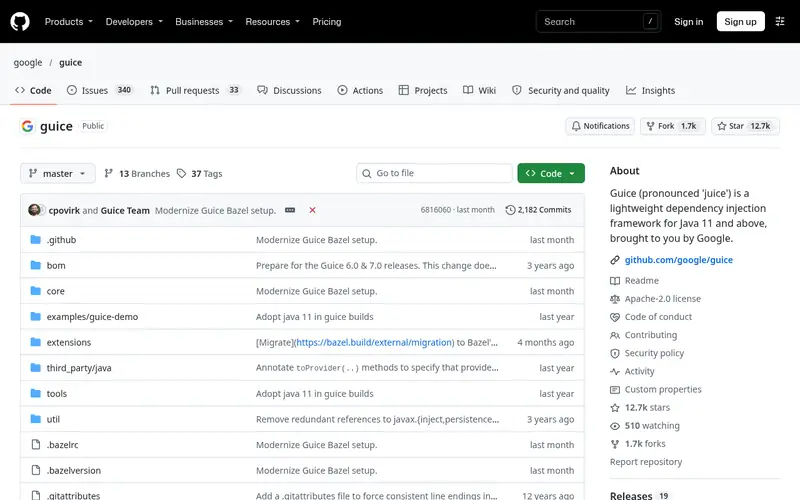
Guice is a lightweight dependency injection framework built around Java annotations and explicit bindings. You declare modules that map interfaces to implementations, then request instances from an injector. It supports constructor injection, provider methods, scopes and just-in-time bindings. It runs on the JVM and is used in server and desktop applications.
Guice is open source under the Apache License 2.0. It does not include a web framework, ORM or configuration server, so you assemble those parts yourself. That keeps it small but means more glue code than Spring Boot. Documentation is solid but the project moves at a slower pace than Spring. Teams that need a large integrated stack should skip it.
Standout: Small footprint and clear binding model
Free (open source), as listed by the vendor (Google Guice website). Confirm the current plan price before you buy.
Free plan. Plans change, so confirm on the vendor's pricing page before you buy.
Benefits
- Small footprint and clear binding model
- strong constructor injection support
Drawbacks
- Smaller ecosystem than Spring
- less active release cadence
Skip it if this limit matters to you: smaller ecosystem than Spring.
Verdict. A sensible pick for developers who want a lightweight annotation-driven container.
Alternatives in this guide: Spring Framework, Dagger, Jakarta CDI (Weld)
Dagger
Best for android and JVM projects that want compile-time injection
What it is and where it fits
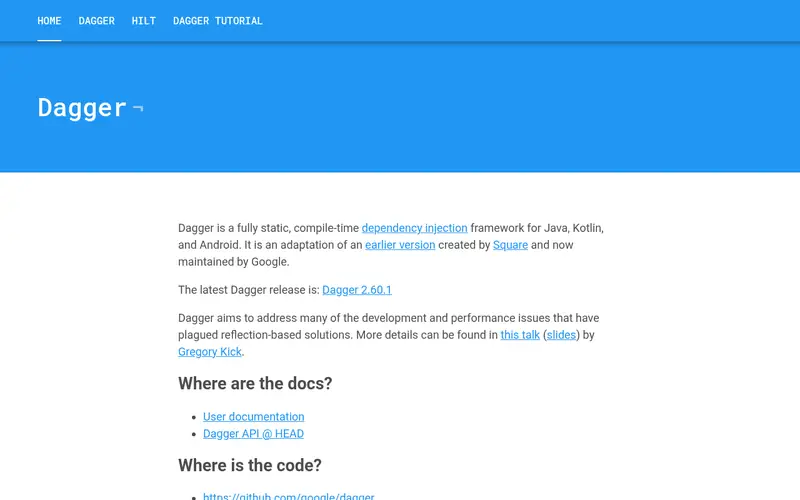
Dagger is a compile-time dependency injection framework. It generates Java source for the wiring, so there is no reflection at runtime and startup is fast. You define components and modules, and the annotation processor validates the graph during the build. It is widely used on Android and also works on plain JVM projects.
Dagger is open source under the Apache License 2.0. The trade-off is build complexity: you need annotation processing configured in your build tool, and errors surface at compile time rather than runtime. It does not provide a full application framework, so web, persistence and configuration layers come from other libraries. Small projects may find the setup heavier than Guice.
Standout: Resolves dependencies at compile time with no reflection
Free (open source), as listed by the vendor (Dagger website). Confirm the current plan price before you buy.
Free plan. Plans change, so confirm on the vendor's pricing page before you buy.
Benefits
- Resolves dependencies at compile time with no reflection
- fast startup
Drawbacks
- More boilerplate and annotation processing setup
- steeper for simple apps
Skip it if this limit matters to you: more boilerplate and annotation processing setup.
Verdict. A sensible pick for android and JVM projects that want compile-time injection.
Alternatives in this guide: Spring Framework, Google Guice, Jakarta CDI (Weld)
Jakarta CDI (Weld)
Best for jakarta EE applications that need the CDI standard
What it is and where it fits
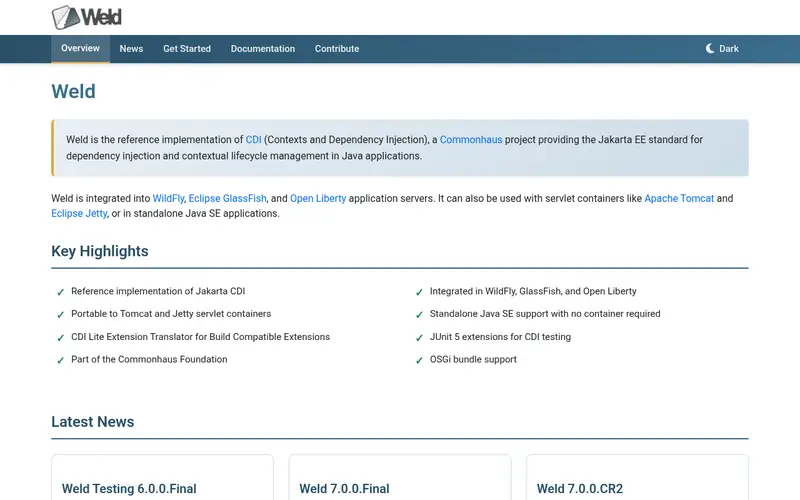
Jakarta Contexts and Dependency Injection (CDI) is a specification, and Weld is its reference implementation. CDI defines injection points, scopes, qualifiers, producers and interceptors. It is the standard injection model for Jakarta EE application servers and also runs in servlet containers with the right setup.
Weld is open source under the Apache License 2.0. Because CDI is a specification, you can move between compliant implementations such as Weld, OpenWebBeans and others. The main limit is context: CDI assumes Jakarta EE APIs, and teams outside that world often prefer Spring or Guice. Check that your runtime supports the CDI version you target before committing.
Standout: Standard specification with multiple implementations
Free (open source), as listed by the vendor (Jakarta CDI (Weld) website). Confirm the current plan price before you buy.
Free plan. Plans change, so confirm on the vendor's pricing page before you buy.
Benefits
- Standard specification with multiple implementations
- strong integration with Jakarta EE
Drawbacks
- Tied to Jakarta EE conventions
- less common in plain Spring shops
Skip it if this limit matters to you: tied to Jakarta EE conventions.
Verdict. A sensible pick for jakarta EE applications that need the CDI standard.
Alternatives in this guide: Spring Framework, Google Guice, Dagger
Micronaut
Best for cloud and native builds that need fast startup
What it is and where it fits
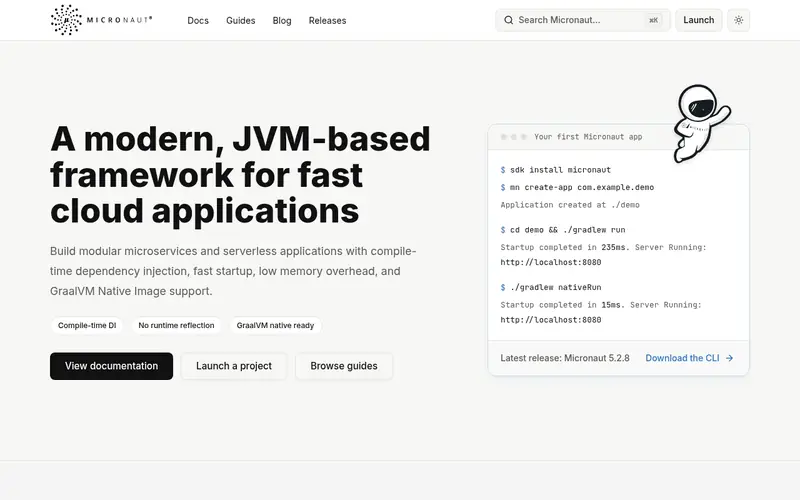
Micronaut is a JVM framework with built-in dependency injection that resolves wiring at compile time. It avoids reflection for injection, which reduces startup time and memory use. It supports constructor injection, scopes, qualifiers and factories, and it integrates with common libraries for HTTP, data access and messaging.
Micronaut is open source under the Apache License 2.0. It targets microservices and serverless workloads, and it has documented support for GraalVM native images. The trade-off is a smaller ecosystem and a programming model that differs from Spring. Teams heavily invested in Spring libraries should weigh migration cost before switching.
Standout: Ahead-of-time injection with low memory use
Free (open source), as listed by the vendor (Micronaut website). Confirm the current plan price before you buy.
Free plan. Plans change, so confirm on the vendor's pricing page before you buy.
Benefits
- Ahead-of-time injection with low memory use
- good GraalVM native support
Drawbacks
- Smaller ecosystem than Spring
- different programming model to learn
Skip it if this limit matters to you: smaller ecosystem than Spring.
Verdict. A sensible pick for cloud and native builds that need fast startup.
Alternatives in this guide: Spring Framework, Google Guice, Dagger
Quarkus
Best for kubernetes and native Java services with fast boot
What it is and where it fits
Quarkus is a Kubernetes-native Java framework that performs much of its dependency injection work at build time. It supports CDI annotations, so teams familiar with Jakarta CDI can reuse that knowledge. It also offers extensions for REST, persistence, messaging and security, and it documents native image builds with GraalVM.
Quarkus is open source under the Apache License 2.0. The build-time model improves startup and memory but restricts some runtime dynamism, such as certain conditional bean setups. Extension coverage is broad but not identical to Spring's. Teams that rely on Spring-specific libraries should check extension support before adopting it.
Standout: Build-time dependency injection
Free (open source), as listed by the vendor (Quarkus website). Confirm the current plan price before you buy.
Free plan. Plans change, so confirm on the vendor's pricing page before you buy.
Benefits
- Build-time dependency injection
- strong native image and container support
Drawbacks
- Some extensions lag behind Spring equivalents
- build-time model has limits
Skip it if this limit matters to you: some extensions lag behind Spring equivalents.
Verdict. A sensible pick for kubernetes and native Java services with fast boot.
Alternatives in this guide: Spring Framework, Google Guice, Dagger
Who should use what
Teams building a large application with many integrations should start with Spring Framework or Spring Boot. Developers who want a small container without a full framework should choose Guice. Android and JVM projects that need compile-time wiring and no reflection should use Dagger. Jakarta EE shops should use a CDI implementation such as Weld, and teams targeting native images or fast startup should evaluate Micronaut or Quarkus.
Questions to settle before you buy
What to check before you buy
- Confirm the framework supports your Java version and build tool.
- Check whether injection is resolved at runtime or compile time, since this affects startup and reflection use.
- Review the licence and any commercial support terms for your organization.
- Test native image or container builds if you plan to use GraalVM.
- Verify that the libraries you depend on have integrations for the framework.
FAQ
Is Spring the only option for Java dependency injection?
No. Guice, Dagger, CDI implementations such as Weld, Micronaut and Quarkus all provide dependency injection. Spring is the most widely used, but the right choice depends on your platform, startup needs and ecosystem requirements.
Do these frameworks cost anything?
All the frameworks listed here are free and open source. Commercial support, hosted services and training may cost money, but the frameworks themselves do not require a licence fee.
What is the difference between runtime and compile-time injection?
Runtime containers such as Spring and Guice resolve dependencies while the application runs, often using reflection. Compile-time frameworks such as Dagger and Micronaut generate wiring during the build, which can reduce startup time and reflection use.
Can I use these frameworks on Android?
Dagger is the most common choice for Android because it resolves dependencies at compile time. Guice can run on Android but is less common. Spring and the full application frameworks are generally not used on Android.
Which framework is easiest to learn?
Guice has a smaller surface area than Spring, and its binding model is straightforward. Spring Boot reduces setup with auto-configuration but has more concepts to learn overall. Dagger requires understanding annotation processing.
Sources we checked
Method: how we score · editorial policy.
Change log. First published 27 Nov 2026.