Stage 04 · Run · Researched comparison
Best Python Dependency Checkers in 2026
deptry is the first pick for most teams because it finds unused, missing and misplaced dependencies in a Python project from a single command. pip-audit is the better choice when known vulnerabilities are the main concern, and uv is the fastest option if you already use it as your package manager and want tree and outdated listings without extra tooling.

By Shihab Mia
Published 28 Nov 2026 · 7 tools compared
We run no ads and no affiliate links at launch. The order of a list follows our published method. See how we score.
Prices are the starting prices vendors list publicly. Plans change, so confirm the current price on the vendor page before you buy.
Key takeaways
- deptry, pip-audit, pipdeptree, pip-check-reqs and uv are free and open source; Safety has a free tier that needs an account.
- pip-audit and Safety check packages against vulnerability databases, while deptry and pip-check-reqs focus on declared versus used imports.
- uv and pipdeptree show the dependency tree and outdated packages but do not audit for vulnerabilities on their own.
- Renovate is free to self-host and automates dependency updates across many ecosystems, including Python.
Who each pick is for
- Finding unused, missing and misplaced dependencies in Python projectsdeptry
- Auditing installed and declared Python packages for known vulnerabilitiespip-audit
- Inspecting the installed dependency tree and conflictspipdeptree
- Vulnerability scanning with a hosted database and team reportingSafety
- Spotting missing or unused entries in requirements filespip-check-reqs
- Fast dependency resolution, tree listing and outdated package checksuv
- Automating dependency update pull requests across repositoriesRenovate
Comparison
| Tool | Best for | Standout feature | Listed starting price | Free plan or trial |
|---|---|---|---|---|
| 1deptry | Finding unused, missing and misplaced dependencies in Python projects | Checks declared dependencies against actual imports | Free (open source) | Free plan |
| 2pip-audit | Auditing installed and declared Python packages for known vulnerabilities | Maintained by the Python Packaging Authority | Free (open source) | Free plan |
| 3pipdeptree | Inspecting the installed dependency tree and conflicts | Shows why each package is installed | Free (open source) | Free plan |
| 4Safety | Vulnerability scanning with a hosted database and team reporting | Scans requirements files and environments | See vendor pricing page | Free plan |
| 5pip-check-reqs | Spotting missing or unused entries in requirements files | Simple check against requirements files | Free (open source) | Free plan |
| 6uv | Fast dependency resolution, tree listing and outdated package checks | Very fast resolver and installer | Free (open source) | Free plan |
| 7Renovate | Automating dependency update pull requests across repositories | Supports many ecosystems including Python | Free (open source) | Free plan |
How we picked
We picked tools that directly address declared, used, outdated or vulnerable Python dependencies, and left out general linters and editors. Criteria were fit for the job, supported platforms, licence and price, whether checks run locally, and known limits such as advisory coverage or reliance on a hosted service. Details come from vendor pages, documentation and project repositories. Prices and free-tier terms change, so confirm them on the vendor site before you commit.
The tools, one by one
deptry
Best for finding unused, missing and misplaced dependencies in Python projects
What it is and where it fits
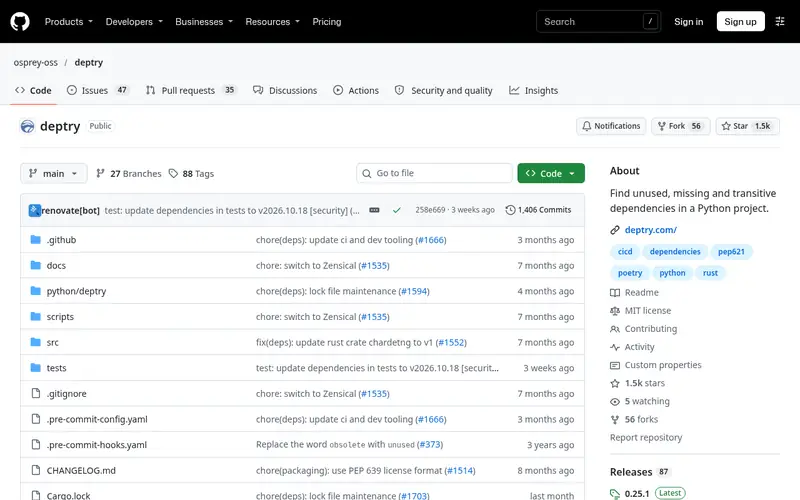
deptry scans your source tree, compares imports with the dependencies declared in pyproject.toml or requirements files, and reports unused, missing and transitive dependencies. It also flags dependencies that belong in a different section, such as dev-only packages listed as runtime requirements.
It installs from PyPI and runs on Linux, macOS and Windows. Configuration lives in pyproject.toml, so it fits into existing CI pipelines without a separate config file. It is released under the MIT licence at no cost.
deptry does not query vulnerability databases, so pair it with pip-audit or Safety. Projects that rely heavily on dynamic imports or plugin loading may see false positives and should review its output before removing anything.
Standout: Checks declared dependencies against actual imports
Free (open source), as listed by the vendor (deptry website). Confirm the current plan price before you buy.
Free plan. Plans change, so confirm on the vendor's pricing page before you buy.
Benefits
- Checks declared dependencies against actual imports
- Supports pyproject.toml and requirements files
Drawbacks
- Does not check for vulnerabilities
- Import detection can miss dynamic imports
Skip it if this limit matters to you: does not check for vulnerabilities.
Verdict. A sensible pick for finding unused, missing and misplaced dependencies in Python projects.
Alternatives in this guide: pip-audit, pipdeptree, Safety
pip-audit
Best for auditing installed and declared Python packages for known vulnerabilities
What it is and where it fits
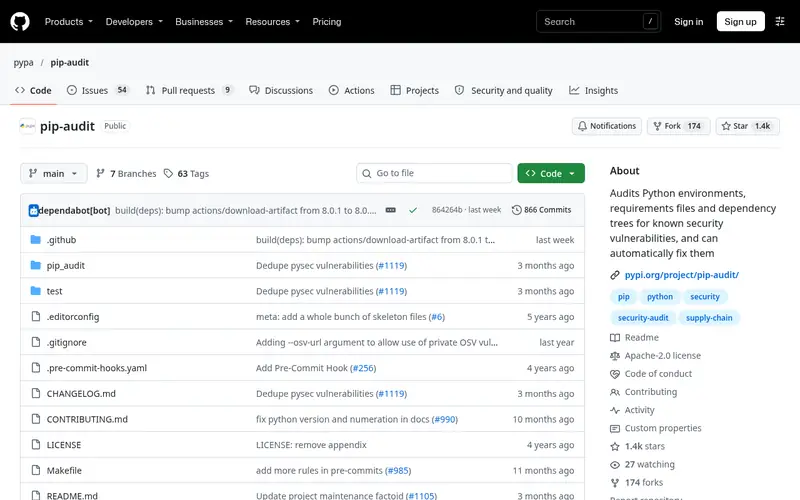
pip-audit checks installed packages or a requirements file against vulnerability databases and reports affected packages with advisory IDs and fixed versions. It is maintained under the Python Packaging Authority, which makes it a common default in CI security steps.
It runs on Linux, macOS and Windows and installs from PyPI. You can audit a local environment, a requirements file or a virtual environment, and it can output JSON for other tools. It is open source under the Apache 2.0 licence.
pip-audit only reports what appears in advisory databases. A clean result does not prove a package is safe, and packages with no published advisories still need review. It does not detect unused or missing dependencies, so it complements deptry rather than replacing it.
Standout: Maintained by the Python Packaging Authority
Free (open source), as listed by the vendor (pip-audit website). Confirm the current plan price before you buy.
Free plan. Plans change, so confirm on the vendor's pricing page before you buy.
Benefits
- Maintained by the Python Packaging Authority
- Audits requirements files and environments
Drawbacks
- Only covers known advisories
- Advisory coverage depends on upstream databases
Skip it if this limit matters to you: only covers known advisories.
Verdict. A sensible pick for auditing installed and declared Python packages for known vulnerabilities.
Alternatives in this guide: deptry, pipdeptree, Safety
pipdeptree
Best for inspecting the installed dependency tree and conflicts
What it is and where it fits
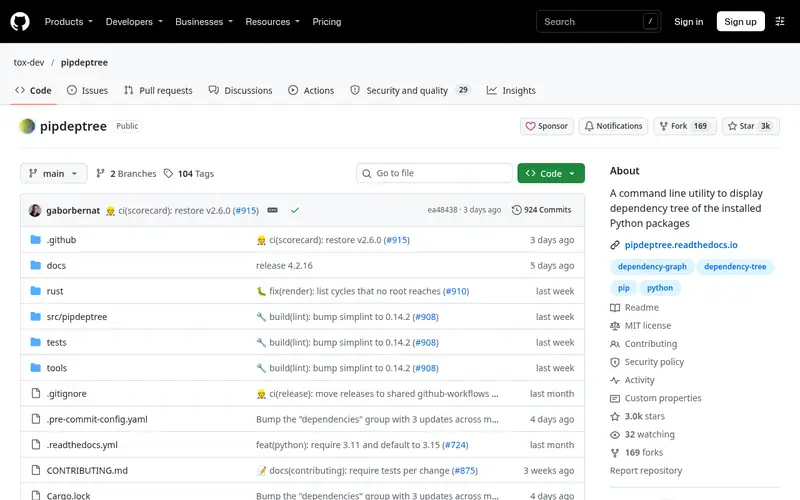
pipdeptree prints the installed package tree so you can see which package pulled in each dependency. It warns when installed packages have conflicting version requirements, which helps when a resolved environment behaves unexpectedly.
It installs from PyPI and runs wherever Python runs. Output can be filtered, shown as JSON or reversed to list dependents of a package. It is open source under the MIT licence.
pipdeptree reads the current environment, so results depend on what is actually installed rather than what your project files declare. It does not audit for vulnerabilities or detect unused dependencies. Use it for diagnosis, then confirm fixes with a resolver or a lock file.
Standout: Shows why each package is installed
Free (open source), as listed by the vendor (pipdeptree website). Confirm the current plan price before you buy.
Free plan. Plans change, so confirm on the vendor's pricing page before you buy.
Benefits
- Shows why each package is installed
- Warns about version conflicts
Drawbacks
- Works from the installed environment, not project declarations
- No vulnerability data
Skip it if this limit matters to you: works from the installed environment, not project declarations.
Verdict. A sensible pick for inspecting the installed dependency tree and conflicts.
Safety
Best for vulnerability scanning with a hosted database and team reporting
What it is and where it fits
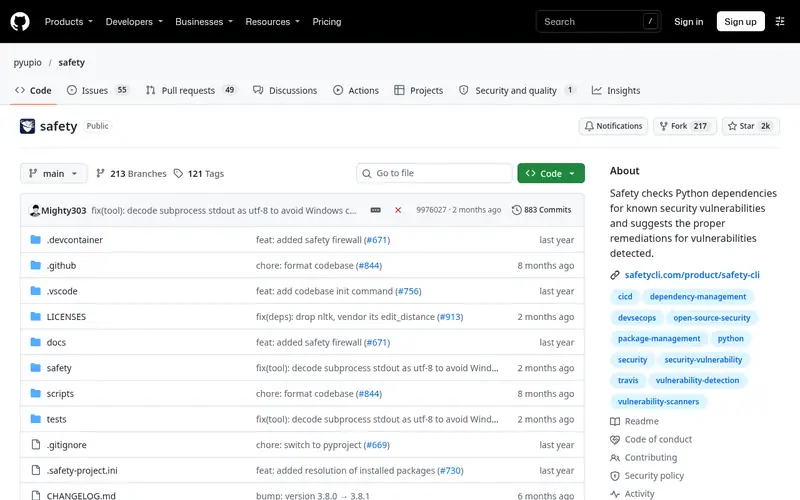
Safety scans Python dependencies for known vulnerabilities using a database maintained by the vendor. It reads requirements files or installed environments and reports advisories with severity information.
The CLI installs from PyPI. A free tier exists but requires an account, and paid plans add team and reporting features. Pricing changes, so check the vendor page before committing. The project is open source, and the hosted database is a separate service.
Because the database is vendor-hosted, results depend on that service being reachable and current. Teams that need a fully offline audit should prefer pip-audit with a local advisory source. Safety is a reasonable fit when you want a managed database and reporting for a team.
Standout: Scans requirements files and environments
See vendor pricing page, as listed by the vendor (Safety website). Confirm the current plan price before you buy.
Free plan. Plans change, so confirm on the vendor's pricing page before you buy.
Benefits
- Scans requirements files and environments
- Has a paid tier with team features
Drawbacks
- Free tier requires an account
- Database access depends on the vendor service
Skip it if this limit matters to you: free tier requires an account.
Verdict. A sensible pick for vulnerability scanning with a hosted database and team reporting.
Alternatives in this guide: deptry, pip-audit, pipdeptree
pip-check-reqs
Best for spotting missing or unused entries in requirements files
What it is and where it fits
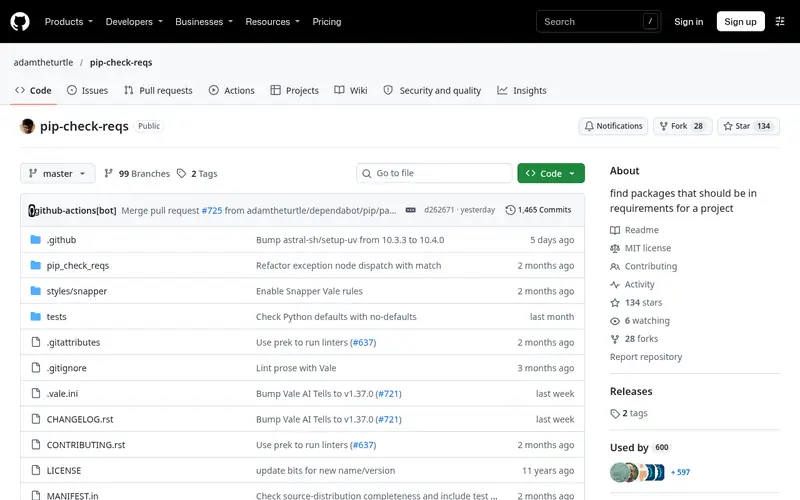
pip-check-reqs provides two commands, pip-missing-reqs and pip-extra-reqs, that compare imports in your code with entries in a requirements file. It reports imports with no matching requirement and requirements that nothing imports.
It installs from PyPI and runs on standard Python platforms. It is a small, focused tool with few options, which makes it easy to add to a script or CI job. It is open source.
The project is less actively developed than deptry, and it works from requirements files rather than pyproject.toml dependency groups. For new projects with modern packaging, deptry is usually the better fit. pip-check-reqs still works for simple requirements-based setups.
Standout: Simple check against requirements files
Free (open source), as listed by the vendor (pip-check-reqs website). Confirm the current plan price before you buy.
Free plan. Plans change, so confirm on the vendor's pricing page before you buy.
Benefits
- Simple check against requirements files
- Small, focused command-line tool
Drawbacks
- Limited project configuration
- Less active than newer alternatives
Skip it if this limit matters to you: limited project configuration.
Verdict. A sensible pick for spotting missing or unused entries in requirements files.
Alternatives in this guide: deptry, pip-audit, pipdeptree
uv
Best for fast dependency resolution, tree listing and outdated package checks
What it is and where it fits
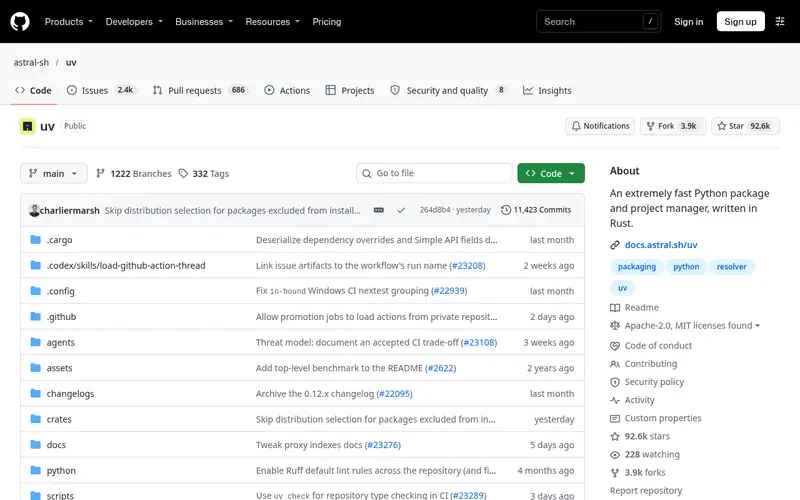
uv is a Python package and project manager written in Rust. For dependency checks it offers uv tree to show the resolved dependency graph and uv pip list --outdated to list packages with newer versions available.
It runs on Linux, macOS and Windows and installs as a single binary. It can manage projects, lock files and virtual environments, and it reads standard pyproject.toml files. It is open source under the Apache 2.0 and MIT licences.
uv does not audit for vulnerabilities, so pair it with pip-audit. Its release cadence is fast, and behavior can change between versions, so pin a version in CI. Teams already using uv get tree and outdated checks without adding another tool.
Standout: Very fast resolver and installer
Free (open source), as listed by the vendor (uv website). Confirm the current plan price before you buy.
Free plan. Plans change, so confirm on the vendor's pricing page before you buy.
Benefits
- Very fast resolver and installer
- Includes tree and outdated commands
Drawbacks
- Not a vulnerability scanner
- Newer project with fast-moving releases
Skip it if this limit matters to you: not a vulnerability scanner.
Verdict. A sensible pick for fast dependency resolution, tree listing and outdated package checks.
Alternatives in this guide: deptry, pip-audit, pipdeptree
Renovate
Best for automating dependency update pull requests across repositories
What it is and where it fits
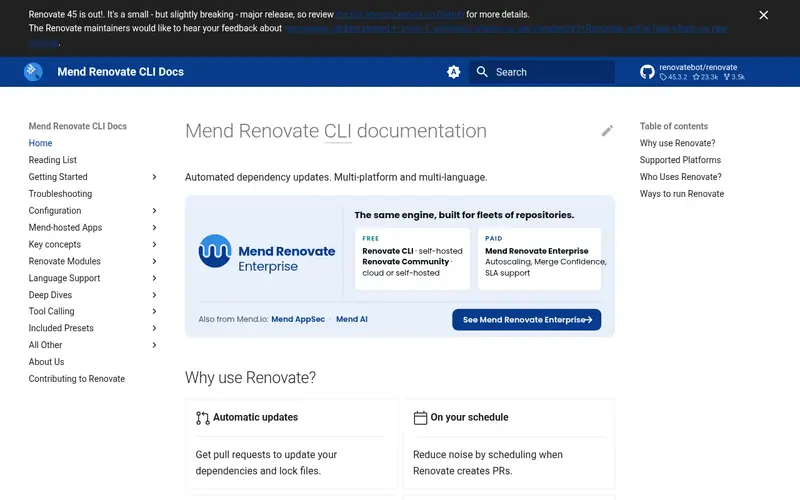
Renovate is an automated dependency update tool. It scans repository manifests, including requirements files and pyproject.toml, and opens pull requests when newer versions are available. It can group updates, set schedules and apply rules per package.
It runs as a hosted app on common Git platforms or self-hosted. Configuration lives in a repository config file. It is open source, and the hosted service has its own terms. It does not replace a vulnerability scanner, though it can apply security updates once they are released.
Setup takes more effort than a single CLI command, and busy repositories need tuning to avoid pull request noise. Renovate suits teams that want updates handled continuously rather than checked by hand.
Standout: Supports many ecosystems including Python
Free (open source), as listed by the vendor (Renovate website). Confirm the current plan price before you buy.
Free plan. Plans change, so confirm on the vendor's pricing page before you buy.
Benefits
- Supports many ecosystems including Python
- Configurable update rules and schedules
Drawbacks
- Requires setup on a Git host
- Not a local vulnerability scanner
Skip it if this limit matters to you: requires setup on a Git host.
Verdict. A sensible pick for automating dependency update pull requests across repositories.
Alternatives in this guide: deptry, pip-audit, pipdeptree
Who should use what
If you want to clean up a messy pyproject.toml, start with deptry. If security review is the priority, run pip-audit, and consider Safety if you want a managed database and team reporting. If you already use uv, its tree and outdated commands cover version checks without extra installs. For repositories that need continuous updates, Renovate automates pull requests, while pipdeptree and pip-check-reqs remain useful for quick diagnosis in older requirements-based projects.
Questions to settle before you buy
What to check before you buy
- Confirm the tool reads your project format, such as pyproject.toml or requirements.txt.
- Check whether it needs network access to a hosted database and whether that fits your policy.
- Run it in CI with a pinned version so results stay reproducible.
- Review reported unused dependencies before removing them; dynamic imports cause false positives.
- Pair a vulnerability scanner with a declaration checker, since they answer different questions.
FAQ
What is the difference between a dependency checker and a vulnerability scanner?
A dependency checker compares what your project declares with what it imports, and flags unused or missing packages. A vulnerability scanner compares installed or declared packages against advisory databases. Tools like deptry do the first, pip-audit and Safety do the second, and many teams run both.
Are these Python dependency checkers free?
deptry, pip-audit, pipdeptree, pip-check-reqs, uv and Renovate are free and open source. Safety has a free tier that requires an account, and paid plans add team features. Check the vendor pricing page for current terms.
Can I run these tools offline?
deptry, pipdeptree, pip-check-reqs and uv work from local files and environments. pip-audit can use a local advisory source. Safety relies on a vendor-hosted database. Confirm network requirements before adding a tool to an air-gapped pipeline.
Do I need more than one tool?
Usually yes. One tool finds unused or missing declarations, another checks for known vulnerabilities, and a third handles updates. Running deptry with pip-audit covers the two most common gaps with little setup.
Should I paste my dependency files into online checkers?
Avoid pasting private requirements files, internal package names or tokens into third-party web pages. Prefer tools that run locally or in your own CI. If you must use a web service, remove internal names and credentials first.
Sources we checked
Method: how we score · editorial policy.
Change log. First published 28 Nov 2026.